
Getting right to the point, cabling the M5Stack U187 MIDI Unit was a straightforward breeze. I now have a tiny General MIDI (GM) module for less than $50 USD. Best of all, the audio is cleaner than other SAM2695 implementations and I have full access to the Roland GS-compatible engine within.
Yep, I traced out signal paths to make sure +5V and ground go to the right places. M5Stack have done a good job with their connector and port layout. Plus, the cable color-coding makes it easy to see “what goes where.”
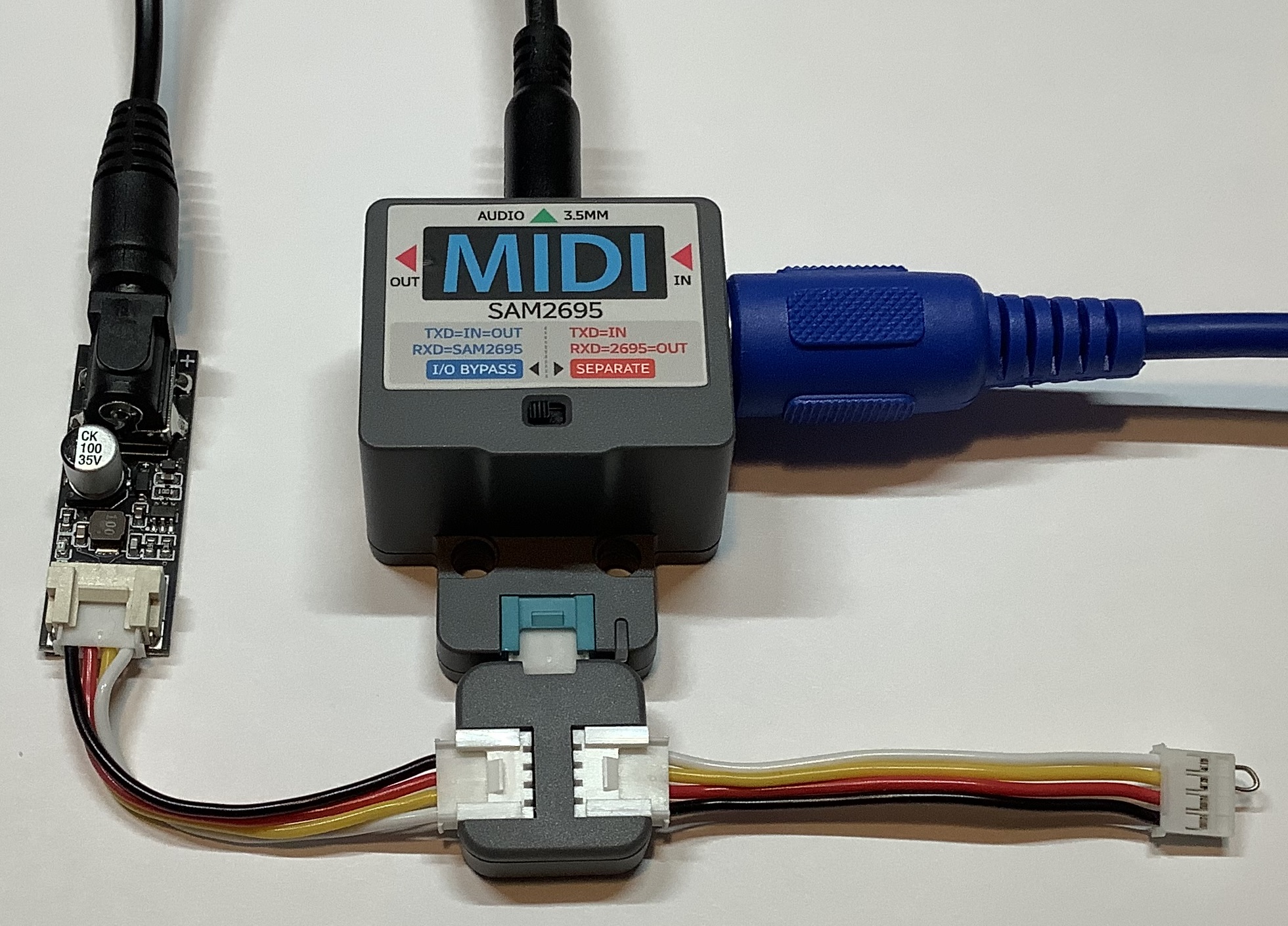
M5Stack U187 General MIDI module cabling
The picture above (click to enlarge) shows all of the electronics and cabling splayed out. I added an in-line power switch between the AC-DC adapter and the M5Stack buck converter. The only “trick” is to jumper the RXD and TXD signals. The jumper creates a signal path from the external MIDI IN to the SAM2695 MIDI port. RXD and TXD are both TTL-level signals, i.e., the receive side is after the opto-isolator.
And, gosh, M5Stack gear is inexpensive for what ya get. I’m tempted to try one of their integrated controllers like the M5Stack Core 3. Count me in.
Next on the agenda is a case. I’m going to stuff everything into a plastic Hammond 1591CSBK, also known as a “guitar pedal” case. I don’t intend to add connectors; the audio, MIDI and power switch cables will dangle out of the box. I’m ham-handed when it comes to craftsmanship and there is no reason to complicate set up. I will use a CME MIDI cable since the CME’s have much smaller plugs. The HOSA MIDI cable (above) won’t fit inside the 1591 case.
The only quibble is that M5Stack have jacks on all four sides of the U187 module. Thus, I’ll need cables with compact, right-angle plugs.
Overall, the M5Stack U187 MIDI Unit is the fastest, cheapest path to a GM tone module. Recommended.
Copyright © Paul J. Drongowski