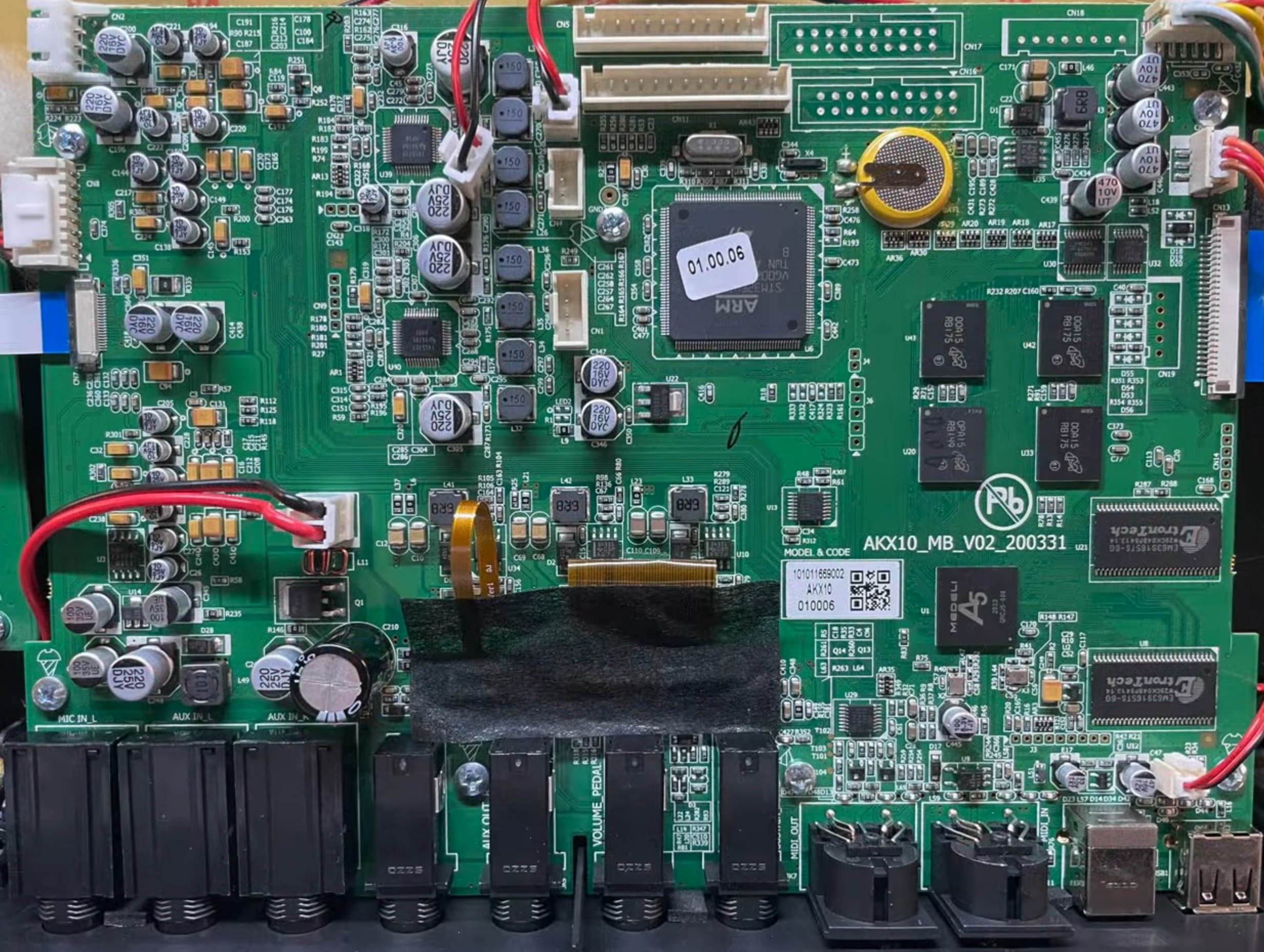
Time for a pre-holiday ramble. NAMM 2026 — also known as “Christmas in January” — is now one month away, January 20-24, 2026. Certainly, November and December product releases will be featured at NAMM 2026. So, dropping into stream of consciousness mode…
Behringer is great at stocking stuffers. The latest stuffer is the two DCO Behringer UB-1 Micro with replicas of the 3396 and 3397 chips once found in the Oberheim Matrix 6/1000. USA pre-order for about $71 USD. Shucks, might as well pony up another $40 and buy the three VCO Behringer UB-Xa Mini Analog Synthesizer at $109. After upgrade, the Mini is 5 voice and it has a 5-pin DIN MIDI input instead of a 3.5mm MIDI jack.
I also have a fondness for Sequential Circuits. The Behringer Pro VS Mini Hybrid Vector Synthesizer is a 4-voice hybrid vector synth, joystick built in for $119. All of these small format modules are much smaller and cheaper than the real deal and don’t take up as much space in a studio. Gosh, they aren’t more expensive than a good plug-in, too.
Sonicware continue to roll out new toys. The ELZ_1 play (now V2) is a small wavetable synth featuring the original Waldorf wavetables. The LIVEN series groove boxes cover a wide range of contemporary music styles. As to my own taste, I’m liking the LIVEN Ambient 0, LIVEN Evoke and LIVEN Lofi-12. Sonicware products are available in the USA through Amazon.
If you crave actual Waldorf tables and sound, check out the nicely-styled Waldorf Protein. The Protein has eight voice polyphony and is 4-part multitimbral. Even though it’s a new model, it just got its first update adding a 12dB filter option, more memory slots and 20 free patches by Kateryna Zavoloka. The USA price is $399 USD — quite reasonable. Eight voice poly is enough to be dangerous and I wish other developers would take note. Three or four voice polyphony ain’t enough for two-fisted pads.
Which brings me to the subject of tariffs. Yes, USA people, you are paying the tariffs. You are also waiting longer for product to arrive on these shores. Check Behringer pricing and you will see lower prices in Europe. Sonicware LIVEN used to be $199; they are now $259. Sonicware moved sales to Amazon because they got tired of chasing shifting tariff rules, especially cancellation of the de minimus exception.
In software-land, Steinberg are shipping new iOS plug-ins and apps. Cubasis gets a boost. iOS versions of the Verve and Etude character pianos join Iconica Sketch on iPad/iPhone. Verve is the Steinberg felt piano which lets you layer in atmospheric elements. Etude is a C3X which — to my ears — sounds more “played in” than the usual pristine Yamaha CFX samples.
Verve, Etude and Iconica Sketch can run standalone as well as AUv3 plug-ins. The new Verve and Etude are described as “designed for iPhone/iPad”. The introductory price is $15.99 (each). What’s the catch? The Verve download size is 19.8MBytes and the Etude download size is 18.8MByte. These are the sizes for the core apps — the full download will be much larger. I’m running Etude on a Mac Mini under HALion and that was an 18 Gigabyte download. (The Iconica Sketch core app is 20.4MB and the full download is 1.6 GBytes.)
Be sure to pick up Steinberg’s free HALion Sonic 7, Guitar Harmonics Essential, LoFi Piano, Novel Piano, Taped Vibes, etc. You can make a lot of music with Steinberg free stuff!
Audio Modeling always have new, innovative products (and holiday sales). SWAM instruments can get price-y, even on iOS. Thus, Audio Modeling have created the Discovery Series (“Explore. Invent. Discover.”) SWAM VariFlute is the first virtual instrument in the Discovery Series. VariFlute is an introduction to physical modeling letting you horse around with pipe length, diameter and material. If you’re missing Yamaha VL, VariFlute is for you. The introductory price is $9.99 and it’s only for iOS.
Too big for a stocking, but now more portable, there’s Arturia’s AstroLab 37. AstroLab is, essentially, AnalogLab in a box. The 37-key model is super light and alleviates my main concern about the 61-key model, that is, its weight. The trade-off, of course, is accepting mini-keys. The 37 is only $700 USD.
Speaking of mini-keys, I still find the Korg Microkey Air to have the most playable mini-keys. I’ve paired (literally!) the Microkey Air 49 with the 1010Music Tangerine via CME WIDI. CME has won me over for Bluetooth MIDI.
As to NAMM 2026 rumors and thoughts, I expect Korg to show up and show out. After dropping KRONOS 3 and miniKORG 700Sm, they haven’t brought much to the stage. Products like Kross need an update. Plus, Triton-based instruments like EK-50 and i3 need to move into the modern age. Can anyone tell me why i3 is more expensive than EK-50?
Yamaha USA Shop has a NAMM 2026 new gear page. The “Synthesizers and Keyboards” section has three new product slots. The first slot is MODX M. The other two slots say “Check back on on January 22, 2026” or some such. Yamaha punters will finally see the PSR-E483. The E483 will have a fraternal twin, too.
Pictures of an Akai MPC XL have leaked. Things looks massive and the rumored price is massive, too: $2,899 USD.
Yamaha STAGEPAS 100BTR mkII
Yamaha have updated the STAGEPAS 100 BTR. The mkII adds two USB Type-C ports: one port for your table/phone (USB 2.0 compatible) and a USB “power delivery” port. The mkII supports USB audio I/O and Bluetooth audio gets a bump to A2DP/HEP. The power delivery port replaces the 24V charging jack in the mkI models. Battery life, size/weight, and audio specs remain the same. MAP for the mkII is $400 USD.
I’m a committed STAGEPAS 100 (mkI) user. I have one at home (no battery) and take a battery-powered 100BTR to my church gig. The sound is clean and is loud enough for practice and personal monitor. The 24V power jack always seemed a little weird because it requires an external laptop-style brick. The mkII changes should make life easier for buskers.
Rather stingy, the instruction manual claims “This product does not come with a USB power adaptor or USB Type-C cable.” C’mon, man, these little STAGEPAS aren’t cheap. STAGEPAS 100 mkI models are on sale right now.
Copyright © 2025 Paul J. Drongowski