Capturing Yamaha DJX styles

I’ve capture roughly 30 MIDI styles from a Yamaha DJX (PSR-D1). Contrary to popular claims on the Web, the DJX will send MIDI messages in its Style mode. You must send MIDI to an external sequencer (like a DAW) and switch patterns using DJX front panel buttons. The DJX wants to be the master clock in Style mode, so the receiving sequencer must be set for external clock.

I’m using the same basic set-up as my Yamaha AN200 adventure. The DJX sends 5-pin MIDI to an HP personal computer running good old (and I mean old!) Cakewalk Home Studio on Windows 11. Because the DJX is clock master, you need to prime Cakewalk to RECORD, turn to the DJX, and fast finger those front panel buttons.

I decided to lay down the Style parts in the following order:

    Lead In | Beat A | Break AA | 
            | Beat A | Break AB |
            | Beat B | Break BB | 
            | Beat B | Break BA | Lead Out

In normal arranger style lingo, the lay down order is:

    Intro A | Main A | Fill In AA | 
            | Main B | Fill In BB |
            | Main C | Fill In CC | 
            | Main D | Fill In DD | Ending A | Fill In BA

This lay down order makes it easier to find style sections and to drop in MIDI markers for the sections. I added an extra section above, Fill In BA, which usually appears at the end of a style file. I add Fill In BA manually when editing the PSR/Genos style file. Usually, Fill In DD makes a good BREAK section.

The DJX sends style data on eight MIDI channels (3 to 10):

    PSR/Genos       DJX          Mapping
    ------------    ----------   ----------
 3                  Hi-hat       -> PSR 15
 4                  Percussion   -> PSR 16
 5                  Bass         -> PSR 11
 6                  Phrase 1     -> PSR 12
 7                  Phrase 2     -> PSR 13
 8                  Phrase 3     -> PSR 14
 9  Rhythm Sub      Kick
10  Rhythm Main     Snare
11  Bass
12  Chord 1
13  Chord 2
14  Pad 
15  Phrase 1
16  Phrase 2

I created a template with eight tracks where each track receives a particular style part (MIDI channel). Thus, the MIDI data is broken out into separate tracks, ready for editing.

You’ll notice from the table that basic PSR/Genos styles operate on channels 9 to 16.

One can also use channels 1 to 8 in a PSR/Genos style by making the appropriate CASM settings. I’m going to keep things simple. My styles, my choice. 🙂

I created a separate Cakewalk template to start a PSR/Genos style. The template has the same track order, but different channel assignments along with initial voice and drum kit assignments. I simply copy and paste the captured MIDI to the style template. Track order is maintained and channels are auto-magically mapped.

The RAW style data from the DJX does not include voice, volume, effect, etc. settings. In a way, this is good because I will re-mix the style, anyway. The DJX has a FUNCTION (number 87) to send MIDI set-up data. I capture the set-up data to its own MIDI file then reverse engineer it. (Michael Bedesem’s Style Dump program is invaluable.) See the example set-up below.

The RAW style MIDI needs a little bit of time correction due to capture skew. The incoming timestamps are consistently 20 ticks too early. Cakewalk lets me nudge all of the messages 20 ticks later (i.e., to the right on the time-line). After nudging, the very first MIDI messages are 20 ticks too late. So, those timestamps need to be changed to 1 : 1 : 0 (measure : beat : tick). These simple steps properly align the RAW data to the timing grid. MIDI notes from the DJX are quantized to a grid, so you can tell if notes are aligned in Cakewalk by inspection.

As to scales and chords, the DJX programmers designed its styles for one-finger players. (Hate to say it.) If you strike a single key (C, for example), the DJX will use the preselected key scale, major or minor. Most of the DJX styles are in a minor key (e.g., Cm). The preselected scale may be based on a chord extension such as Cm7(9).

PSR/Genos styles are very flexible allowing major and minor scales taken from a wide range of chord types. I’m trying to keep things simple and target a single scale. A converted DJX style should always respond correctly when the played chord matches the original preselected chord (and scale). A converted DJX style might do the right thing (sound in-scale) or it might not.

Another complication is built-in chord progressions. Yes, some of the DJX styles have preselected chord progressions, e.g., |: Cm7(9) | Fm7(9) :|. Try as I might, I cannot shoehorn such chord progressions into a single chord type and scale. The DJX uses a lot of extensions (7th, 9th, 11th, 13th) and it isn’t always possible to find a single scale.

If a DJX style follows a progression, I take the simple approach and produce a one-finger style. If you’re familiar with arrangers, a one-finger converted style is similar to so-called “DJ Styles“, or INTROs and ENDINGs. Yamaha INTROs and ENDINGs are often complicated affairs which mimic popular songs and have non-trivial built-in chord progressions. It lets one-finger players sound like virtuosos. 🙂

Before ditching out, I’ll leave you with an example set-up. The only way I can keep my sanity is to make a table like this for each style to be converted.

********************************
098 On Hit   86 BPM
********************************

Minor key, chord progression, can override.  |: Cm7 | F7 :|

Ch Part       MSB/LSB/PC0 Level Pan Rev Cho Var
-- ---------- ----------- ----- --- --- --- ---
 3 Hi-Hat     126   0  22    92  C    0   0   0  B900 Kit
 4 Percussion 127   0  32    86  C   15   0   0  Jazz Kit
 5 Bass         0   0  35    90  C    0   0   0  Fretless Bass
 6 Phrase 1     0   0  73    86  C   50   0  52  Flute
 7 Phrase 2     0   0  90    60  C    0   0   0  Pad 3 (polysynth)
 8 Phrase 3     0   0  28    76 L63   0   0  26  Electric Guitar (muted)
 9 Kick       126   0  22    76  C    0   0   0  B900 Kit
10 Snare      126   0  22   100  C    0   0   5  B900 Kit

Reverb Type     Hall 1        F0 43 10 4C 02 01 00 01 00 F7
Chorus Type     Chorus 1      F0 43 10 4C 02 01 20 42 11 F7
Variation Type  Cross Delay   F0 43 10 4C 02 01 40 08 00 F7

Hi-Hat     B900 Kit   58  HH 2 Closed         --> Drum Machine OR HipHop Kit
                      59  HH 2 Open

Percussion Jazz Kit   49  Crash Cymbal 1      --> Jazz Kit
                      53  Ride Cymbal Cup
                      54  Tambourine
                      63  Conga H Open
                      64  Conga L

Kick       B900 Kit   37  BD T8 2     -> 44   --> T8 Kit  OR  Bass Drum Kit
                      38  BD Jungle 1 -> 55
                      39  BD Jungle 2 -> 54
                      40  BD T8 2Cont -> 45

Snare      B900 Kit   49  SD HipHop2          --> HipHop Kit

The channel table summarizes basic voice settings. These settings give me a starting point for new voicing and mixing decisions. The drum info at the bottom lists the specific kits and drum instruments in the rhythm tracks. The DJX uses non-standard drum kits (B900, DJX kit, etc.) and its drum notes (instruments) need to be mapped to standard PSR/Genos kits and drum notes. Mapping is a major pain, but somebody has got to do it. 🙂

Hope you found this post informative!

Copyright © 2026 Paul J. Drongowski

Yamaha DJX in the house

I mentioned the Yamaha DJX-II and its older brother, the PSR-D1 (DJX), in my article about vibe and why we need it. I converted a large number of DJX-II patterns to Genos/PSR styles and always wished to convert DJX styles, too.

Browsing around the Interwebs, one is led to believe that DJX patterns (“styles” in PSR-D1 lingo) were locked away in the DJX and couldn’t be tapped. Yes, the DJX does not send MIDI in SONG mode, but it does transmit MIDI style data in STYLE mode.

So, yeah, I’m crazy — I bought an old DJX (PSR-D1). Guitars 4 Vets was selling two DJXs on the Sweetwater Gear Exchange and I purchased one of them. Like most 25+ year old gear, it’s a bit scuffed up. It cleaned up nicely and is operational enough to yield its “secrets.” Here are a few observations.

Ancient weapons

Fortunately, the DJX Service Manual is available on Elektrotanya in case something goes wrong. The DJX dates back to June 1998 which were truly early days for Yamaha PSR, XG and AWM. Still, we see the beginnings of the classic Yamaha arranger architecture. The clock rates and capacities have changed drastically since 1998, but the general shape (structure) was there.

The key scanning board (MKS3) contains an HD63B05V0F07P CPU. The CPU is an Hitachi 8-bit CMOS microcomputer (8MHz clock) loaded with Yamaha’s custom firmware. The CPU communicates with the tone generator over a serial link. Shades of the E-Bus!

The tone generator is the first member of the Yamaha SWX processor family, the SWX00 (HG73C201FD). SWX processors integrate a host processor, AWM tone generator and effect units onto a single chip. The SWX minimize overall part count and are intended for low-cost keyboards. (The famous RM1x incorporates an SWX00, too.) The SWX00 is clocked by a blazing 8.4672MHz crystal oscillator, demonstrating that you don’t need gobs of gigahertz to perform basic sample-based synthesis.

The SWX00 isn’t going to knock anyone out with sound quality! Hey, it’s DJ-stuff, it’s naturally lo-fi! 22,050Hz evenly divides into 8.4672MHz; that’s 384 clocks per sample which is just about right for early AWM. 22,050 is consistent with sampling time: 6 seconds into 128KBytes of memory. Yes, “kilobytes.”

Caveat: The base sample rate could be as low as 11,025Hz. That divides evenly, too.

Polyphony is 32.

The SWX00 drives an NEC UPD6379AGR DAC. This is a 2-channel 16-bit audio DAC in an 8-pin plastic SOP. The post-DAC LPF is an UPC4570C-based -12dB/octave filter with a 27kHz corner frequency.

Speaking of sampling, the DJX does not have a discrete ADC. The incoming audio signal is routed to one of the SWX00’s analog inputs. The other analog inputs sense the front panel knobs. You ordered lo-fi, right? 🙂

The wave ROM — which contains the front panel voices, GM voices and drum kits — is an enormous 4MBytes. The program ROM is 2MBytes. Working memory consists of a 512KByte DRAM and two 128KByte SRAM devices. SRAM contents are kept alive by its own non-switched power bus. If you want to keep your memory contents alive, you’ll need six D-cell batteries or a reliable power adapter (12V center position 1.5A) — and don’t turn that adapter off! The batteries will slowly drain in the STANDBY power state.

Characteristics

Lo-fi aside, what you get isn’t bad:

  • Front panel voices and General MIDI (GM) sound set
  • GM drum kits plus several “DJ” kits
  • Basic effects: 8 reverb types, 4 chorus types, 33 DSP types
  • 100 styles
  • Two amplified speakers (2 x 6W, 2 x 12cm)
  • 5-pin MIDI IN and MIDI OUT
  • Sustain pedal input
  • PHONES output doubles as the AUX OUT
  • MIC/LINE In for sampling
  • Realtime knobs: cutoff, resonance, groove, assignable, bass boost
  • Ribbon controller and pitch bend wheel

The real-time knobs and master volume control are sturdy enough. The master volume control is a bit scratchy, but it’s set it and forget it. The pitch wheel has taken a real beating, unfortunately.

Arranger people will recognize a lot of basic Yamaha arranger features:

  • One INTRO (“LEAD IN”) and one ENDING (“LEAD OUT”) per style
  • One MAIN A (“BEAT A”) and one MAIN B (“BEAT B”) per style
  • AA, AB, BB and BA fill-ins (BREAK OUTs)
  • SYNC start
  • Chord recognition

That’s where the similarities end. Yamaha was quite creative in those days. There are different key zones and functionality beyond the usual arranger stuff, so be sure to read the manual if you get your own DJX.

Oddities

Here’s a few notable differences and quirks after working with the DJX and making first attempts at style conversion.

Like the DJX-II, the DJX has its own custom drum kits in addition to the GM drum kits (e.g., Standard kit, Jazz kit, etc.) The DJX “Special Kits” are:

  • Analog Kit 2 (T8)
  • Analog Kit 3 (T9)
  • Electronic Kit 2 (T8 + T9)
  • B900 Kit
  • DJX Kit

The Analog Kit 2 and Analog Kit 3 appear to be the predecessors of the well-known T8 Kit (808) and T9 Kit (909). Layout is somewhat different from the modern kits, but the content is similar. Electronic Kit 2 is a zany amalgam of 808 and 909 hits and noises. Maybe Electronic Kit 2 is analogous to the modern Drum Machine kit? Its instrument layout is totally non-standard.

The B900 kit was lifted from the B900 EOS workstation. One must assume that its inclusion was due to an affinity for sound designer Tetsuya Komuro and 1990’s J-Pop. “EOS” stands for “Entertainment Operating System” and is the bridge from QY- and QS-like products to the early Motif era.

The DJX kit was built purposely for the DJX. It includes vocalizations (“Yeah!”, “Go!”, etc.) and scratches. Neither the B900 kit or DJX kits have modern equivalents. The non-standard layouts of the “Special Kits” make style conversion a true PITA.

The DJX-II patterns have chord progressions cooked in. They are the ultimate for the one-finger player. The progressions are hip and are one of the reasons why I like the DJX-II.

The DJX hasn’t decided yet what it wants to be when it grows up. I hear simple progressions in some of the DJX styles. Other styles cater to a single type of extended chord like Cm7(9). Then there is the following description in the DJX manual:

When you play single notes, the DJX automatically produces chords that are based on the root note you play and are best suited to the selected style. For example, all single note chords in the Techno style (#001) are minor, all chords for Trip Hop (#002) are minor 7th 11th, etc. This lets you quickly and easily play the most musically useful and stylistically appropriate chord changes — just by pressing a single key!

Playing full chords may not change the pattern chord as intended. For example, playing major seventh chords will not change the chords of a pattern that has minor and dominant seventh phrases and lines.

There are definitely DJX styles like that. Yikes! It’s going to be difficult to find a consistent transformation from DJX chord behavior to modern arranger fingering behavior. I might need to freeze the chord progressions and make everything one-finger.

Please don’t get me wrong. These differences in behavior might seem like oddities and quirks after using Yamaha gear for so many years. I kinda wish Yamaha would get the old creative mojo again. Both the DJX and DJX-II were nifty inventions.

Copyright © 2026 Paul J. Drongowski

Pre-review: Yamaha PSR-SX620

True to form, Yamaha dropped the new PSR-SX620 arranger workstation while I was in the wilds of Alaska. Thus, these comments are late to the party.

The PSR-SX620 is the “value” SX model in Yamaha’s mid-range arranger product line. The SX models vastly exceed the E-series in many dimensions, so I won’t make any comparisons to E-series. If you’re truly short on cash, E-series is your best and only option. The initial SX620 street price (AKA Minimum Advertised Price or MAP) is $1,249.99 USD. Oh, just call it $1,250! A thousand buck keyboard is not inexpensive and the SX620 is the “value” model with respect to the SX720, SX920 and Genos 2.
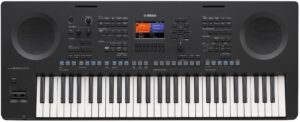
Yamaha PSR-SX620

Based on forum comments, SX prices vary greatly by geographic region. The SX620 does not always sit nicely below the SX720. Check the prices in your region as the delta between SX620 and SX720 may not be that big. It’s your call. The PSR-SX620 will be the top of the line portable keyboard in Japan; The SX620 is not on the Yamaha Japan web site at the time of this writing. If you want a more capable arranger-type keyboard in Japan, it’s STAGEA, baby.

Like the SX600 which it replaces, the SX620 has a decent enough spec:

  • 1,002 Voices + 51 Drum/SFX Kits + 480 XG Voices
  • 137 S.Articulation!, 34 MegaVoice, 31 Sweet!, 74 Cool!, 89 Live!
  • 450 preset styles
  • 416 Pro Styles, 33 Session Styles, 1 Free Play Style
  • Style File Format (SFF), Style File Format GE (SFF GE)
  • Chord Looper
  • Record to USB WAV only
  • Playback from USB WAV only

It’s the lightest SX model at 18 pounds. The SX620 does not have the newer FSB keybed and its non-touch color display is much smaller (4.3 inches) than SX720 and SX920.

The SX620 has Style Section Reset, but does not have Style Section Change Timing, Style Section Time Signature, and Style Dynamics Control. If you need these features, pony up for the bigger siblings.

The SX620 specs out pretty well in the DSP effects area. It offers roughly the same DSP effect presets as the other SX models. The SX920 is the king of the hill with VCM effects and 13 insert effects. The SX620 and SX720 allow 9 insert effects. Insert effects help make styles and MIDI songs come alive, so the more the merrier.
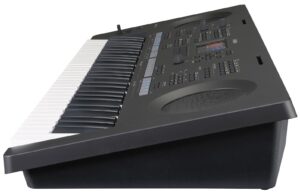
Yamaha PSR-SX620 side view

The SX620 has a redesigned speaker system with internal passive radiators. Each stereo channel has a 12cm speaker, 15 Watts per side. The bigger siblings add tweeters and bi-amplification (SX920). The redesigned necessitated a large front panel producing an “angry duck” kind of look. Some people are OK with the new front panel aesthetics, others dislike it intensely. Personally, the look is growing on me.

PSR-SX620 connectivity

Connectivity is more limited than its sibs. The SX620 doesn’t have 5-pin DIN MIDI or secondary LINE outputs. Otherwise, you won’t be wanting.

Memory capacity is another way Yamaha differentiates models:

  • 360 MB expansion memory (versus 1GB and 2GB)
  • 1 MB per Song (versus 3MB per Song)
  • 226 Multipad Banks x 4 Pads (versus 349 and 500 banks)
  • 500 (max.) Records per Playlist file (versus 2,500 records)

The older SX600 has 100 MB of expansion memory. Given the size of modern-day flash, these capacities always seem chintzy.

Voice-wise, the SX620 has 1,002 voices up from 850. 51 drum kits up from 43 kits. As to voice category, here’ a comparison against SX600:

  • 137 S.Articulation! (SX620) versus 73 (SX600)
  • 34 MegaVoice versus 27
  • 31 Sweet! versus 27
  • 74 Cool! versus 64
  • 89 Live! versus 71

Yamaha has a way of “promoting” voices to Super Articulation. Thus, you will find a few familiar sounds among the new SArt presets. Marketing and product tiering is a silly game sometimes.

Essentially, the SX620 has the S975 sound set. However, you will find a few surprise additions:

  • Pianosphere (Pianos & E.Piano)
  • PianoSweeper (Pianos & E.Piano)
  • LatinAccSuper (Organ & Accordion)
  • LatinAccForS (Organ & Accordion)

Yamaha voice names are not fully consistent from model to model (e.g., 80sSynthBrassProfit instead of BrassProfit), so your mileage may vary (YMMV). Plus, these guys can’t spell. Compare on the basis of MSB/LSB/PC number.

It isn’t strictly correct to say that the SX620 is exactly the S975 sound set. The SX620 picks up new guitar voices from its predecessor, the SX600:

  • CavacoLegato (Guitar)
  • CavacoRR (Guitar)
  • CavacoStrum (Guitar)
  • Cavaco (Guitar)
  • CavacoMute (Guitar)
  • ViolaCaipiraLegato (Guitar)
  • ViolaCaipiraRR (Guitar)
  • ViolaCaipiraStrum (Guitar)
  • ViolaCaipira (Guitar)
  • ViolaCaipiraMute (Guitar)
  • ViolaCaipiraSlide (Guitar)
  • Bandolim (Guitar)
  • BandolimTremolo (Guitar)
  • BandolimTouchTrem (Guitar)

The Megavoice listing reveals internal multi-samples. There you’ll find the Bandolim, Cavaquinho and ViolaCaipira in both the SX620 and SX600. These guitars are not on the S975.

I don’t compare bloops, bleeps or things that bang in the night. So, I’ll leave it to you to compare synth sounds and drum kits. New kits include: Punchy EDM kit and Trap kit.

As to new styles, you’re definitely on your own! Yamaha posted 20 style demo videos to the Yamaha Global channel on Youtube. If you have 25 minutes, a bunch of them are collected here. A few of the demo styles are on Genos 1, e.g., R&BSoulBallad, 12/8 PopBallad, Amazing Gospel. The styles are pretty much what we have come to expect from Yamaha’s style developers — studio-quality sound. Frankly, I couldn’t hear a huge qualitative difference between the SX620 demo videos and Genos 1.

I wish the SX620 display was bigger or that the videographer zoomed in. I want to cop their chord progressions. 🙂 Check out my page with free Chord Looper banks.

Speaking of chord progressions, SX620 has Chord Looper, one of my favorite features. The 12/8 PopBallad demo shows the Chord Looper in action. In this case, Chord Looper remembers the eight chord sequence beneath the ballad: F – Gm7 – Bb – C – Dm – F/A – Bb – C. Once set, Chord Looper handles the changes for the player who can concentrate on melody and fast fingering controls.

What conclusions can I draw without playing the darned thing? I played an S950 for a few years before upgrading to Genos 1. It made a lot of good music and I had a lot of fun with the S950. So much so, that I happily bought a Yamaha CSP-170 digital piano with a similar sound set (minus the high-end piano voices, of course). On the basis of sound quality, I don’t see how you can go wrong with the PSR-SX620.

Folks in the know recommend careful comparison shopping as far as price is concerned. If you can buy an SX720 for a small upward delta, do it. You will get more voices, styles, features and expansion memory. The ability to add new voices and styles is important because Yamaha is taking 5 to 6 years between full, major releases. Never rely on minor software updates; buy a keyboard as it is today.

Hopefully, demo units will roll out to stores shortly. In case you missed it, my site gave a sneak peek nearly four weeks before the official announcement. Keep it locked here.

Bonus: Chord progressions!

Rave (EDM) Main Floor

    |: Cm | Ab | Eb | Gm :|

Disco Pop

    |: Gm7 | Cm7 | Fm7 | Bb :|

R&B Soul Ballad

    |: Cm7 | Gm7 | AbMaj7 | Dm7(b5) :|

Reggaeton Groove

    |: Cm | Ab | Eb | Bb G7 :|

12/8 Pop Ballad

    |: F | Gm7 | Bb6 | C | Dm | F/A | Bb | C :|

Dance Pop

    |: Dm7 | Am7 | Gm7 | A7 :|

Amazing Gospel

    |: F | C/E | Gm7 | Csus4(7) :|

Copyright © 2026 Paul J. Drongowski
In praise of vibe

Just to show I’m alive!

One of my favorite projects is mining and reclaiming “lost” content from vintage beat boxes and such. I’ve shared results here — free downloads:

I spent some time messin’ with Yamaha Mobile Music Sequencer (MMS), searching for pleasant chord progressions. [Yamaha have discontinued the MMS app — bummer.] The MMS patterns are based on the Yamaha MM6/MM8 quasi-synths, quasi-arrangers. I reclaimed a bunch of MMS patterns and converted them to Genos/PSR styles.

As much as I like MMS, the patterns are missing that je ne sais pas. Some might say they are missing verve; let’s say they are missing vibe.

Vibe is the feeling of excitement when we hear music that moves us emotionally. The opposite of vibe, I guess, is “flat”, like beer, champagne or sode which has lost its fizz. The stuff may taste OK, but it’s missing the bubbles that tickle our tongue and nose.

Thus, I haven’t been motivated to polish and release the MMS-based styles. It takes energy to convert and create content — energy to get through the slog of production. Sad to say, the factory styles in my beloved QY70 are kinda flat, too.

Extrapolating a bit, lack of vibe may affect the way people feel about arranger workstations. Yeah, early arrangers had a certain cheese factor. However, today’s tone generators and effects are fully professional and contemporary mid- to high-end arranger keyboards are capable of polished results.

A lot of arranger folks prefer Korg arrangers over Yamaha saying “Korg has a live sound.” Part of that liveness is vibe. Yamaha are trying to move the needle with their newer styles. The new Genos2 R&B styles, for example, have a lot more vibe. They are well-played and Yamaha need to hire those style developers again!

The DJX-II has some of the best vibe-y patterns produced by Yamaha. That’s why I had fun converting DJX-II patterns to SEQTRAK. These patterns groove. As of this writing, the original DJX (PDR-D1) remains untapped. The DJX patterns (styles) are shorter than DJX-II with fewer variations and no cooked-in chord progressions. Still, the DJX (1998!) has more vibe than a typical arranger.

If you would like to learn more about contemporary music, I recommend the book “Switched on Pop” by Nate Sloan and Charlie Harding. The book is based on their podcast of the same name. It’s a popular musicology book that should appeal to musicians, songwriters and listeners alike. If you want to know where popular songs get their vibe and mojo, it’s a good read.

Copyright © 2026 Paul J. Drongowski

Pop demo styles for Yamaha

The new Yamaha PSR-E483 and PSR-E583 have new styles which have not yet been released for Genos and the SX series.

Since folks might be interested in hearing the new styles, Mark Wilburn and I teamed up to create a few quick and dirty Yamaha arranger styles based on the new E-series styles.

Please think of these styles as “demos“. They are far from perfect:

  • Two MAIN variations just like the E-series
  • One INTRO and one ENDING just like the E-series
  • E-series voices not the stellar Genos/SX voices
  • No effects beyond the basic E-series chorus and reverb
  • No chordal variations for INTRO/ENDING

If you have ever attempted style creation, you know how much work it is to add these features. That’s not an excuse — just admiration for Yamaha’s style developers! We expect Yamaha to bring these styles up to Genos/SX quality in the future. Thus, these styles today are “demos”.

If you would like to try the demo styles, here is the ZIP file (E-pop-v1.zip).

The ZIP extracts into a directory named “E-Pop”. E-Pop has three subdirectories:

  • Styles: What you have been waiting for (.STY files)
  • Source: Raw MIDI files and Cakewalk projects
  • MIDI: More raw MIDI song files (SMF Type 0)

If you want to try the styles, copy the .STY files to your arranger, load them up and play. The README.TXT file has some suggested chord progressions.

People who want to try their own hand at style creation will be interested in the Source and MIDI subdirectories. These subdirectories contain the raw MIDI files which we used to create the demos. Be sure to read the README text files for additional tips and information.

As to suggested song names, we drove ourselves crazy trying to match songs with the demo styles. Sometimes everything matched up, sometimes not. Please post your guesses on the Yamaha Musicians Forum where we lurk. 🙂

Have fun!

Copyright © 2026 Paul J. Drongowski
Yamaha PSR-I510 and PSR-I610 keyboards

Yamaha sent the PSR-E583 and PSR-E583 to India to find themselves. Like the Beatles, they came back changed.

You must check the PSR-I510 and PSR-I610 introductory video. Holy mother of funk! 🙂 Damn, I want more of that. More Indian demo tones.

The overview video with Karthick Devaraj has some sweet moments, too. [Dude can play.] Could you imagine if we had this ting during the 60s? Let me hear your sitars ringing out!

Yeah, yeah, I know. This is cultural appropriation on my part. 🙂

Now the PSR-I510 and PSR-I610 plug:

  • 887+ Voices, including 40+ Indian Voices
  • 382+ types of auto accompaniment Styles, including 60+ Indian Styles
  • 40+ Riyaz (Tabla/Mridangam & Tanpura) patterns
  • 65+ Songs, including 25+ Indian Songs
  • PSR-I510: 2×6 Watts; PSR-I610 2×12 Watts
  • Pitch bend wheel
  • Modulation wheel (PSR-I610 only)
  • Looper recording
  • Auto Chord Play
  • USB to Host (Type C), LINE OUT, MIC IN

Some of the Indian voices are Super Articulation Lite, e.g., S.Art Lite Santoor, Swarmandal. My friend Bharadwaj will be happy to see the Riyaz patterns.

This is the first time I had fun listening to demos all week.

Yamaha Global have posted a new MIDI Song to Style introduction video.

Copyright © 2026 Paul J. Drongowski

NAMM 2026: PSR-E483 and PSR-E583 announcement

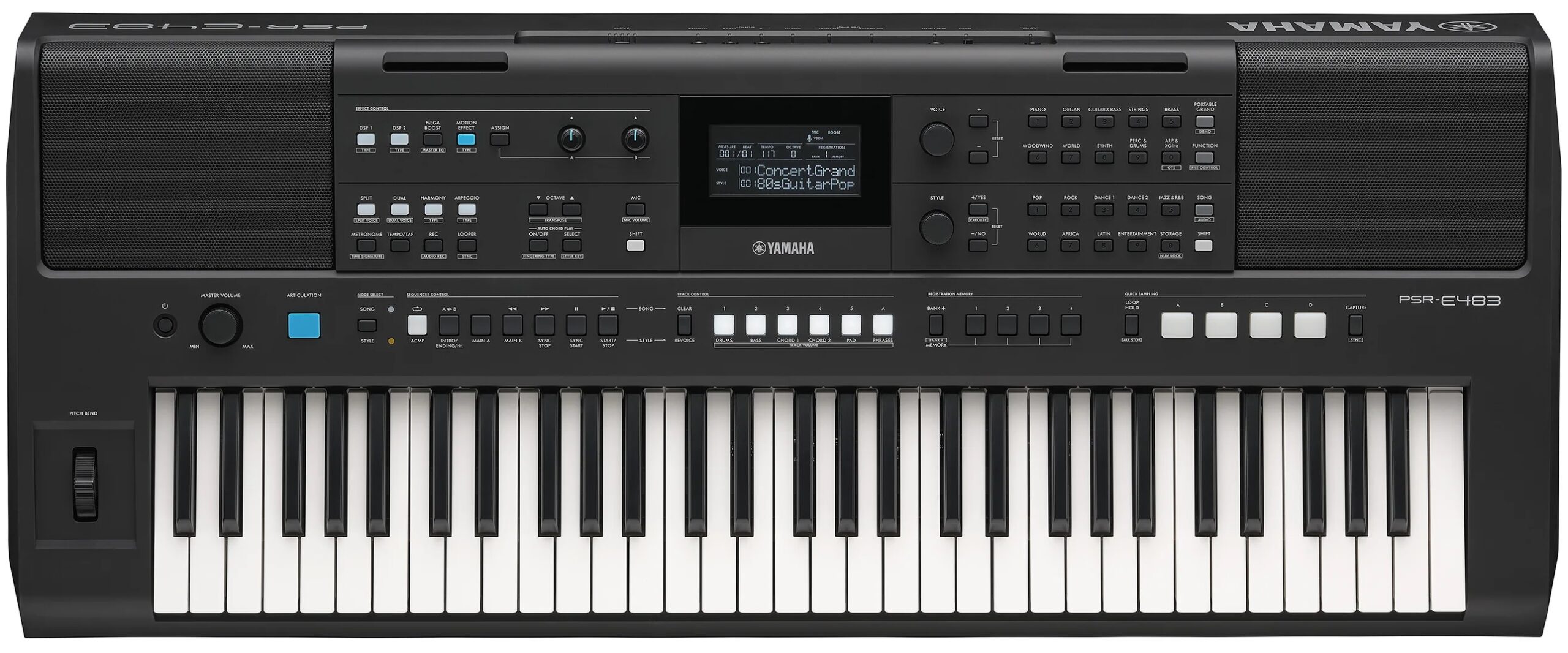
Here are a few details about the upcoming Yamaha PSR-E483 and PSR-E583. Yamaha Global have released an overview video. Yamaha Global also have a longer walkthrough video.

  • 61-key velocity-sensitive keyboard
  • Over 860 voices including Super Articulation Lite voices
  • 345 accompaniment styles
  • Auto Chord Play plays pre-programmed chord progressions
  • 100 pre-programmed progressions or record your own
  • 41 DSP1 effetcs, 12 DSP2 effects, reverb, chorus, master EQ
  • Motion effects
  • Two assignable Live Control knobs
  • Pitch bend wheel
  • Looper to record and loop chord progressions, rhythmic parts, and melodic phrases
  • Quick Sampling to record short audio samples assigned to buttons
  • USB audio recorder (up to 80 minutes record time)
  • USB audio interface
  • E483: Two 6 Watt speaker (2 x 12cm) channels; E583: Two 12 Watt speaker (2 x 12cm) channels
  • Connections: Left and right line outputs, microphone input, AUX input, headphones, USB TO HOST (Type C) and USB TO DEVICE (Type A)
  • AC adapter power or AA batteries
  • MIDI Song To Style app

The PSR-E583 model as a modulation wheel and an expression pedal input. The PSR-E583 has more voices — 890 voices vs. 860 voices — including four more Super Articulation Lite voices (19 SArt vs. 15 SArt). PSR-E483 USA MSRP is $499 USD and MAP is $400. PSR-E583 MSRP is $599 and map is $490. Thus, the extra E583 goodies cost $90 more.

Yamaha PSR-E483 keyboard (NAMM 2026)

The PSR-E583 adds only 0.6 pound (0.3kg) of weight — 16.1 pounds (7.3kg) vs. 15.5 pounds (7.0kg). The E583 uses the larger PA300C 16V power supply while the E483 uses the PA-150 12V adapter. Whoa! Punters should take note of the different power requirements and should not interchange adapters!

Yamaha PSR-E483 keyboard (Rear)

The front panel and case have a clean, professional look in black. The redesigned LCD display has a “grid” format.

Yamaha PSR-E483 and PSR-E583 display (NAMM 2026)

If this sounds a lot like the older PSR-E473, well, you’re right. It is an incremental step, not a revolution. Still, Yamaha makes good quality instruments and the PSR-E483/E583 will make a good starting point for budget-conscious musicians. My own preference would be the PSR-E583 — I can’t live without an expression pedal!

Copyright © 2026 Paul J. Drongowski

NAMM 2026: Yamaha PSR-E483 and PSR-E583, updates

Yamaha promotions have mentioned PSR-E483 and PSR-E583 models before next week’s NAMM 2026 (January 20-24, 2026), so it’s a safe bet that they will appear from the fairy dust. Many budget-conscious punters have awaited new E-series models and will be happy to see them. No specs or details yet, but stay tuned.

Casper at Casper tutorSynth caught sight of a new Genos 2 Voice and Style Expansion Pack: “Back In Time”. Watch Casper’s video for more information. The pack looks like a “greatest hits” collection from early Yamaha arranger keyboards (e.g., PSR-2700, PSR-5700, PSR-6700, PSR-7000 and PSR-9000.

Genos and PSR users will be glad to get the updated MIDI Song to Style application (V1.2) — which will be announced, also. [Don’t look for it quite yet.] The update supports Windows 10/11, macOS 15 (Sequoia) and macOS 26 (Tahoe). Supported keyboard models are: Genos2, PSR-A5000, PSR-SX920, PSR-SX720, PSR-SX600, PSR-E583, PSR-E483, PSR-E383, PSR-EW320, PSR-EZ310 and PSR-I300.

Speaking of updates, the Yamaha CK61/CK88 have received update v1.10. The update adds the following new features:

  • Additional new MENU parameter: “Part SW Mode”.
  • Additional new SETTING parameter: “Pan”.
  • Additional new SETTING -> Rotary Speaker parameters: “Balance”, “Stereo/Mono”, “Speed”, “Acceleration” and “Transition”.
  • Additional new SETTING -> Audio Trigger -> Play Mode parameter: “Hold”.
  • Additional new shortcut operation to “Master Tune”.

And of course, “Fixed minor problems.” Download it today.

Yamaha SEQTRAK got a major update from v1.21 to v2.00. New features are:

  • Added “DrumKit” track type, allowing up to 7 drum sounds in a single track
  • Added “Synth” track type, enabling drum tracks to be used as synth tracks
  • Extended Bar Length button functionality to Drum tracks
  • Enabled value changes via ALL knob rotation while pressing the following buttons: VOL+/-, PAGE, SCALE, OCTAVE, KEY, BPM+/-, SWING

The SEQTRAK app is also bumped to v2.00. Check out the SEQTRAK update video.

MODX M OS v3.00 catches MODX M with Montage M (modulo reduced MODX M functionality). New features are:

  • Now supports Expanded Softsynth Plugin for MONTAGE M/MODX M.
  • New effect types (GS1 Ensemble & Tremolo, M/S EQ Compressor, CS Ring Modulator) have been added.
  • New waveforms (Clavi) and Performances have been added.
  • AN-X and FM-X parameters have been added to the Part LFO destination.
  • ESP Control has been added to DAW Remote.
  • Updated the initial control number settings for controllers used in DAW Remote.
  • Note Limit and Note Shift have been added to Scene, with support for External Part.

The MODX M update is available now. Here is Blake’s Take. Blake has been a busy lad writing Takes for the SEQTRAK and CK updates, too. All to be found on the YamahaSynth.com site. MODX M OS v3.0 demo by Masataka Kono (no talking, just playin’).

As Scott Hanson would say, “This is the witching hour.” Keep your eyes open as updates pop up like Spring flowers.

Copyright © 2026 Paul J. Drongowski

Roland Go:Keys mini-review

Maybe it’s the visual aesthetic which keeps drawing me back to the Roland GO:KEYS 3 and 5. Yes, it’s a box. The simple lines, however, are clean. The chassis colors are well-chosen and the turquoise is lovely. The pastel white keys are a good match.

With time on my hands, I dropped by Kennelly Keys in Everett, WA to give the sounds a try. With so many on-line demos, I decided to focus on playability and voice quality. The styles and chord patterns are hipper than Casio, Yamaha and Medeli. Roland are catering to younger players and contemporary genres. I could have a lot of fun jamming along to chill, downtempo, neo-soul, etc. with GO:KEYS.

Roland Go:keys 3

Today, however, it’s the Advent season church music for the week. Why not kill two birds with one stone and get today’s practice out of the way, too? The instruments are light-weight (max 5.5kg or 12.3 pounds). I could see taking one to church rehearsal (maybe a church gig) since they run on battery power and have built-in speakers.

The keys are piano-ish and are not synth-style keys. They are great for the more than decent acoustic pianos, electric pianos, pads, strings and orchestral instruments. If you have a chance to play a GO:KEYS (gen 2), take it. The keys compare favorably with the Casio CT-S500 and CT-S1000V.

Sonically, pianos are definitely a strength. Strings are good and you get a healthy selection of tones and articulations. (It ain’t VSL. 🙂 ) The pads surprised me. I found more usable simple pads than MODX. I don’t need or want tricked up pads. I didn’t have to look too hard to find them.

The orchestral instruments (e.g., oboe, clarinet) are passable. French horn ain’t bad. If this is your thing, too, I would look to the Roland Cloud and download the EXZ007 “EXZ Orchestra” expansion. The Orchestra expansion contains voices from the SR-JV Orchestral 1 and 2 boards, the Vocal Collection and more. I bought these boards back in the day for $200 USD a pop. Amazing.

Organ-wise, I got on with so-called pipe organ reasonably well. The quieter pipe organ voices are pleasing. The piano keys don’t get in the way if you are playing at a slow tempo and legato touch. Faster tempos may require adjustment. EXZ007 adds a few pipe organs, too, along with a raft of choirs from the old Vocal Collection. (Thank you, Eric Pershing.)

Hate to say it, but Hammond B-3 organs are a disappointment. None of the basic tones/registrations clicked with me (no pun intended). Further, who in the hell makes organ voices velocity sensitive? Yes, there are a few of those abominations.

Better drawbar organs are available in the EXZ008 “EXZ Vintage Keys” expansion. The EXZ008 contains the SR-JV Keyboards of the 60s and 70s (pianos, clav, B-3, combo organ) and a slew of vintage synths. The in-built “VK Rotary” effect is an improvement on the bog standard rotary effect which is really a chorus in cheap disguise.

Playing B is where the box piano keys got in the way. This could be a deal-breaker for organ-oriented players. Playing at a fast tempo felt wrong and I couldn’t adjust to the key response. Major yellow flag for me here. Bummer, everything was going so good.

Roland cannot be faulted for the keys. My Novation Launchkey 49 Mk4 has box piano keys and I have similar issues playing organ with them. I bought the Mk4 for playing AP/EP on a light, swappable MIDI controller in my studio. Think over your requirements and choose.

I spent most of my time playing the GO:KEYS 3 through its internal speakers. The 3 exhibits a lot of boxy-ness. Yes, I’m sure it sounds better through an external amp. The 5 is less boxy. Overall, not a big deal because I usually play through battery powered Yamaha Stagepas 100 or Headrush FRFR GO.

So, 3 or 5? The 5 has much better connectivity. It may seem a trivial matter, but the 5 front panel legends are easier to read than the turquoise. I flat out could not read the button labels on the turquoise and kept refering back to the white 5 nearby. Advantage 5.

Now for the big decider. The 5 can load EXZ expansions which include waveforms. The 3 can only load patches (voice meta-data) and styles. I would almost certainly acquire EXZ007 and/or EXZ008. Both expansions include waveforms, so GO:KEYS 5 it is.

I’m still sorting out Roland Cloud subscriptions and lifetime keys. I would likely get lifetime keys for EXZ007 and EXZ008. That’s an extra cost. Wait, there is another extra cost — downloading requires the Roland Cloud Connect wireless adapter. $124 USD Ka-ching. The adapter includes a 12 month Pro Membership, but still…

Overall, I’m favorable impressed by the current Roland GO:KEYS. If there was a model 5 with a synth-action keybed, I would buy one.

Right now, we are in the looming shadow of NAMM 2026 (January 20-24, 2026). Yamaha will almost certainly announce the next E-series 400 model sometime in the next few months. Plus, it’s time for Korg to update the i3, EK-50 and Kross. Logically, it’s better to hold off for NAMM and see what comes our way.

Copyright © 2025 Paul J. Drongowski

Gettin’ the itch to chop

I’m always in the mood for tiny noise makers and, possibly, mods. My latest fantasy is a good-sounding add-on module to be controlled by a Novation Launchkey 49 Mk4 or Arturia Keylab Essential 49 (both in my clutches).

So, round up the usual suspects! I thought about taking the Mototool to the Yamaha PSS-A50 since it has good mod potential. I’d like to keep the main board and front panel intact, ditching the mini-keyboard, After listening to the A50 sounds, I got cold feet! If I did go Dr. Frankenstein on it, the front panel plus main board combo would be larger than my goal.

I browsed through a zillion Yamaha and Casio service manuals and teardown videos. The now discontinued PSS series keyboards are the smallest having only two internal PCBs. The PSR-F50+ relatives have as many as five PCBs. Even the simplest looking Casios (e.g., CT-S1, CT-S100) have three boards or more. Nope.

Pocket Miku, AKA NSX-39, is a good candidate although one must be willing to sacrifice MIDI channel 1 to that atrocious Miku voice. I did a little deep diving on Japanese NSX sites and found a Real Acoustic Sound (RAS) sax demo that is every bit as good as an Articulated Element Modeling voice on Tyros. It’s a shame that Yamaha never pursued the RAS tech. NSX is pretty much dead to Yamaha, too, because every NSX link to a Yamaha site is a 404.

I A/B tested PSS-A50 voices against NSX-39. Same waveforms, I’m sure. The NSX-1 chip (YMW820) is a kissing cousin to the Yamaha SWLL (YMW830) in the now defunct PSS series. The NSX-1 has better effects, a full GM sound set, and a more capable XG implementation. Goes to show that Yamaha could be making a killer E-series machine, but chooses to make dumb marketing decisions.

The main drawbacks to either A50 or NSX-39 is MIDI communication. Both devices would require a 5-pin MIDI hack or a MIDI host.

SAM, where are you?

I also compared Dream SAM against the Yamaha SWLs. Specifically, I A/B’ed the Yamaha sounds against the MIDIPLUS miniEngine USB. The miniEngine combines a USB MIDI host, 2,500mAh rechargeable battery, and Dream SAM2553 synthesizer chip.

I honestly want to like the miniEngine, however, a few of its flaws are hard to overlook: serial (5-pin) MIDI doesn’t work, the audio output is a bit noisy and the SAM2553 sound doesn’t quite rise to Yamaha. The SAM has a nice Roland GS implementation, providing access to certain high-want parameters via MIDI CC and NRPN messages. Yamaha XG requires SysEx to access key parameters like REVERB type and CHORUS type, effectively putting those parameters out of the reach of most MIDI controllers (including mine).

Still, I can’t quit SAM. M5Stack sell the U187 MIDI unit for $14.50 USD. The U187 is tiny, has two 5-pin MIDI DIN connectors and is based on the SAM2695. After I threw in GROVE connectors, etc. and an M5Stack buck converter, the dust settled around $60 including tax, tariff and shipping. I’ll let you know how it goes.

CME H2MIDI Pro

And, speaking of MIDI hosts. I tried driving the A50 and NSX-39 through a DoReMiDi USB MIDI HOST UMH-20 from Yamaha MODX6. No Joy. I think the Active Sensing messages from the MODX make the DoReMiDi crazy and message transmission was sporadic.

I’ve had issues with the UMH-20 before. At this juncture, I cannot recommend the DoReMiDi.

I ordered and tried the CME H2MIDI Pro instead. No issues. CME know how to make MIDI devices! Plus, the H2MIDI can be configured to filter out Active Sensing, an important feature because Yamaha refuses to provide a software switch that turns off Active Sensing (despite many customer requests).

CME is a strong recommend.

SWLL update

A few intrepid investigators are deep-diving the Yamaha SWLL (and related) processors. The SWL processors are used extensively in the entry-level E-series keyboards. The SWLL is a super-low cost system on a chip which combines an AWM tone generator and an ARM7TDMI core.

In previous posts, I’ve danced around the specific host core in the SWL series. We now know, conclusively, it’s an ARM7TDMI core. Yamaha has been phasing out the old SH architecture cores in favor of ARM (and Linux). BTW, the CSP-100 series may be the last product based on SH. The CLP-800 employs the newest member of the SWX family, the SWX-100F. No doubt, it’s an ARM, too. CVP, on the other hand, is RIP.

Copyright © 2025 Paul J. Drongowski