
MOX performance to PSR style (part 1)

After my initial success with the SmoothItOver style, I decided to convert several more Yamaha MOX workstation performances to PSR-S950 styles. I will post the new styles real soon now.

I changed tactics. Some of the Yamaha MOX performances are based on phrases from older model, non-arranger keyboards. For example, I suspect that the “Club Jazz” phrases are taken from the Yamaha S-80 synthesizer. Yamaha is good at mining old keyboards for MIDI phrase data; Roland and Korg do the same. As far as I can tell, Yamaha “Club Jazz” has not ever been an arranger style and it surely is not implemented on the PSR-S950 or current Tyros models. Several of the funkier performances that I wanted to port use “Club Jazz” phrases. Thus, I needed to develop a method of my own to mine MOX performances directly from the MOX.

In order to make a PSR/Tyros style, we first need to get the MIDI phrase data for a performance into a standard MIDI format (SMF) file. That is the subject of this post (part one). Then, we need to translate the SMF file into a style. That will be the subject of part two — a future post.

A MOX performance consists of one to four parts where each part has its own distinct voice and set of arpeggios (phrases). When you jam with a performance, you trigger the arpeggios using the left part of the MOX keyboard by playing a note or a chord. The arpeggiator follows the root note or chord that you play and modifies the phrase data (e.g., transposes it) on the fly. The modified MIDI phrase data is sent to the appropriate tone generator. (This is the typical use case. The internal engine is far more flexible than this scenario!) You change arpeggios by pressing one of the special function buttons (SF1-SF6). Each of the four parts goes to the corresponding arpeggio, that is, pressing SF3 for ARP3 changes each part to its own ARP3. Thus, each performance part plays its own pre-programmed phrase.

We are going to capture the arpeggio MIDI data using performance record mode. Performance record mode is your friend! (Please see my page on getting started with the MOX.) This mode records MIDI data as you play chords and switch through arpeggios. We are going to play a special kind of song that captures the MIDI data for all of the arpeggios.

First, we need to determine the song structure. Some of the arpeggios play MAIN sections, some play FILL sections and some play BREAK sections. MAIN sections are usually four bars long and FILL/BREAK sections are one bar long. Select ARP1 and play a CMaj7 chord. Listen to ARP1. Is it a MAIN section (four bars long)? Is it a FILL/BREAK section (one bar long)? Do this listening exercise for each ARP. Then jot down a song structure such as:

    ARP#     Section    Starting measure
    ----     -------    ----------------
    ARP1     MAIN A     1
    ARP2     MAIN B     5
    ARP3     MAIN C     9
    ARP4     FILL A     13
    ARP5     FILL B     15
    ARP6     BREAK      17

The starting measure is when the section should start in the song. It tells us when to switch to the next arpeggio when we play the song in performance record mode. Please note that we intend to play each of the fills twice in order to capture enough data for four fills in the final PSR/Tyros style. Yamaha’s performance sometimes have more mains or fills, so you need to be flexible and ready for anything downstream in part two.

Hit the record button to go into performance record mode. Choose “SONG” and the song number. The MIDI data will be written into this song. Set KeyOnStart to ON. This arms the left side of the keyboard. Turn off the metronome click; you won’t really need it. (Page 34 of the MOX Owner’s Manual describes performance record mode in case you are confused at this point.) You’re now ready to play the special song.

Select ARP1 by pressing SF1. Hit a CMaj7 chord on the lower end of the keyboard to start playing (and recording) the song. During measure 4, hit SF2 to queue up ARP2. ARP2 begins to play in measure 5. Hit SF3 during measure 8 to queue up ARP3. ARP3 begins to play in measure 9. And so forth. Hit STOP after measure 17 to stop recording. The MOX then finishes recording and switches to SONG mode. At this point, you can save the MIDI data in the SONG by hitting STORE or you can go back to performance mode and try again. Since the song is short, it isn’t a big deal to play it again if you make a mistake.

When you have the song, the final step is to write the song as an SMF file on a USB drive. Hit the FILE button and follow the procedure for saving a song as an SMF file. (Hit SAVE, set the name, set the save type to SMF, etc.) In part two, we will translate the SMF to a PSR/Tyros style using PC-based software tools.

Why play a CMaj7 chord? The phrases in a PSR/Tyros style must have a known chord root and chord type. CMaj7 is the conventional chord root and type for styles. The CMaj7 chord forces the arpeggiator to voice phrases for a CMaj7 chord thereby making the final MIDI data style-ready.

Before leaving the MOX behind, you should jot down a few performance notes that will help during the latter stages of the porting process. Jot down the MOX voice for each part. This will help you to select style voices for the PSR/Tyros. Pay careful attention to the guitar and bass voices. Are they Mega Voice voices? Do the voices incorporate FX like slides, scrapes, etc.? You may need to dig into the voice programming to find out if a bass voice uses bass FX. Guitar and bass effect notes are usually mapped to C6 or higher. You will need to give FX notes special treatment during part two.

One or more performance parts may be designated for live soloing or comping. The arpeggios for such parts are turned OFF. Usually, Yamaha provides a right hand part for soloing. They may also provide a pad in the left hand, that is, a pad plays if the left hand chord is held. In rare cases, the right hand may even trigger its own arpeggio! Make note of any special performance behavior that you want to emulate on the PSR/Tyros.

That’s it! At this point, you have an SMF file to be translated to a style. Check out part two and part three of this series.
Smooth It Over

Here’s a Yamaha PSR-S950 style for funky jazzers — SmoothItOver.

As some of you know, many of the Motif/MOX arpeggios are based on what once were PSR/Tyros arranger keyboard styles. SmoothItOver is a little payback going the other way.

The MOX has about a dozen or so jazzy/funky Performances that are fun to jam to. One of my favorites is called “Smooth It Over.” A MOX/Motif Performance is a four instrument mini-mix where each instrument can be driven by a different arpeggio (musical phrase). Arpeggios are triggered by hitting one or more notes on the keyboard. Many of the arpeggios respond to and follow chords. A musician can lay down a song or groove by switching through groups of arpeggios and playing along.

The SmoothItOver performance on the MOX splits the keyboard into a lower and an upper part. (Sound familiar?) The lower part of the keyboard triggers drum and bass arpeggios as well as directly sounding the notes played, using a mellow electric piano voice. The upper part of the keyboard is for melody and is configured with a growl tenor sax. The drum and bass arpeggios are taken from the 70sDiscoFunk and GospelFunk styles.

The PSR/Tyros SmoothItOver style rips off, errr, builds on the equivalent sections from the 70sDiscoFunk and GospelFunk styles. I added OTS buttons with the FunkGtr 16Bt3 Multi Pad bank. Be sure to throw in the Multi Pad guitars when playing. (These Multi Pads follow the left hand chords.) It really kicks the PSR/Tyros style up a notch over the MOX version. The ability to switch melody voices on-the-fly through OTS is another advantage over the MOX.

The INTROs and ENDINGs are little lame since this style is built for jamming and practice, not covers. Try it with a minor blues (e.g., Dm7, Gm7, Am7) and switch between sections frequently to vary the groove. Drop a little guitar via the Multi Pad buttons. Have fun!

Don’t let anyone kick sand in your face at the beach just because you play “an arranger.”

BTW, I know someone will ask, “Why not transfer phrase data, etc. from the MOX to the PSR?” Two good reasons:

  • The MOX/Motif instruments are programmed much differently than similar PSR/Tyros instruments. The bass in Smooth It Over, for example, lays out the sound elements in different MIDI velocity and note ranges.
  • The note transposition rules and tables are hidden on the MOX.

It’s much easier to start out with the native style data on the PSR than to re-map the MOX phrase data to PSR instruments and recreate all of the note transposition programming.

Here’s an arpeggio-to-style section correspondence table:

    Type  ARP#  Style section
    ----  ----  ---------------------
    Drum  ARP1  MB_Gospel Funk
    Drum  ARP2  MA_Gospel Funk
    Drum  ARP3  MB_Gospel Funk
    Drum  ARP4  FA_Gospel Funk
    Drum  ARP5  FB_Gospel Funk
    Drum  ARP6  BA_Gospel Funk

    Bass  ARP1  FA_70sDiscoFunk _XS
    Bass  ARP2  FB_70sDiscoFunk _XS
    Bass  ARP3  MB_Gospel Funk _XS
    Bass  ARP4  MB_Gospel Funk _XS
    Bass  ARP5  FA_70sDiscoFunk _XS
    Bass  ARP6  BA_Gospel Funk

Transferring QY70 style to PSR

Some of us are trying to mine our old beat boxes (like the Yamaha QY70) for styles and phrases. I tried transferring a QY70 “style” to an S950.

“8Detroit” is an 8-beat QY70 style. A QY70 style has only six sections: Main A, Main B, Fill In AB, Fill In BA, Intro, Ending. There is no break section. The fill-ins are called “AB” and “BA” because they are intended to be transitions from Main A to Main B and from Main B to Main A.

I determined the section lengths through the QY70 phrase editor. Here are the QY70 section lengths:

     Section     Length
     ----------  ------
     Main A      2 bars
     Main B      4 bars
     Intro       2 bars
     Fill In AB  1 bar
     Fill In BA  1 bar
     Ending      6 bars

Here is the process that I used to create a PSR compatible style called “8DetroitStyle.sty”.

1. Create a QY70 song in the QY pattern track. Use Cmaj7 throughout. The song has the following structure/sections:

     Measure   SMF   Section     MIDI Marker
     -------  -----  -------     -----------
       1:2     2:3   Main A      Main A
       3:6     4:7   Main B      Main B
       7:8     8:9   Intro       Intro A
        9      10    Fill In AB  Fill In AA
       10      11    Fill In BA  Fill In BB
      11:16   12:17  Ending      Ending A

The first column is the section location in the pattern track. The second column is the section location in the generated SMF file.

2. Copy the QY70 song to an empty song. Use the QY70 “Expand Backing” job to expand the pattern track to MIDI events in tracks 9-16.

3. Use the QY70 Data Filer program to transfer and translate the QY70 song to an SMF file on a PC. Enable the option to insert XG initialization data at the beginning of the SMF file.

4. Open the SMF file in Sonar. Insert MIDI markers at the locations specified above. Save the SMF file as MIDI type 0.

5. Rename the MIDI file with the “.STY” extension.

6. Use Jorgen Sorensen’s Style Fixer program to check the file and to insert a default CASM into the MIDI file.

7. Transfer the style file to a USB drive and test the file on the PSR.

60sSuperGroup mash-up

In my last post, I started the process of converting the PSR-S950 audio style “60sSuperGroup” to all MIDI. I like the 60sSuperGroup audio style, but the really strong back-beat in MAIN A makes it hard to use that section on anything other than the Beatles song “Ticket To Ride.” In order to make this style more generally useful, I’m replacing the audio rhythm tracks with appropriate MIDI tracks. Last time, I had worked on the MAIN and FILL IN sections and now it’s time to attack the INTROs and ENDINGs.

Here’s my process.

  • Find a style which is similar to 60sSuperGroup. 60sVintageRock is a good alternative because it is your basic Mark II rock and roll.
  • Load 60sVintageRock into Style Creator.
  • For each section, copy the non-rhythm parts from 60sSuperGroup into the new style.
  • Change the section lengths to match the source style 60sSuperGroup.
  • Save the new style as 60sFabFour.
  • Listen to each new section critically.
  • If a section doesn’t work musically, copy a section from a different candidate style.
  • Edit DSP effects to match 60sSuperGroup.
  • Save a bunch of intermediate copies along the way in case you need to back up to an earlier version.

Overall, the MAIN and FILL IN sections from 60sVintageRock were a good match and sounded pretty good. The one measure INTROs were OK, too. The longer INTROs and ENDINGs were more of a problem. So, I identified a few alternative candidate styles and built a table of INTRO/ENDING section lengths to find and try alternatives. Here’s the table:

           Target:
         60sFabFour  60sVintageRock  60sPopRock  VintageGtrPop
         ----------  --------------  ----------  -------------
INTRO 1      1             1              1            2
INTRO 2      2             4              5            4
INTRO 3      5             9              4            9
INTRO 4      1             1              1            1
ENDING 1     3             3              3            2
ENDING 2     4             4              3            3
ENDING 3     5             6              7            5
ENDING 4     1             1              1            1

I tried to use alternatives that were the same section lengths as 60sSuperGroup and the new style 60sFabFour.

ENDING 2 was the most difficult to nail. I tried different alternatives and then needed to shorten the section length to get rid of some beats that ran on — kind of like Ringo didn’t know when to stop. Here are the final source styles for the INTROs and ENDINGs:

           Target:
         60sFabFour  Source style
         ----------  --------------
INTRO 1      1       60sVintageRock
INTRO 2      2       VintageGtrPop
INTRO 3      5       60sPopRock
INTRO 4      1       60sVintageRock
ENDING 1     3       60sVintageRock
ENDING 2     4       60sPopRock
ENDING 3     5       VintageGtrPop
ENDING 4     1       60sVintageRock

A lot of luck and trial and error is involved here. Luckily, the alternatives fit pretty well.

DSP1 is configured as a SYSTEM variation effect for both 60sSuperGroup and 60sVintageRock. However, the parameters are different. The guitars are sent to the SYSTEM effect in order to get a VOX AC30 amp “chime”. The final effect parameters are taken from 60sSuperGroup:

Category: REAL DIST
Effect: ST AMP VT

COMP SW          ON
COMP SUSTAIN     0.4
COMP LEVEL       6.0
DIST TYPE        Crunch
DIST DRIVE       7.8
DIST EQ          Mid Boost
DIST TONE        7.0 
DIST PRESENCE    6.0
DIST OUTPUT      24

This uses a Real Distortion effect and you will need to change this when porting the style to an older model keyboard. I did not change the OTS settings in the new style since I was happy with the OTS settings from 60sVintageRock.

I put a copy of the 60sFabFour style on the Music Gallery page.

S950 audio style mash-up

The Yamaha PSR-S950 and Tyros 5 arrangers provide audio styles as well as conventional, pure MIDI-based backing styles. Audio styles replace the MIDI-based rhythm tracks with an audio track of a (human) drummer playing a kit. The remainder of the backing track is provided by MIDI. On the up side, the audio rhythm parts have more nuance and sound pretty darned good. On the down side, the audio track in a style cannot be modified or eliminated nor can they be replaced by a user’s own audio track. Whether this limitation is a quirk of the Yamaha software or a permanent feature remains to be seen.

One of the S950 audio styles is “60sSuperGroup.” I’ve been off in Pepperland trying to pull some Beatles tunes together. I kept gravitating back to 60sSuperGroup for backing, but the drum back-beat in Main Section A is so strong that it doesn’t fit with hardly anything other than the song “Ticket To Ride.” It would be great to apply the non-rhythm parts to other songs.

Time to replace the audio rhythm parts in the 60sSuperGroup audio style. Unfortunately, one must work around the limitations of Yamaha’s software. The MIDI drum style “60sVintageRock” is roughly the same tempo and its rhythm parts are your basic Mark II rock and roll — in other words a good candidate style for a mash-up.

First, I loaded 60sSuperGroup, got into Style Creator and tried copying the 60sVintageRock rhythm parts into 60sSuperGroup. No joy. Once a style is an audio style, it’s always an audio style. Further, you cannot store the audio style to an external device like a USB jump drive. Yeah, the manual says this explicitly, but it was worth a try. No need to go down that rat-hole again.

So, here’s the process that I followed. I loaded 60sVintageRock as the base style and got into Style Creator. I then copied the non-rhythm parts from 60sSuperGroup into the new style which I called “60sHybrid”. I did this for MAIN A-D, FILL IN A-D, BREAK, INTRO 1 and ENDING 1. I’m not a big fan of long preplayed intros and endings, plus I didn’t know how well the longer intros and endings would mash up. Even without these additional intros and endings, this was more than enough button pushing for one day!

Here is a side-by-side comparison of INTRO and ENDING lengths:

         60sSuperGroup  60sVintageRock
         -------------  --------------
INTRO 1        1              1
INTRO 2        2              4
INTRO 3        5              9
INTRO 4        1              1
ENDING 1       3              3
ENDING 2       4              4
ENDING 3       5              6
ENDING 4       1              1

I’m not sure how to fix up these up as yet. Suggestions?

The two styles have different instrument-to-style part assignments. Here’s the instrument information for 60sSuperGroup:

Part  Vol  Pan  Var  Instrument         
----  ---  ---  ---  -----------------
RHY1   54  C      0  PowerKit1          OFF
RHY2   72  C      0  RealDrums          OFF
BASS   66  C      0  Mega VintageFlat   ON
CHD1   51  L28  127  Mega SingleCoil    ON
CHD2   42  R30  127  Mega SolidGuitar2  ON
PAD    48  C      0  Mega 12StringGtr   ON
PHR1   44  R32  127  Mega SingleCoil    OFF
PHR2   70  C      0  GrandPiano         OFF

The rhythm channels are both OFF because all drum/percussion is provided by the audio track. Here is the instrument information for 60sVintageRock:

Part  Vol  Pan  Var  Instrument         
----  ---  ---  ---  -----------------
RHY1   54  C      0  PopLatin           OFF
RHY2   72  C      0  RealDrums          ON
BASS   66  C      0  Mega VintagePick   ON
CHD1   51  L28  127  Mega SteelGuitar   ON
CHD2   42  R30  127  Mega SolidGuitar2  ON
PAD    48  C      0  CurvedBars         ON
PHR1   44  R32  127  Mega SingleCoil    OFF
PHR2   70  C      0  Harmonica          OFF

Since nothing was copied to INTRO 2-4 and ENDING 2-4, the instruments and sound for these sections do not match the sections copied from 60sSuperGroup. The mismatch is readily apparent when played.

DSP1 is configured as a SYSTEM variation effect. I needed to edit the effect parameters in order to get that VOX AC30 amp chime. Here are the parameters; they are the same as 60sSuperGroup DSP1:

Category: REAL DIST
Effect: ST AMP VT

COMP SW          ON
COMP SUSTAIN     0.4
COMP LEVEL       6.0
DIST TYPE        Crunch
DIST DRIVE       7.8
DIST EQ          Mid Boost
DIST TONE        7.0 
DIST PRESENCE    6.0
DIST OUTPUT      24

It’s been an interesting experiment so far! The resulting mash-up should be quite useful when tracking up-tempo, early Beatles rock and roll.

PSR/Tyros XG effects

I’ve been busy making my PSR-S950 gig-ready. I’ll describe the overall set-up in a separate post as soon as I have a little more time.

Part of the job involves converting some of my General MIDI 2 backing tracks to the PSR-S950 sound engine. The PSR (and Tyros) sound engine follows the Yamaha XG architecture and the sound engine responds to Yamaha XG System Exclusive (SysEx) MIDI messages. The XG SysEx messages configure tone generation and the effects that are applied to the tone generator outputs. Let’s limit the discussion to MIDI song sequencing and assume that there are 16 MIDI channels and each channel is routed to a separate tone generator. We’ll ignore style parts and how to tweeze tone generation in order to keep this discussion focused on effects.

There are two types of XG effects: system effects and insertion effects. We are already quite familiar with two common system effects: chorus and reverb. Potentially, the output from any tone generation channel can be sent independently to chorus and/or reverb. System effects routing and control follows a send-return model like a well-featured analog mixer. The amount of signal sent to the (virtual) chorus or reverb unit from a given channel is determined by a send level. Chorus and reverb are used so frequently that “standard” MIDI controller numbers are assigned for reverb (CC91) and chorus (CC93) depth.

Just like the real-world mixer model, an insertion effect is a channel specific effect. The output from a tone generator is sent directly to the input of the insertion effect and the output of the insertion effect becomes the output from the channel. An insertion effect belongs to one and only one channel (tone generator). The XG architecture does not allow insertion effects to be chained. So, if you need a chain of guitar-oriented effects, you need to read through the effects table in the Yamaha data list and find a multi-effect that does the job.

Now, life gets interesting. The XG architecture defines two kinds of (virtual) effect units: EFFECT1 and EFFECT2. Each kind of effect has certain capabilities and SysEx messages.

XG EFFECT1 has a special name: the Variation effect. The Variation effect is very (no pun!) flexible. It can function as either a system effect or as an insertion effect. In PSR/Tyros-land, the Variation effect is assigned to the DSP1 unit. That’s why the user and reference manuals have special rules and conditions that govern the use and configuration of DSP1. On certain specific PSR models such as the PSR-S750, DSP1 often supports more effect types (e.g., kinds of distortion or whatever) than its cousins, DSP2, DSP3, DSP4, etc. If a song uses DSP1, the set-up information in your MIDI SMF file, at a minimum, must send SysEx to choose system or insertion mode and the effect type.

XG EFFECT2 effects are optional, that is, an XG keyboard does not need to implement any EFFECT2 effects. (EFFECT1 is also optional, but such a keyboard is only “XG-Lite” compliant like the PSR-E443.) The old QY-70 sequencer, for example, implements EFFECT1, but doesn’t support any EFFECT2 effects. The Yamaha Mobile Music Sequencer only supports EFFECT1, too. In PSR/Tyros-land, the number of ancillary DSP units (DSP2, DSP3, DSP4, etc.) determine the number of supported XG EFFECT2 effects. All XG EFFECT2 effects are insertion effects. Period. No choice.

With this background in mind, you will need to take some time to study the XG effects-related parameters in the MIDI message section of the PSR/Tyros manual. This is time well-spent.

Let’s take a look at a few details, though, in order to see how all of this fits together. First, here are a few points to summarize EFFECT1, the Variation effect.

  • XG EFFECT1 is assigned to PSR/Tyros DSP1.
  • This effect unit provides reverb, chorus and other insertion/system effects.
  • The Variation effect is configured for either insertion or system mode.
  • The Variation effect is shown in the mixer console effect window.
  • As an insertion effect, the send level is 127 and cannot be changed through the mixer console window.

The following three SysEx messages configure the Variation effect as an insertion effect. All numbers are hexadecimal. The effect type is MSB:5F and LSB:20, which is MSB:95 (decimal) and LSB:32, known to human beings as Real Distortion “MLT DS SOLO.” It’s a guitar multi-effect suitable for a lead guitar solo.

     Start SysEx message
     |  Yamaha ID
     |  |  Device number
     |  |  |  Model ID
     |  |  |  |                 End SysEx message
     |  |  |  |                 |
    F0 43 10 4C 02 01 40 5F 20 F7      Choose effect type
    F0 43 10 4C 02 01 5A 00 F7         Variation connection (00:insertion)
    F0 43 10 4C 02 01 5B 00 F7         Variation part
                 |  |  |
                 EFFECT1 parameter addresses

These three messages are called “XG Parameter Change” messages because they change an XG control parameter (e.g., effect type) stored at a particular address (e.g., 02 01 40). Most of the message is reusable boilerplate like the Yamaha ID, device number and model ID. Since we are using the Variation effect in insertion mode, we must assign the effect to a part, also know as a MIDI channel. In this case, we are assigning the Variation effect to Part 1 (MIDI channel 0).

Here’s a few bullet points to summarize what we know about EFFECT2.

  • XG EFFECT2 is assigned to one of DSP2, DSP3, DSP4, …
  • XG EFFECT2 is always an insertion effect.
  • The DSP unit is selected via the XG parameter address in the SysEx message.
  • The insertion effect must be assigned to a (song) part/MIDI channel.

Here is a quick example of two SysEx messages to set up an insertion effect on part 2 (MIDI channel 1) on DSP4.

                 EFFECT2 parameter address
                 |  |  |
    F0 43 10 4C 03 02 00 4E 10 F7      Choose effect type (0x4E 0x10)
    F0 43 10 4C 03 02 0C 01 F7         Variation part
                    |     |
                    |     Part 2 (MIDI channel 1)
                    00:DSP2 01:DSP3 02:DSP4

The first SysEx message selects the effect type (XG parameter address: 03 02 00). The effect type is MSB:4E and LSB: 10 which is MSB:78 (decimal) and LSB:16 (decimal). This is AUTO WAH1. The second message assigns DSP4 (02) to MIDI channel 1. Please note that the DSP unit is selected by the second byte in the XG parameter address.

This information should be enough to get you started. From here, I recommend reading about the Yamaha XG tone generation and effects architecture.

Yamaha, at one time, published diagrams showing Tyros 2 and XG effect routing. Unfortunately, these helpful diagrams are now hard to find. Here are links to the Tyros 2 effect diagram and the MU-128 XG effect diagram.

Sparkfun Danger Shield

Sparkfun is one of my favorite companies. I like their products and their service is very good and reliable. I’ve learned a lot by studying their designs and I especially like their commitment to education.

Previously, I built two Sparkfun kits: the Redboard PTH Arduino and the MIDI break-out board. I have several more kits on hand to satisfy the occasional urge to solder!

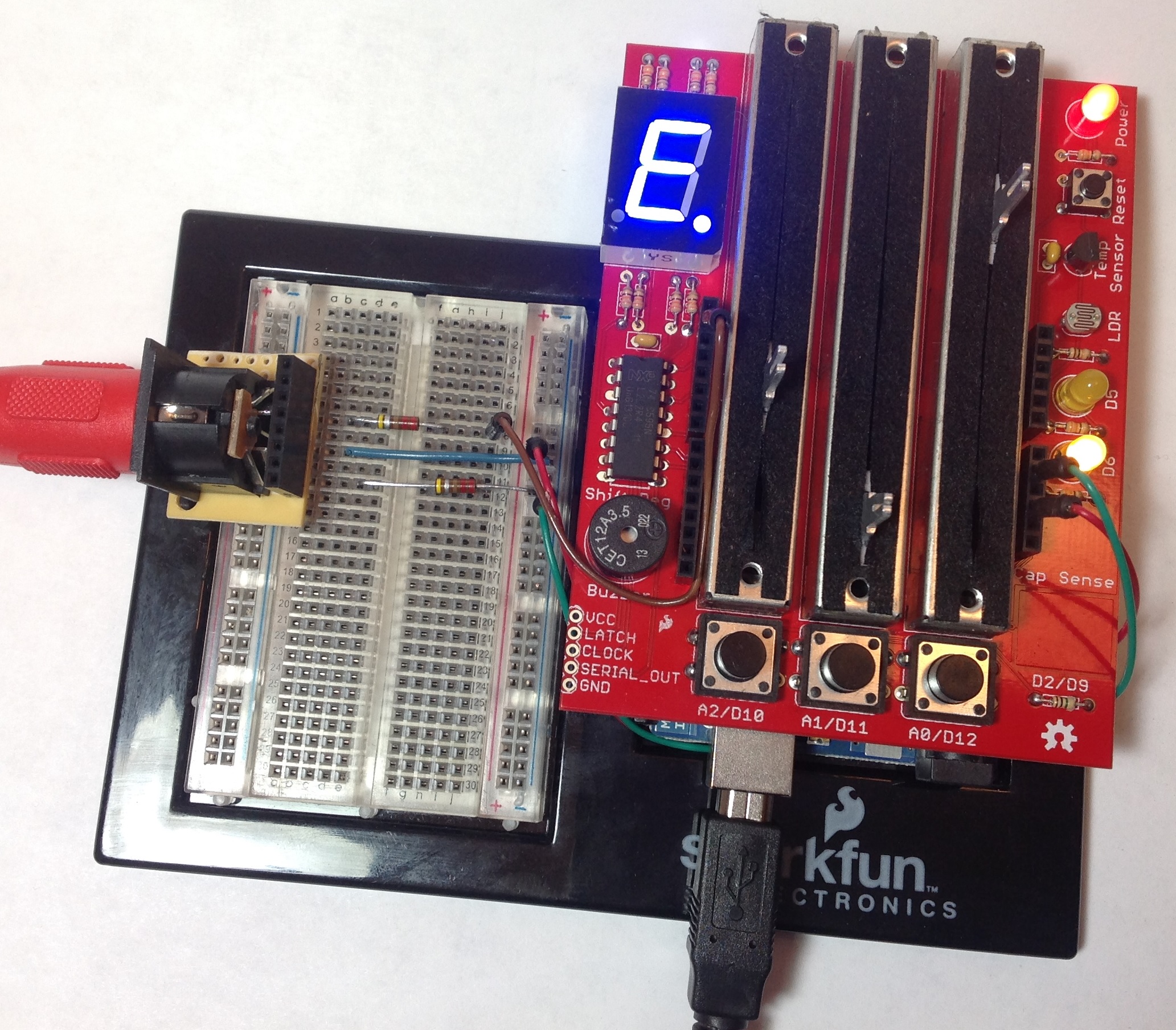
Recently, I built a Sparkfun Danger Shield, hoping to use it as part of a MIDI drawbar controller. The code for the controller is still a work in progress. So, in the meantime, here is a micro-review of the Danger Shield.

The Danger Shield is a “jack of all trades” for input to an Arduino. It has three large sliders, three momentary contact buttons, one temperature sensor, one light sensor, and a capacitive touch sensor. The Danger Shield also provides basic output/display capability, too. The shield has two yellow LEDs, a seven-segment display, and a buzzer. For the MIDI controller project, I’m mainly interested in the sliders, buttons, LEDs and seven-segment display. However, I can see some creative possibilities for the other sensors in MIDI control.

Kit assembly went quite well, taking about two hours total. I think that a beginner could put one together without too much trouble. There was only one minor hang-up. The on-line assembly instructions are out-of-date. Two decoupling capacitors were added to the design after the instructions were published. One capacitor is mounted near the temperature sensor and the other capacitor is mounted near the shift register integrated circuit. This could trip up a beginner since they will have two small parts left over if they simply follow directions!

DangerShield

Sparkfun thoughtfully provide an Arduino Sketch (program) to test the sliders, buttons, etc. This is a great idea and I wish that more companies provided test programs with their products. When you build a kit, you really want to know if everything works before you design the kit into an experiment or prototype. Unfortunately, the test program expects the cap sense code to be installed as an IDE library. This dependency could trip up a beginner since they would need to learn how to install library code before running the test program. Since I didn’t intend to use the cap sense pad right away, I commented out the cap sense code and tested everything else.

The one thing that surprised me is the physical size of the shield. It is much bigger than the standard Arduino footprint. I had originally intended to stack the Danger Shield, the MIDI break-out board and the Arduino on a Liquidware side-by-side extender. This approach would have saved me the effort of whipping up a 5-pin MIDI OUT port. Unfortunately, the large size of the Danger Shield prevents much stacking.

I decided to prototype on an Arduino UNO which is installed on a plastic Arduino and breadboard holder. The Danger Shield is stacked on top of the Arduino UNO. The 5-pin MIDI OUT port resides on the breadboard. I built a 5-pin DIN break-out board to securely attach the 5-pin connector to the broadboard as well as provide a way to make necessary connections to the Arduino +5V, ground and TX pins. This quick-and-dirty break-out board should aid future experiments, too, and is a good investment of time. Finally, I wrote a quick test program to drive MIDI data through the output port and to make sure that it was electrically sound before I connect it to an expensive synthesizer or arranger workstation.

All in all, I recommend the Danger Shield. It’s possible to build a pretty decent user interface given a little bit of creative thought. The sliders and buttons are robust and should endure much abuse during testing.

Tyros 4 teardown

I stumbled across this Yamaha Tyros 4 teardown on Youtube. Although the video is a little bit long-winded, you get a peek under the hood of the Tyros 4 and see a few of the circuit boards.

Unfortunately, the video is short on the kinds of details that you would find in a Yamaha service manual. I wish that the producers had taken a close pan of the main logic board with enough resolution to read the part numbers. The narrator read off the part number of the main CPU, Renesas R8A77310D, but then stated that he couldn’t find information on the web. OK, here’s the info. It’s a Renesas SH7731 processor containing an SH4AL-DSP core. The maximum clock speed of the SH7331 is 333.4MHz. The SH-4 core is a rather powerful, DSP-capable core.

The narrator also mentioned an Altera Cyclone. This is a field programmable gate array (FPGA) which probably provides some glue logic like a bus bridge. Since it’s an FPGA, it could be programmed to do just about anything.

The video shows at least two other very large scale integrated circuits. Two of these are probably SWP51 tone generators. The SWP51 has two 16-bit wave memory ports (each with separate address and data ports). Therefore, the IC package is big and has a lot of pins. The SWP51 is where Yamaha keeps the secret sauce. They have never published papers about it and with good reason; Korg, Roland and Casio would probably love to know what’s inside, too!

Given that the Tyros 4 has Vocal Harmony 2, it most likely has an SSP2 chip.

Leaving the video aside, here’s a few “big picture” thoughts.

First, it’s interesting to see how Yamaha have been riding the CPU and memory technology curves. They have used successively more powerful SH architecture CPUs over the years. They clearly have deep knowledge and competence with this architecture. Memory-wise, they have progressed from mask ROM to bulk programmable ROM (P2ROM) to NOR/NAND flash. NOR/NAND flash is so widely used in the PSR-S950, for example, that the entire machine — in theory — could be reprogrammed.

Next, if I were Yamaha, I would consider using an ARM system on a chip (SOC) in the entry level and possibly the lower mid-range keyboards. They could achieve a higher level of functional integration with ARM and still obtain low power consumption. Further, they could provide superior tone generation at the entry level. The proof point is the Yamaha Mobile Music Sequencer (MMS) app on the Apple iPad. MMS on ARM supports eight tracks of playback with a polyphonic, XG-like software tone generator. MMS provides basic XG variation effects which are not current entry-level features. Of course, this means that Yamaha is willing to leave its comfort zone with the SH architecture!