Gettin’ the itch to chop

I’m always in the mood for tiny noise makers and, possibly, mods. My latest fantasy is a good-sounding add-on module to be controlled by a Novation Launchkey 49 Mk4 or Arturia Keylab Essential 49 (both in my clutches).

So, round up the usual suspects! I thought about taking the Mototool to the Yamaha PSS-A50 since it has good mod potential. I’d like to keep the main board and front panel intact, ditching the mini-keyboard, After listening to the A50 sounds, I got cold feet! If I did go Dr. Frankenstein on it, the front panel plus main board combo would be larger than my goal.

I browsed through a zillion Yamaha and Casio service manuals and teardown videos. The now discontinued PSS series keyboards are the smallest having only two internal PCBs. The PSR-F50+ relatives have as many as five PCBs. Even the simplest looking Casios (e.g., CT-S1, CT-S100) have three boards or more. Nope.

Pocket Miku, AKA NSX-39, is a good candidate although one must be willing to sacrifice MIDI channel 1 to that atrocious Miku voice. I did a little deep diving on Japanese NSX sites and found a Real Acoustic Sound (RAS) sax demo that is every bit as good as an Articulated Element Modeling voice on Tyros. It’s a shame that Yamaha never pursued the RAS tech. NSX is pretty much dead to Yamaha, too, because every NSX link to a Yamaha site is a 404.

I A/B tested PSS-A50 voices against NSX-39. Same waveforms, I’m sure. The NSX-1 chip (YMW820) is a kissing cousin to the Yamaha SWLL (YMW830) in the now defunct PSS series. The NSX-1 has better effects, a full GM sound set, and a more capable XG implementation. Goes to show that Yamaha could be making a killer E-series machine, but chooses to make dumb marketing decisions.

The main drawbacks to either A50 or NSX-39 is MIDI communication. Both devices would require a 5-pin MIDI hack or a MIDI host.

SAM, where are you?

I also compared Dream SAM against the Yamaha SWLs. Specifically, I A/B’ed the Yamaha sounds against the MIDIPLUS miniEngine USB. The miniEngine combines a USB MIDI host, 2,500mAh rechargeable battery, and Dream SAM2553 synthesizer chip.

I honestly want to like the miniEngine, however, a few of its flaws are hard to overlook: serial (5-pin) MIDI doesn’t work, the audio output is a bit noisy and the SAM2553 sound doesn’t quite rise to Yamaha. The SAM has a nice Roland GS implementation, providing access to certain high-want parameters via MIDI CC and NRPN messages. Yamaha XG requires SysEx to access key parameters like REVERB type and CHORUS type, effectively putting those parameters out of the reach of most MIDI controllers (including mine).

Still, I can’t quit SAM. M5Stack sell the U187 MIDI unit for $14.50 USD. The U187 is tiny, has two 5-pin MIDI DIN connectors and is based on the SAM2695. After I threw in GROVE connectors, etc. and an M5Stack buck converter, the dust settled around $60 including tax, tariff and shipping. I’ll let you know how it goes.

CME H2MIDI Pro

And, speaking of MIDI hosts. I tried driving the A50 and NSX-39 through a DoReMiDi USB MIDI HOST UMH-20 from Yamaha MODX6. No Joy. I think the Active Sensing messages from the MODX make the DoReMiDi crazy and message transmission was sporadic.

I’ve had issues with the UMH-20 before. At this juncture, I cannot recommend the DoReMiDi.

I ordered and tried the CME H2MIDI Pro instead. No issues. CME know how to make MIDI devices! Plus, the H2MIDI can be configured to filter out Active Sensing, an important feature because Yamaha refuses to provide a software switch that turns off Active Sensing (despite many customer requests).

CME is a strong recommend.

SWLL update

A few intrepid investigators are deep-diving the Yamaha SWLL (and related) processors. The SWL processors are used extensively in the entry-level E-series keyboards. The SWLL is a super-low cost system on a chip which combines an AWM tone generator and an ARM7TDMI core.

In previous posts, I’ve danced around the specific host core in the SWL series. We now know, conclusively, it’s an ARM7TDMI core. Yamaha has been phasing out the old SH architecture cores in favor of ARM (and Linux). BTW, the CSP-100 series may be the last product based on SH. The CLP-800 employs the newest member of the SWX family, the SWX-100F. No doubt, it’s an ARM, too. CVP, on the other hand, is RIP.

Copyright © 2025 Paul J. Drongowski
Yamaha PSS-A50: Look inside

Let’s take a quick tour of the Yamaha PSS-A50.

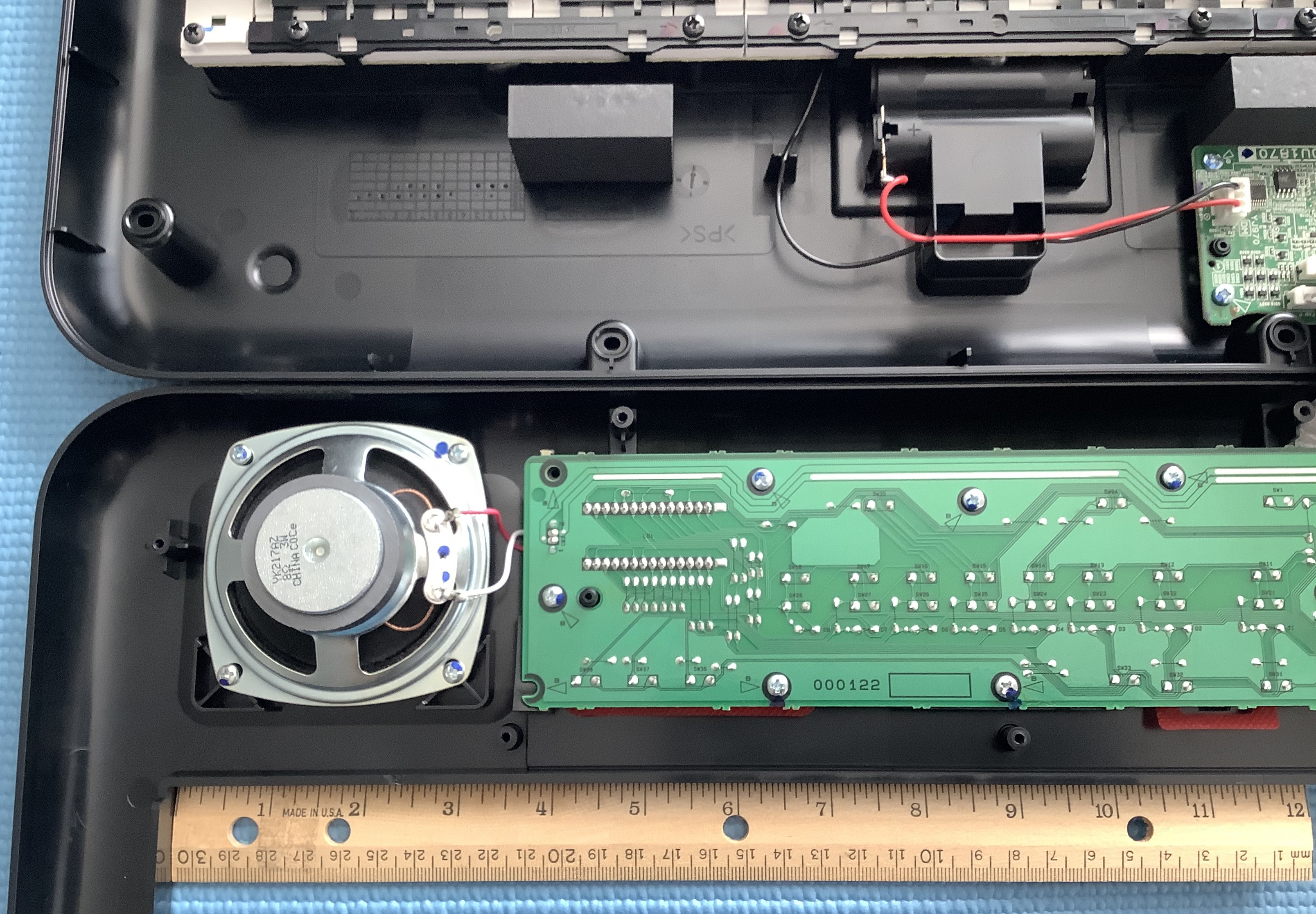
Yamaha PSS-A50 top and bottom [Click images to enlarge]

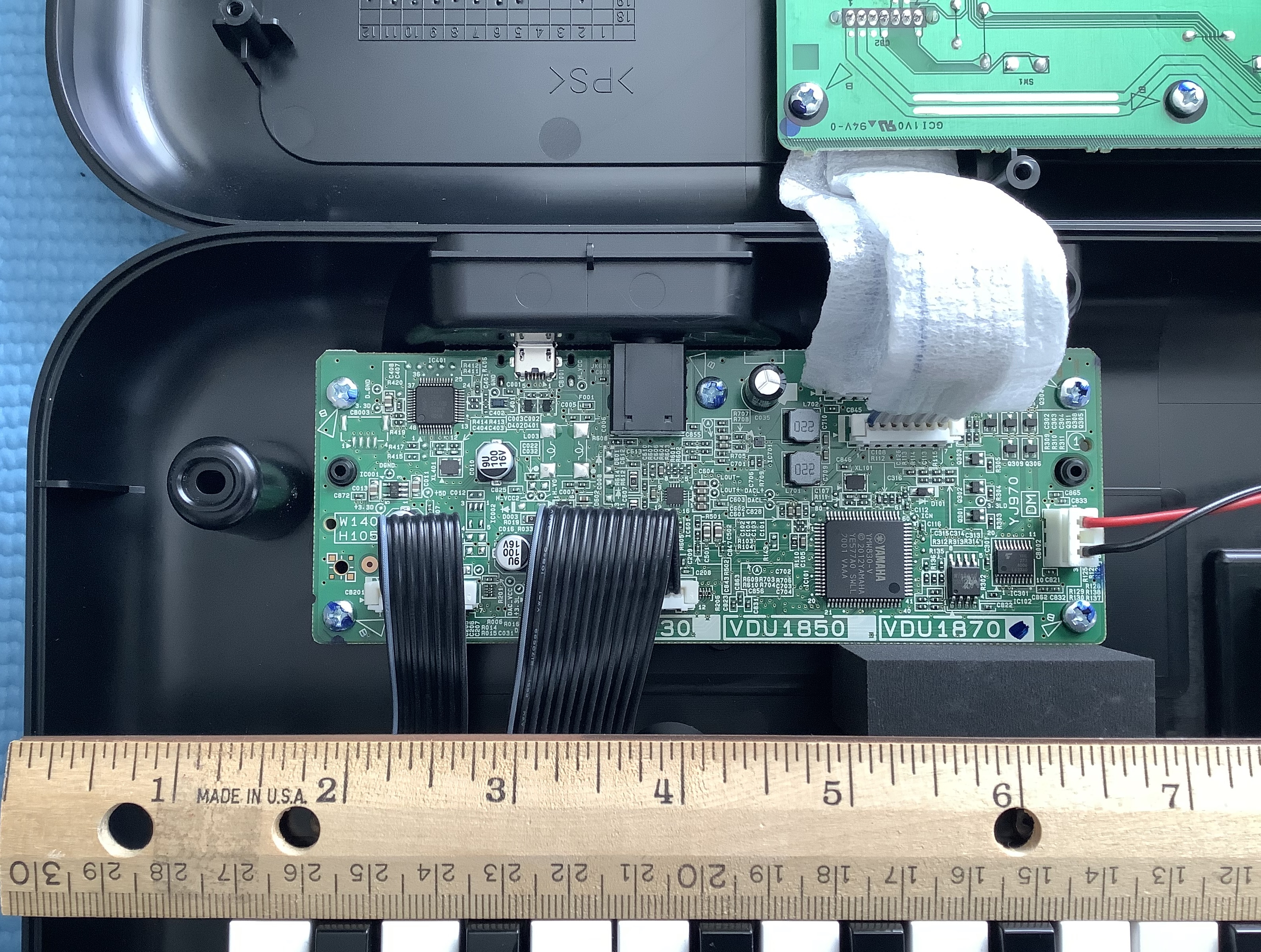
The A50 has two main boards: the digital and analog electronics board (DM) and the front panel board (PN). After removing nine screws — don’t forget the screw hidden in the battery compartment — the A50 splays into two halves: the bottom half containing the battery compartment, DM board and keybed, and the upper half containing the speaker and PN board. The battery connects to a JST XH connector on the DM board. Ribbon cables connect the keybed and the panel board to the DM board.

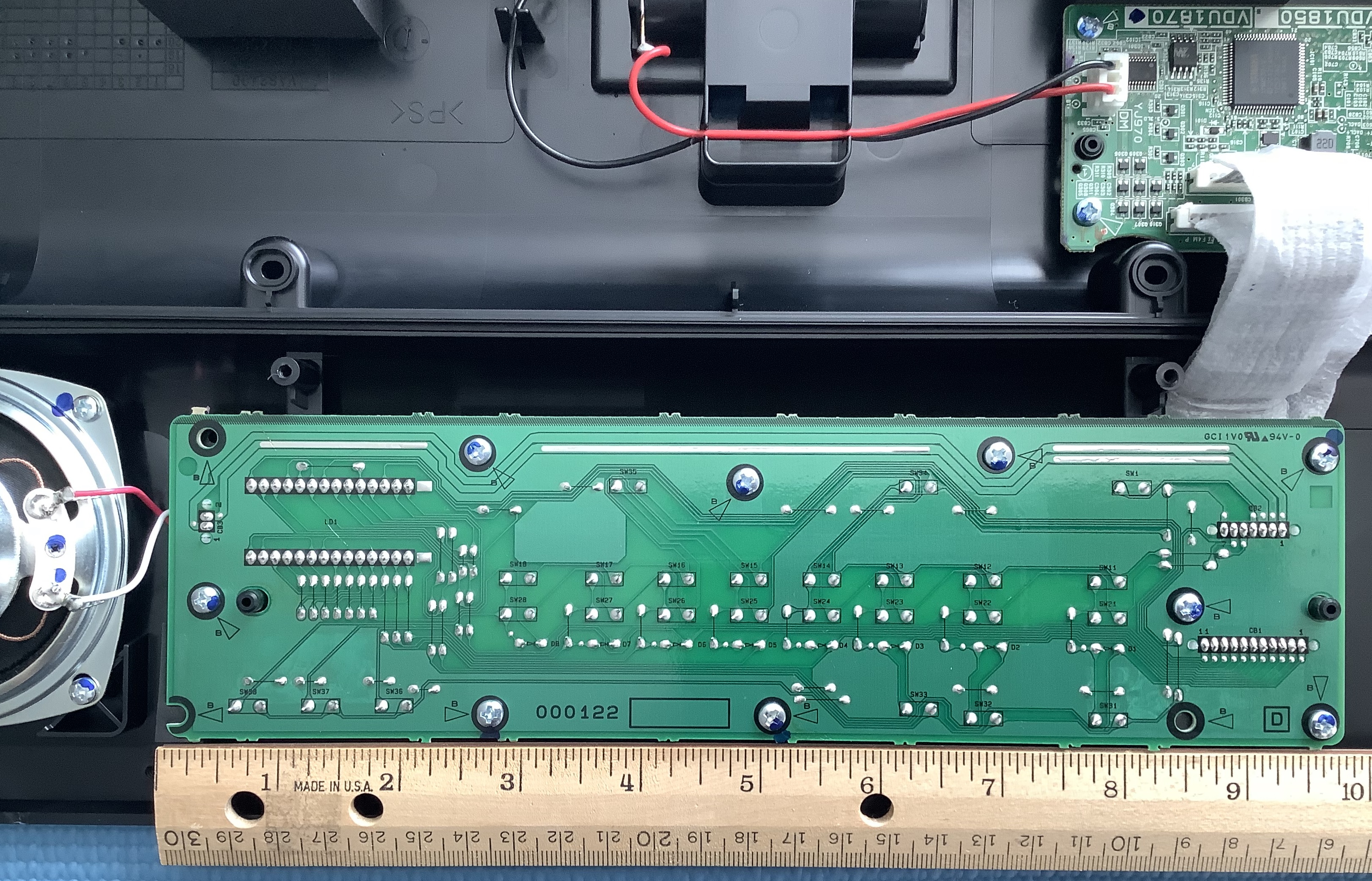
Yamaha PSS-A50 front panel board (PN)

The PN board has traces for the front panel buttons. The buttons are arranged into a 3 by 8 switch matrix: 3 drive lines and 8 sense lines. The power Standby/ON switch has two dedicated lines. The eight sense lines are shared with the three digit LED display. A further 3 lines are devoted to the display (for a total of eight lines). In addition to the front panel switch matrix, the PN board conducts audio signals to the speaker through two wide PCB traces.

I dare to say that the A50, PSS-E30 Remie and PSS-F30 have the same panel board. Only the front panel graphics and software differentiate the models in that regard.

Yamaha PSS-A50 main electronics board (DM)

The DM electronics board is tiny and is packed with surface mount (SMT) components. Impressive! The main digital components are:

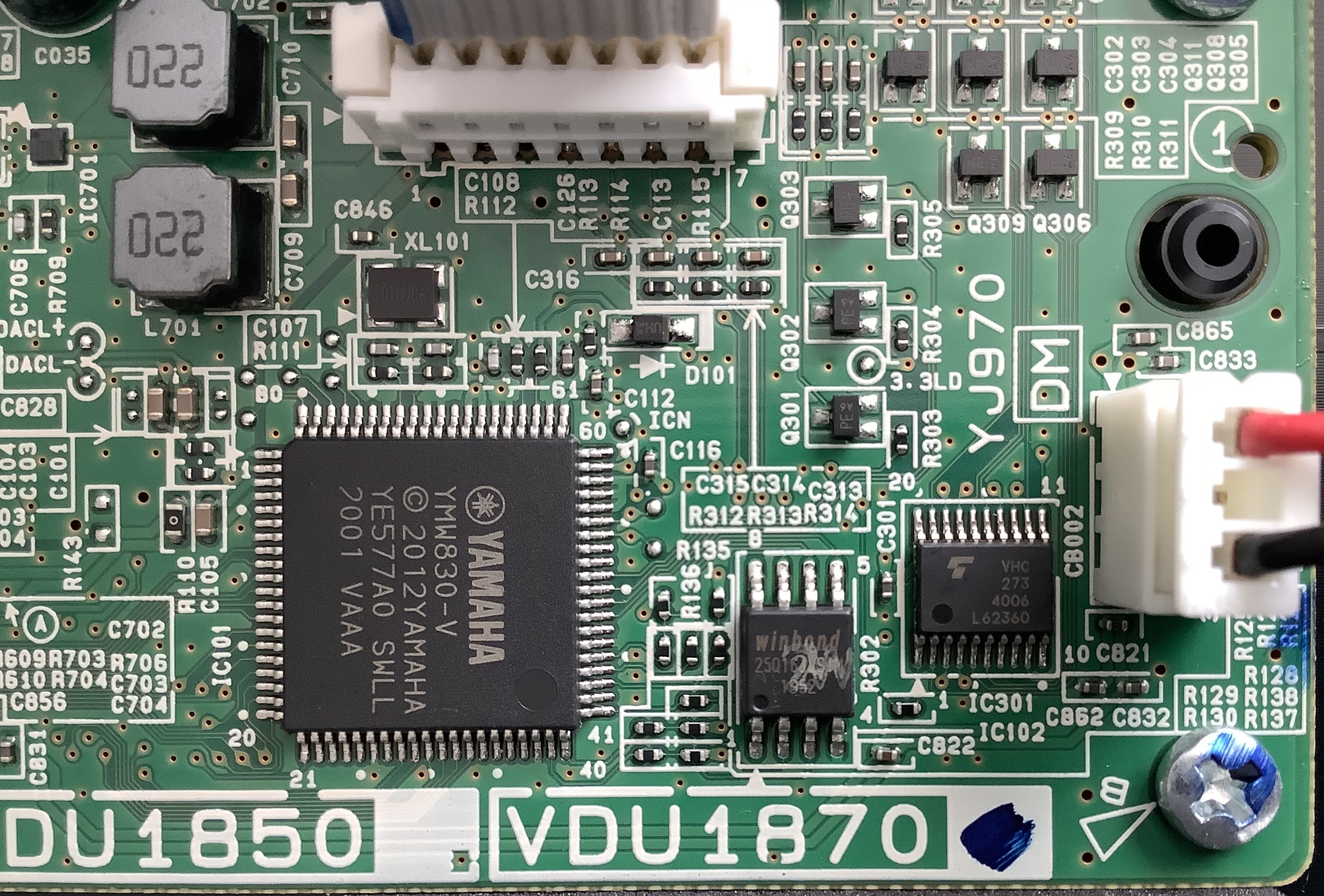
  • Yamaha YMW830-V: Processor and tone generator (IC101)
  • Winbond 25Q16JVS1M: 16Mbit Serial flash memory (IC102)
  • 74VHC273: 8-bit latch for display data (IC301)
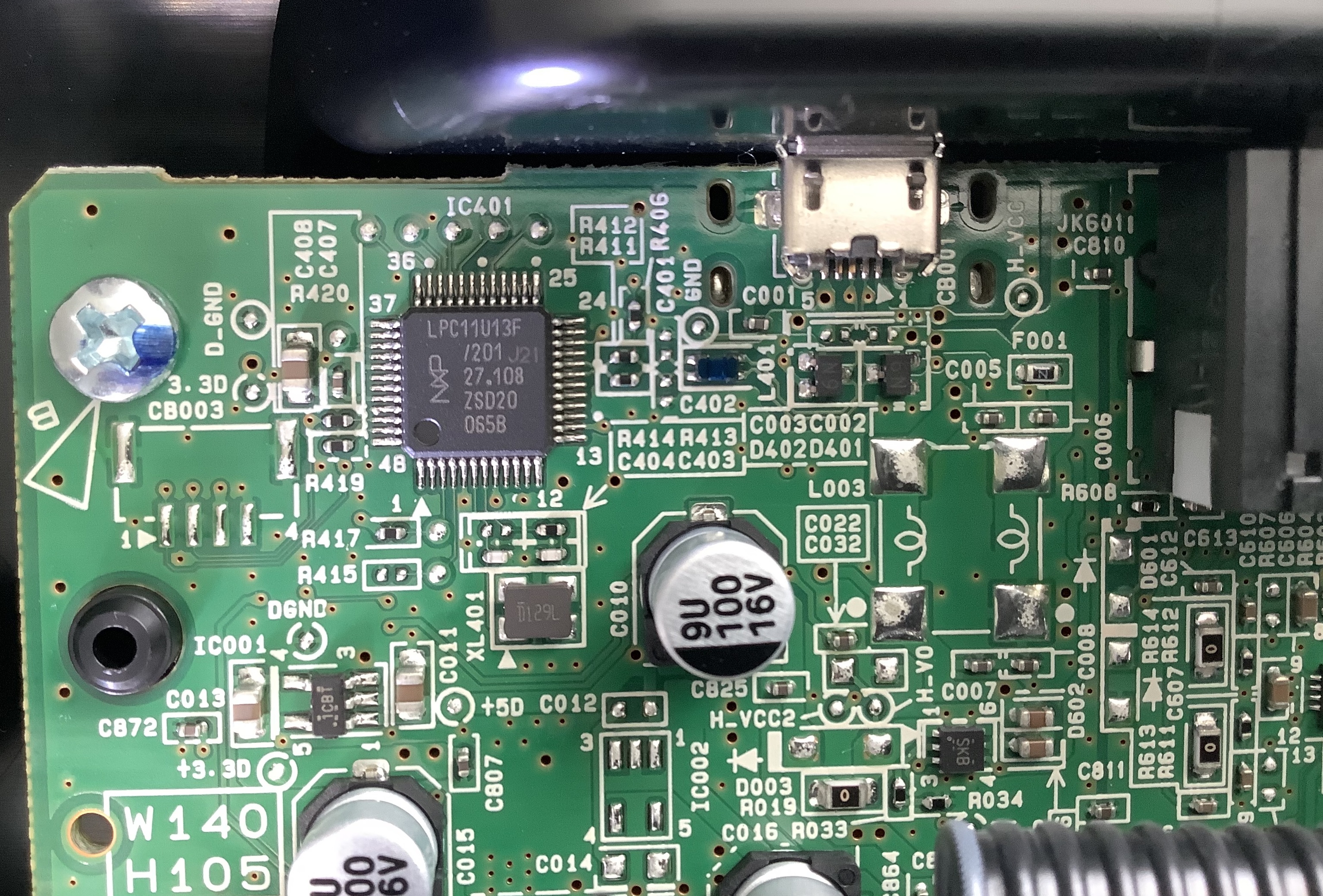
  • NXP LPC11U13F/201: USB interface (IC401)

The YMW830-V is also known as “SWLL” and is a Yamaha proprietary system on a chip (SOC). The A50 has separate amplifiers for the speaker (IC701) and headphone output (IC601):

  • TI TPA6132A2RTER: Headphone amplifier (IC601)
  • Rohm BD27400GUL: Mono class-D power amplifier (IC701)
  • NJR NJM2740M: Dual operational amplifier (IC501)

The dual operational amplifier is part of the post-DAC low pass filter. Finally, the power-related components are:

  • TI TLV74333PDBVR: 3.3V regulator (IC001)
  • TI TPS63060DSCR: Switching regulator (IC004)
  • TI TPS25200DRVR: 5V eFuse/power switch (IC006)

The A50 must choose and switch between +5V USB power and battery power. That’s the role of the eFuse/power switch component.

Yamaha PSS-A50 USB interface (NXP ARM MCU)

The NXP LPC11U13F is a bit of a surprise to me. It is an ARM Cortex-M0 32-bit microprocessor (MCU) with 24KB of flash memory. The SWLL sends and receives MIDI through its UART RX/TX ports. The ARM LPC converts simple MIDI from the SWLL to MIDI over USB. Using an ARM MCU to do the job seems like over-kill. It goes to show how far we have come as an industry when an MCU can be dedicated to such a mundane task!

Yamaha PSS-A50 CPU (Yamaha YMW830-V SWLL)

The SWLL (YMW830-V) has many of the specs that we’ve come to know about Yamaha’s entry-level CPUs. The external crystal resonates at 16.9344MHz. The SWLL internal clock is 33.8688MHz and generates a 67.7376MHz master clock. If these numbers look odd to you, simply note that they are even multiples of 44,100Hz, the basic sample rate:

    67.7376MHz = 44,100Hz * 1,536

When an external DAC is used, the master clock provides the bit serial audio clock. 1,536 can be subdivided in all sorts of interesting ways depending upon sample word length.

The SWLL integrates host CPU, memory, tone generation, serial MIDI communication, keyboard and front panel scan ports, and display ports. The digital to analog converter (DAC) is also integrated into the SWLL. The SWLL is truly Yamaha’s low-cost system on a chip solution.

The SWLL loads its software and samples from a 16Mbit serial flash ROM. 2MBytes for software and samples is not much, so one wonders if the SWLL has a preprogrammed flash memory of its own?

With the exception of the ARM LPC chip, the A50, PSS-E30 Remie and PSS-F30 electronics are identical. The software and samples determine the product personality. Such a high degree of commonality allows Yamaha to manufacture PSS keyboards (in India) and sell them at a dirt cheap price. Hats off — the amount of technology at this price — less than $100USD — is simply astounding.

Copyright © 2021 Paul J. Drongowski