DigiTech Trio needs a quick upgrade

The DigiTech TRIO is one of those product that I want to love. The basic idea is commercially viable — an assistant that learns a simple song then adds bass and drum parts. There is some smart technology and smart people behind the TRIO. It is truly innovative. (Does the world really need another distortion pedal?)

DigiTech needs to improve both the product and the customer retail experience in order to make the TRIO successful.

Here’s my experience. I read a few on-line reviews beforehand and knew that it was important to “keep it simple” when starting out with the TRIO. I did not, however, read the operations manual. A mistake, perhaps, but most potential customers do not read the manual ahead of time. Heck, they frequently do not read the manual at all.

The Guitar Center staff did not know that there is a DigiTech TRIO. They needed to look up the TRIO in the inventory database. The clerk struggled to provide power to the TRIO. No help with actual operations here.

Left alone with the TRIO, it took me several moments to suss out LEARN mode and PLAY mode. I didn’t immediately realize that I needed to hold the footswitch in order to switch modes. Even a simple graphic or hint on the front panel — “Hold to change between PLAY and LEARN mode” — would have been enormously helpful.

I’m not the greatest guitar and barely know half-a-dozen chords. I decided to start out slow and simple in LEARN mode by playing single notes in time on the low E string. I also went Ramone and played power chords. Not only didn’t the TRIO learn or add a simple bass/drum pattern in E, there was no feedback other than a blinking LED. The TRIO should at least learn the tempo and add a simple beat ASAP, even if it’s just snare taps. A simple beat would help the user to play in time and provide a measure of positive feedback. Many players are pretty bad like me and they need help.

Eventually, I gave up on LEARN mode and switched to PLAY mode. At least I was able to audition some of the backing tracks. Then, I drove home.

DigiTech need to develop and release a Mark II update — and soon. First off, the TRIO needs to store and recall songs. If a user invests a lot of effort in teaching the TRIO a song, they will want to save it for later. More importantly, storage should be preloaded with songs in the most common keys and chord progressions. For example, there should be a few simple blues I-IV-V patterns in E, A and D. There should be funk patterns like a simple ii-V (Dm-G7) or I7(#9) (E7(#9)).

Yeah, everybody hates presets. However, pre-stored songs would really help the retail experience. Lame players like me can listen to and play to sample songs even if we can’t figure out LEARN mode. Also, one common complaint in on-line forums comes from blues players who can’t wring a simple blues backing out of the TRIO. Pre-stored songs would give the end user value while they learn LEARN mode and develop backing tracks of their own.

The big insight from this experience is the need for instant gratification, most preferably without reading the manual. A musical device or instrument should do something satisfying immediately, right out of the box. That’s where the Yamaha Reface CP is such a kick. It has a live panel and the Reface CP is instant musical fun. Guitarists expect to plug in and make noise. Instant gratification in the store converts to impulse sales. The TRIO, unfortunately, is a complicated lump and the retail staff are no help.

I hope that DigiTech takes these suggestions to heart. The TRIO concept has a lot of musical and sales potential. It just needs to provide a better, immediate user experience in the store and in the studio.

Reface CP: Yes, I played one!

Finally got a chance to try a Yamaha Reface CP and a Reface DX. Given the genres of music that I play, I’m the most interested in the Reface CP and YC models. The CP and DX were on the floor at Guitar Center, so I decided to try the DX, too. I’ll catch the YC another day when it’s in stock.

As we all know, Guitar Center on Saturday afternoon is not the ideal environment for a trial. I demo’d through headphones mainly to cut out the din from the rug-rats randomly pounding on keyboards and the sonic self-stimulation from the guitar department.

Even under these degraded conditions, the CP sounds excellent. The sound is the stuff, if you know what I mean. (This is a family web site.) Quick impressions of the main sounds:

  • Rhodes I: Nice, mellow, laid back, smooth.
  • Rhodes II: Bright, snarky, barks like a dog (in the good way).
  • Wurli: Solid performer, not too polite, more Ray than Supertramp.
  • Clav: Solid performer, good body.
  • CP: Bright knife, brings make the old days without the back ache.

The effects are excellent. Dial in the drive and/or the appropriate effect and you’re good to cover:

  • Smooth Operator
  • Do It Again
  • What’d I Say
  • Higher Ground

and a whole lot more! Max out the drive and it doesn’t get that annoying digital fizziness. The wah needs to be tuned into the appropriate frequency range, but that’s SOP. The wah can be made so bright that it cuts glass and pokes holes in the eardrums. (Not a recommended practice.)

One part of Yamaha’s marketing pitch truly rings right. The CP is a “live panel” instrument. Be ready to dial everything in with no presets. Very old school and a nice change from menu diving. This kind of interactivity bodes well for the YC organ, when I finally find one.

Mini keys. Sigh. If you’re a player, then expect to MIDI the CP to a real keyboard. That said, Yamaha are right to be proud of these mini-keys. They are very responsive. I didn’t have too much trouble laying down block chords or noodling a solo line. However, three octaves is at least one octave too short for stretching out or laying down full right hand jazz chords while holding down any kind of bass. My chief adjustment problem with the mini-keys is playing left hand stride or arpeggios. You probably saw this coming, too.

Build quality is reasonably good for a small, light-weight instrument. The knobs have a solid feel. I’m somewhat less enamored of the volume slider and octave switch. They feel a little bit cheap. The toggle switches are retro in a Home Depot kind of way. Yamaha had better mind their Chinese suppliers because this board could easily degrade to trash if someone sneaks cut-rate components into it.

The built-in speakers are just OK. You’re probably going to connect the CP to a decent amp and speakers anyway.

Bottom line, the CP sound is nicely crafted. I hope to hear these sounds with this kind of interactivity in a new full-size ax soon.

I had to give the DX a try especially since I had a DX-21 back in the day. Turn on the DX and soon you’re back in 4 OP FM yesteryear. Folks in electronic genres (EDM, etc.) dig FM, but for the kind of music that I play today, I’m not ready to return to FM. If you are into FM, then you really should give the DX a try. It, too, is the real stuff.

Extra credit

It is a long drive to GC, so I tried a few other instruments, too.

I had a discussion with one of the salepeople about the CP, mentioning electric piano, jazz chords, etc. This guy was so desperate to make a sale that he insisted on trying the Roland JD-Xi. Only a Carpathian would recommend a JD-Xi to a retro-jazzer. Well, it turns out, the guys was a Carpathian — a guitar player trying to make sales in the keyboard department. Cheesh.

I did try the JD-Xi. Definitely not my cup of tea. Plus, the Yamaha HQ mini-keys really are much better than the JD-Xi.

The keyboard department had a used Tyros for sale. Yes, the original Mark I. I tried it just for grins and to see how much Tyros and mid-range PSRs have progressed over the years. Needless to say, the PSR-S950 — and definitely the newer S970/S770 — are light-years beyond the Tyros Mark I.

Finally, I gave the DigiTech Trio a try. The Trio is a stomp box accompanist. You put it in learn mode, play a rhythm pattern on guitar, and the Trio identifies the tempo and key. Then, in play mode, the Trio adds a bass and drum backing track selected from one of several genres. The Trio is based on musIQ® technology licensed from 3dB Research Ltd. Some of the backing tracks are provided by PG Music, developers of Band-In-A-Box (BIAB). (There’s quite a music technology mafia in Victoria, BC.) Harman, who own DigiTech, liked MusIQ so much that they bought 3dB Research, too.

I couldn’t teach the Trio a thing. I am a lousy guitarist, I was hungry and I definitely was tired of the sonic assault in the guitar department. The backing tracks that I heard were OK although I think BIAB itself sounds better. If you intend to try one in a store, be sure to read the manual ahead of time…

Serial memory and tone generation

Ah, September. Soon it will be time to speculate about new products at the Winter 2016 NAMM!

Every now and again, I take a pass through recent patent filings from Yamaha to get an idea about future product developments. Of course, the tech in a filing may never make it to product. However, a few common threads begin to appear over time.

This post starts with a patent application having the inauspicious title, “Sound Generation Apparatus.” This US application 2014/0123835 was filed on November 5, 2013 and is based on Japanese patent -244002, which was filed November 5, 2012.

First, a little background about the Yamaha tone generation architecture. Yamaha has used the same overall architecture for mid- and high-end workstations and tone modules since the mid-1990s. (TG-500, anyone?) These products employ one or more large scale integrated circuits for tone generation. Current versions of the tone generator IC, the SWP51L, has two dedicated memory channels for waveform data. Each channel has a 16-bit parallel data bus and a parallel address bus (24 or more bits wide). The parallel interface takes at least 40 pins per channel.

That’s a lot of incoming and outgoing connections (80 plus pins for both channels). IC packaging costs are in the range of $2.50 USD to $4.50 per pin. So, there is a direct relationship between the number of IC pins and manufacturing cost. Ultimately, this cost has a real effect on profit and the final price of the product.

The Yamaha patent application describes a serial interface for waveform memory in place of a parallel interface. The serial interface requires six pins per channel. Instead of 80 pins, the serial interface approach uses only 12, providing an 8 to 1 savings in packaging costs alone.

The application cites the Winbond 25Q series as the kind of flash memory to be supported by the serial interface. The largest 25Q device has a 64MByte capacity and can sustain a 40MByte/second transfer rate (quad SPI mode). This is nearly sufficient bandwidth to drive 128 44,100Hz stereo polyphonic voices (about 45MBytes/sec).

If you do the math that’s 128 times 44,100Hz times eight bytes. Two successive samples are required in order to perform interpolation although the oldest sample could be cached.

The product implications are interesting. At the low end of the scale (one or two channels), the device footprint is much smaller. The small size allows a corresponding decrease in the size of the product. Maybe a guitar pedal stomp box?

The high end of the scale is more intriguing. It becomes possible to build a tone generator IC with four or even eight independent channels of tone generation where each channel is driven by its own memory stream. We’re talking 1,024 polyphonic voices in the same LSI footprint as today’s SWP51L.

There are design implications for entry-level keyboard products, too. The SWL01 system on a chip (SOC) integrates both CPU and tone generator onto the same IC. Waveform data (samples) travel on the same bus as CPU instructions and data. A serial SPI interface requires only six pins and might let designers shift waveform storage from ROM on the system bus to a dedicated memory bus and channel. Software might be able to perform new tasks such as variation effects with more bandwidth available to the CPU on the system bus.

I feel confident to predict that the next generation of Standard Wave Processor (SWP) is in development. The SWP51L has been around for a while (including Tyros5). Here are a few key products and members of the SWP50 family:

    Product   Year  TG chip
    --------  ----  -------
    Tyros     2002  SWP50
    Motif XS  2007  SWP51
    Tyros 3   2008  SWP51B
    Tyros 5   2013  SWP51L

It is definitely time for a new design, not an incremental refresh.

Yamaha sees its internal integrated circuit capability as a strategic advantage. Up to this point, Yamaha have both designed and fabricated its own ICs. Last year, Yamaha transferred its fabrication line to Phenitec Semiconductor. Yep, Yamaha has gone fabless. This gets a huge capital expense off its balance sheet. It also means that Yamaha is under less pressure to reuse the same parts across product lines in order to get its IC manufacturing volume up. This is one reason why the SWP51 has had such long legs and why the SWL01 is used across all of the E-series arrangers. Volume, volume, volume! The pressure to (re)use Yamaha’s own IC solutions has been reduced.

We’ll see if Johnny can read (defenses) against Dick LeBeau. Go Browns!

XG effects: SYSTEM mode

The last time that I took a look at Yamaha XG effects, I discussed using the VARIATION effect as a channel insertion effect. I’m now working on a PSR/Tyros style where I would like to apply an amp simulation effect to two channels. So, it’s time to learn about the configuration of VARIATION effects in SYSTEM mode. Even though I’m working on a style, you can apply these techniques to any Standard MIDI File (SMF) for play-back on an XG sound engine.

XG insertion effects are relatively easy to configure as the VARIATION effect is added to the signal chain of a single MIDI channel (XG part). Configuration of the VARIATION block as a SYSTEM effect takes more effort (i.e., more System Exclusive messages), but is well worth it. Now that I understand SYSTEM mode better, I may set up a DAW template for SYSTEM mode and use that template as my default effect configuration.

The diagram below shows the signal flow for the VARIATION, CHORUS and REVERB effect blocks when VARIATION is configured for SYSTEM mode. I show only one channel (Part NN) entering from the left in order to keep the diagram simple. Control “knobs” are drawn as ovals; these are XG/MIDI parameters under your control. The first four knobs — CC91, CC93, CC94 and DRY — are per-part parameters and need to be set for each of the sixteen channels (parts). The MIDI Continuous Controller (CC) knobs set the reverb, chorus and variation send levels for the part, respectively. In my project, I set the variation send (CC94) for two parts to non-zero levels and set CC94 for the remaining parts to zero. The non-zero levels pass the signal to the VARIATION block.

XG_System_Mode

The reverb, chorus and variation send levels are configured using MIDI Continuous Controller messages, but the DRY level is set using an XG System Exclusive (SysEx) message. Although this looks inconsistent, it follows Yamaha’s XG recommendations, i.e., use CC messages in preference to SysEx where possible. DRY level must be controlled using SysEx as no corresponding MIDI CC message is defined.

Please see the table at the end of this post for further message programming details.

The rest of the effect blocks and knobs are global (system-wide). The REVERB, CHORUS and VARIATION return levels (REV RET, CHO RET, and VAR RET) along with the DRY levels determine the amount and balance of effected and un-effected (dry) sound. All of the return levels default to 0dB (decimal 64 or 0x40 in hexadecimal notation). The default for each per-part DRY level is the maximum (decimal 127 or 0x7F). These default values enable signal flow right from the beginning and are a good starting point for experimentation and tuning. At least you are guaranteed to get some sound out of the effect section!

The VARIATION, CHORUS and REVERB blocks need to be configured through the usual XG SysEx voodoo. You need to select at least the effect type and be sure to configure the VARIATION effect for SYSTEM mode. In actual practice, you should do this before setting any send levels as the change to SYSTEM mode changes the level parameters to new default values.

Now the fun begins! The default configuration puts the three effect blocks in parallel. The inter-block send levels:

  • Send VARIATION to CHORUS (VAR to CHO)
  • Send VARIATION to REVERB (VAR to REV)
  • Send CHORUS to REVERB (CHO to REV)

establish serial effect routings between blocks. The level values determine the degree to which a series connection is made (i.e., how much signal is passed). Initially, all of these knobs are set to zero and the effects are full parallel. You can change these values to add reverb and/or chorus to the effected variation signal, for example, in the same way that you add reverb and/or chorus to a part.

The higher end arranger workstations offer a rich choice of CHORUS block effects — everything from chorus, phaser and flange to rotary speaker. Thus, you can create a long effect chain from VARIATION to CHORUS to REVERB, if you so desire. Want to phase a distorted guitar sound? You can!

The following tables summarize the low level details of effect programming. The addressable XG parameters must be set with the usual SysEx magic, e.g., F0 43 10 4C 02 01 40 4B 01 F7 to set the effect type.

Continuous Controller (Per part/channel)                    "Knob"

  CC91  Part/Channel REVERB SEND                            (CC91)
  CC92  
  CC93  Part/Channel CHORUS SEND                            (CC93)
  CC94  Part/Channel VARIATION SEND                         (CC94)

MULTI PART (per part/channel NN)

  Address   Parameter             Default
  --------  --------------------- -------
  08 NN 11  DRY LEVEL             0x7F                      (DRY)
  08 NN 12  CHORUS SEND           0x00
  08 NN 13  REVERB SEND           0x28 (decimal 40)
  08 NN 14  VARIATION SEND        0x00

REVERB effect block (global)

  Address   Parameter             Default
  --------  --------------------- -------
  02 01 00  REVERB TYPE           0x01, 0x00 (HALL1)
  02 01 0C  REVERB RETURN         0x40 (off:0x00, 0dB:0x40) (REV RET)
  02 01 0D  REVERB PAN            0x40 (center)

CHORUS effect block (global)

  Address   Parameter             Default
  --------  --------------------- -------
  02 01 20  CHORUS TYPE           0x41, 0x00 (CHORUS6)
  02 01 2C  CHORUS RETURN         0x40 (off:0x00, 0dB:0x40) (CHO RET)
  02 01 2D  CHORUS PAN            0x40 (center)
  02 01 2E  Send CHORUS to REVERB 0x00 (off, 0dB:0x40)      (CHO to REV)

VARIATION effect block (global)

  Address   Parameter             Default
  --------  --------------------- -------
  02 01 40  VARIATION TYPE        0x05, 0x00 (DELAY LCR2)
  02 01 56  VARIATION RETURN      0x40 (off:0x00, 0dB:0x40) (VAR RET)
  02 01 57  VARIATION PAN         0x40 (center)
  02 01 58  Send VAR to REVERB    0x00 (off, 0dB:0x40)      (VAR to REV)
  02 01 59  Send VAR to CHORUS    0x00 (off, 0dB:0x40)      (VAR to CHO)
  02 01 5A  VARIATION CONNECTION  0x00 (insert:0, system: 1)
  02 01 5B  VARIATION PART #      0x7F (off: 0x7F)

Arranger memory: One more time!

OK, OK, not everyone reads service manuals and schematics for their keyboard. However, I do get a little frustrated when posters compare apples to oranges, and make statements like “I can buy 1GByte for $1 (USD), so why is Yamaha so stingy with wave memory?”

Here is some information from the S750/S950 and Tyros5 service manuals and product data sheets. Please keep in mind that there are many different kinds of memory in an arranger. I’m going to focus on tone generation because that is the most relevant to wave memory size.

Both the S750/S950 and Tyros5 use proprietary Yamaha tone generator integrated circuits designated “SWP51L”. The S750/S950 designs use one SWP51L and the Tyros5 has two SWP51L chips. Each SWP51L has two dedicated memory ports (called “HIGH” and “LOW”) where each port consists of an address bus and a 16-bit parallel data bus.

In the S750/S950, each port is connected to a WAVE ROM:

    S750 WAVE ROM-L 1Gbit IC308   JS28F00AM29EWLA
    S750 WAVE ROM-H 1Gbit IC302   JS28F00AM29EWLA

That’s 128MBytes per device for a total of 256MBytes (2 times 128MBytes).

The Tyros5 microarchitecture is a little more complicated — the memory devices are shared between two SWP51Ls via separate shared address and data busses. There are six WAVE ROM integrated circuits:

    Tyros5 WAVE ROM-L0 1Gbit IC702   S29GL01GS10TFI020
    Tyros5 WAVE ROM-H0 1Gbit IC716   S29GL01GS10TFI020
    Tyros5 WAVE ROM-L1 1Gbit IC703   S29GL01GS10TFI020
    Tyros5 WAVE ROM-H1 1Gbit IC717   S29GL01GS10TFI020
    Tyros5 WAVE ROM-L2 1Gbit IC704   S29GL01GS10TFI020
    Tyros5 WAVE ROM-H2 1Gbit IC718   S29GL01GS10TFI020

That’s a total of 768MBytes (6 times 128MBytes).

Those cryptic names in the tables above identify the specific memory component. The components come from two vendors: Micro Technology and Spansion. Here are the gory details.

    Micron Technology JS28F00AM29EWLA  56-pin TSOP
        Parallel NOR Flash Embedded Memory
        Configurable width data bus (8- or 16-bits)
        Asynchronous random/page read
            Page access speed: 25ns
            Random access speed: 110ns
            Page size: 16 words or 32 bytes

    Spansion S29GL01GS10TFI020 56-bit TSOP

        GL-S MirrorBit Eclipse Flash Non-Volatile Memory
        S29GL01GS 1 Gbit (128 Mbyte)
        16-bit parallel data bus
        Asynchronous 32-byte page read
            Page access speed: 25ns
            Random access speed: 100ns
        Program and erase rates (i.e., write speed)
            Buffer Programming (512 bytes) 1.5 MB/s
            Sector Erase (128 kbytes) 477 kB/s

The read speed (25ns per 16-bit word in page mode) is much faster than write speed, and that’s OK in this application because the data is always read once it’s loaded/initialized. The SWP51L probably operates in page mode since the samples are accessed sequentially. Dunno ’bout you, but 25 nanoseconds per 16-bit word is darned fast. The access speed is MUCH higher than a typical USB flash drive.

Two 27-bit address busses and two 16-bit data busses are sent to/from the plug-in expansion board. These busses extend the two shared WAVE ROM busses. The expansion board needs to keep up with the high read rate.

Please note that the CPU does not get anywhere near the sample streams. That work is assigned to the SWP51Ls.

Hope this helps to clarify.

Crunchin’ da drums

In my last post, I discussed Motif/MOX eight zone (8Z) drum kits. The eight zone concept lets you assemble eight different percussion sounds into a custom kit. The waveforms are assigned to voice elements and are stretched/limited to eight different keyboard (MIDI note) zones. The Motif/MOX have matching arpeggios that work with the 8Z kits.

By the way, the 8Z drum kits were first introduced with the Motif XS. My notes on the 8Z kits and this note on effects apply to all later models including the Motif XF and MOXF.

If you have ever tried the percussion sounds alone without effects, the drum sounds are kind of “plain Jane” without a lot of impact. This post deconstructs a couple of effects which can be applied to break beats and other styles that require crunch and animation.

The first effect chain is taken from the Voice PRE8:060 “8Z Romps.” The voice has two insert effects connected in series. INSERT A is a Lo-Fi algorithm with the following parameters (effect preset “Max Lo-Fi”):

    #  Parameter              Value    Numeric
   --  ---------------------  -------  -------
    1  Sampling Freq Control  4.01KHz  (10)
    2  Word Length            93       (93)
    3  Output Gain            +7 dB    (14)
    4  LPF Cutoff             20.0KHz  (60)
    5  Filter Type            Radio    (2) 
    6  LPF Resonance          10.0     (100)
    7  Bit Assign             2        (2)
    8  Emphasis               On       (1)
   10  Dry/Wet                D<W63    (127)
   15  Input Mode             Stereo   (1)

The parameter number, name, values, etc. are taken from the MOX Data List. (See the section titled “Effect Parameter List” in the PDF file). The numeric values — given here in decimal — are what you need to program the effect through System Exclusive MIDI messages. More about this in a minute.

The Lo-Fi effect adds a lot of crunch and crush. But, wait! There’s more. The INSERT B effect is the AmpSim 1 amp simulator. Its parameters are:

    #  Parameter              Value    Numeric
   --  ---------------------  -------  -------
    1  Over Drive             54%      (54)
    2  Device                 dst1     (2)
    3  Speaker                Combo    (2)
    4  Presence               +10      (10)
    5  Output Level           34%      (34)
   10  Dry/Wet                D<W63    (127)

This is the “Beat Crunch” effect preset.

Please remember that my goal is to use the 8Z break beats in a PSR/Tyros style. In order to do accomplish this, I found the equivalent effects algorithms for the Yamaha PSR-S950 arranger workstation. Here are the equivalent algorithms:

    MOX            PSR-S950
    --------       -----------------------------
    Lo-Fi    --->  Lo-Fi DRUM1 (MSB:94 LSB:18)
    AmpSim 1 --->  V_DIST CRUNC (MSB:98 LSB:18 )

Unfortunately, the XG effects architecture supports at most one system-wide variation effect or one per-part insert effect. So, I decided to use the Lo-Fi algorithm because it seemed to provide most of the grit and nastiness that I was seeking.

It took a little detective work to find and match up the corresponding effect algorithms between the Motif/MOX and the PSR/Tyros. The effect type is enough to get into the same neighborhood. The rest of the sleuthing involves comparing the parameter lists in order to find the exact (or best) match. The MOX has Virtual Circuit Modeling (VCM) effects and the S950 does not. Therefore, you may not always be able to find an exact match.

With the S950 Data List in hand, I translated the effect parameters into the hexadecimal System Exclusive (SysEx) messages to configure the Lo-Fi effect on the PSR:

    F0 43 10 4C 02 01 40 5E 12 F7   Variation Type
    F0 43 10 4C 02 01 5A 01 F7      Variation Connection (SYSTEM)
    F0 43 10 4C 02 01 42 00 0A F7   PARAMETER 1 Sampling Freq Control (10)
    F0 43 10 4C 02 01 44 00 5D F7   PARAMETER 2 Word Length (93)
    F0 43 10 4C 02 01 46 00 0E F7   PARAMETER 3 Output Gain (14)
    F0 43 10 4C 02 01 48 00 3C F7   PARAMETER 4 LPF Cutoff (60)
    F0 43 10 4C 02 01 4A 00 02 F7   PARAMETER 5 Filter Type (2)
    F0 43 10 4C 02 01 4C 00 64 F7   PARAMETER 6 LPF Resonance (100)
    F0 43 10 4C 02 01 4E 00 02 F7   PARAMETER 7 Bit Assign (2)
    F0 43 10 4C 02 01 50 00 01 F7   PARAMETER 8 Emphasis (1)
    F0 43 10 4C 02 01 54 00 7F F7   PARAMETER 10 Dry/Wet (127)
    F0 43 10 4C 02 01 74 01 F7      PARAMETER 15 Stereo  (1)

I configured the effect as a system-wide variation effect such that multiple percussion parts may be sent to the effect. I inserted the SysEx messages into the set-up measure of the PSR style file using SONAR (my usual DAW/sequencer). Yow, the difference between the percussion sounds without and with this effect is like night and day!

The MOX insert effects are followed by a system-wide Tempo Cross Delay effect (effect preset “4beat Echo”). This effect adds a nice bit of animation to the overall sound. The MOX effect parameters are:

    #  Parameter              Value    Numeric
   --  ---------------------  -------  -------
    1  Delay Time L>R         4th      (11)
    2  Delay Time R>L         8th.     (10)
    3  Feedback Level         16       (80)
    4  Input Select           L        (0)
    5  Feedback High Dump     0.5      (5)
    6  Lag                    0ms      (64)
   10  Dry/Wet                D<W63    (127)
   13  EQ Low Frequency       250Hz    (22)
   14  EQ Low Gain            0dB      (64)
   15  EQ High Frequency      4.0KHz   (46)
   16  EQ High Gain           0dB      (64)

The equivalent S950 effect is TEMPO CROSS1 (MSB:22 LSB:0). I assigned this effect to the system-wide CHORUS block.

Here are the S950 (XG) SysEx messages to configure the delay effect in the CHORUS block:

    F0 43 10 4C 02 01 20 16 00 F7  Chorus Type TEMPO CROSS1
    F0 43 10 4C 02 01 22 0B F7     PARAMETER 1 Delay Time L<R     (11)
    F0 43 10 4C 02 01 23 0A F7     PARAMETER 2 Delay Time R<L     (10)
    F0 43 10 4C 02 01 24 50 F7     PARAMETER 3 Feedback Level     (80)
    F0 43 10 4C 02 01 25 00 F7     PARAMETER 4 Input Selection    (0)
    F0 43 10 4C 02 01 26 05 F7     PARAMETER 5 Feedback High Dump (5)
    F0 43 10 4C 02 01 27 40 F7     PARAMETER 6 Lag                (64)
    F0 43 10 4C 02 01 2B 7F F7     PARAMETER 10 Dry/Wet           (127)
    F0 43 10 4C 02 01 32 16 F7     PARAMETER 13 EQ Low Frequency  (22)
    F0 43 10 4C 02 01 33 40 F7     PARAMETER 14 EQ Low Gain       (64)
    F0 43 10 4C 02 01 34 2E F7     PARAMETER 15 EQ High Frequency (46)
    F0 43 10 4C 02 01 35 40 F7     PARAMETER 16 EQ High Gain      (64)

A little bit of delay on a busy drum part goes a long way. The send level (not shown here) is relatively low — just enough to add a little animation to the sound without creating a lot of clutter. It sounds OK, but I might adjust the send level dynamically and add more delay to exposed parts like the break while keeping the MAIN sections clean.

I hope this short effects clinic helps you out!

MOX interview: Follow up

Here’s a quick follow up after my interview with Yamaha marketing.

First, the word “conversation” is a better description than “interview.” I had a really enjoyable, high-bandwidth conversation with fellow gear-heads. What could be better than that? The Yamaha team members are friendly, extremely knowledgeable and open. They are also good listeners and had read my pre-interview MOX retrospective.

So, thanks to Yamaha for listening!

I also learned some things that I intend to put into practice going forward. We discussed how I created the voices that I use on my church gig and the issue of sound dropping across voice changes in MOX Voice Mode. One way to avoid sound cut-off is to use Song Mode instead of Voice Mode. Assign a voice to each part in Song Mode and then select parts on the fly. I’ll have to give this a try. I also want to experiment with the assignable knobs for drawbar control and Song Mode may be part of this solution, too.

Since the conversation was relatively short — about 25 minutes with my MacBook Air crashing due to a thermal overload part way through (Yikes!) — I went blank on some of the reasons and history for my work style. For example, I created the voices for the church gig through the front panel and didn’t use either the PC- or iPad-based editors. I since reconstructed my mind-set from way-back-when. I’m sure that I was sooooo anxious to use the MOX at the gig that I just dove into the front panel. I had programmed a TG-500 back in the day and the Yamaha voice architecture was still familiar to me. (The Motif/MOX effects structure is way easier to understand than the old TG, thankfully.) The last thing I needed was a software editor to get between me and the gig!

I didn’t have an iPad when I bought the MOX6 and wasn’t aware of the Yamaha apps for Motif/MOX. The apps — once I learned about them — motivated me to budget for and to buy the iPad. Aside from Web-browsing and e-mail, my iPad is almost entirely devoted to music-making tools (no cat videos). I have both Cubasis and Mobile Music Sequencer (MMS) installed. MMS gets used; Cubasis not so much. Cubase is one of those tools that I want to learn — kind of like my current explorations in Ableton Live.

Starting today, I would use the iPad apps. Heck, I should (would) check out the Yamaha PC-based editor and the fine Motif/MOX tools by John Melas.

Well, there you have it. A positive experience all the way around!

If you’re curious about how I use the MOX for content creation, please check out the following posts and pages:

Yamaha Reface (No, I haven’t played it)

It’s Internet de rigueur to comment on the new Yamaha Reface keyboards — whether you’ve played them or not! So, here goes…

I’m in fat city with an original AN-200 (Prophet-5 plus beat machine in a box), a P-50m (pianos in a box), a CS-01 (monophonic analog synthesizer) and a Nord Electro 2. Although a few of these pieces are gathering dust, they pretty much cover the sonic territory of Reface. DX-wise, I had more than enough FM in the 80’s, thank you, and could always get my old CE-20 repaired, if the urge to frequency modulate should ever overcome me again. Overall, I’m unlikely to take the plunge and buy a Reface keyboard just out of necessity.

First off, I genuinely wish Yamaha all the success in the world with these products. This is the first time that Yamaha have strayed from the AWM2 mainstream in some years. I would hate to see this innovative product line tank and make Yamaha risk-averse. The Reface product line started out as an after-hours skunk works engineering project. The fact that Yamaha committed to manufacturing and marketing Reface is significant and shows real effort to shift their corporate culture. Further, if Reface makes scads of money for Yamaha, then its profits will lift other boats within Yamaha.

Sonically, Reface sounds pretty darned good. The CP and YC are my favorites because they fit with the musical genres that I work in. I hope that some of this technology will migrate into future synthesizer and arranger workstation products. Spectral Component Modeling (which includes Virtual Circuit Modeling) grew from VL technology. The VCM effects in the MOX/Motif are quite good, so please give me more of that! I am pleased to see Yamaha work on organ emulation and would like to see the drawbar control, vibrato/chorus and rotary speaker effects in a new workstation. Both the Motif/MOX and higher-end arrangers are missing the Hammond “vibrato scanner” effect — a significant omission.

So, why am I not buying? Apparently, “mini” keyboard sales are making money for Novation and others, and Yamaha wants a piece of this market. The decision to use mini-keys strongly bifurcates the marketplace — you either like (accept, tolerate) mini-keys or you don’t. I’m a “don’t.” I have tried mini-keys in the past and, well, no thanks. This is not an “anti-Yamaha” position — I lost all interest in the Korg Odyssey, for example, when I learned that it had mini-keys.

The Reface is touted as a portable, take-it-anywhere keyboard. If you’ve been reading this blog, then you know that I’ve put together a portable rig based on the Korg Triton Taktile (TT.) The TT has 49 full-size keys and is not much bigger or heavier than a Reface. The TT key bed is excellent and four octaves is enough room to roam. Although the TT is missing the up-to-date tone generation and effects technology in Reface, it’s a very playable alternative to Reface.

Finally, there is the issue of the $500 street price. I suspect that Yamaha is looking to make a few extra bucks from the early adopters. Korg may have pursued the same strategy with the TT. They brought the TT out at a higher street price and then eventually reduced the price to the current $350 USD. The TT comes with a superb bundle of software plug-ins and offers, making it a terrific bargain. Unfortunately, for Yamaha, this is the competition facing Reface (pun intended) and a $500 street price looks mighty steep for an ax with mini-keys and no free software incentives.

Internet reaction from Reface detractors has been vehement — far over the top, in my opinion. It seems like some people have taken Reface as a personal affront! Please, settle down. Yamaha is a big company and they will surely roll out new products for the rest of us. The Motif refresh is overdue, for example, and must be in the works. It’s good to see Yamaha releasing new products that are out of its mainstream offerings. All the best!

Free DJX-II styles/patterns for PSR/Tyros

Once upon a time (around the year 2000), Yamaha was into beat boxes and other spiffy tools for creating dance, hip hop, and other forms of “electronic” music. The DJX-II groove machine was an entry-level keyboard designed for budding DJs and musicians. It combined a funky looking 61-key keyboard, pattern-based sequencer and basic sound engine into an all-in-one, battery-powered instrument with built-in amplifier and speakers. Genres included techno, trance, garage, hip hop, old skool and trip hop.

DJX-II

The musician or DJ could select from 70 preset patterns, each pattern with ten variations. The variations were further categorized into six MAIN patterns and four FILL patterns. The keyboard was divided into five 12-key zones where each octave performed a specific performance function. One of the zones selected the current variation allowing the player to switch between pattern variations. Another zone transposed the pattern into the current root key.

Yamaha still makes the original DJX-II patterns available through its support site. Each of the files is a standard MIDI file (SMF) containing a single pattern. Although they are in SMF format, the files are not immediately useable. The rhythm tracks are programmed for some truly ancient and arcane Yamaha drum kits, none of which adhere to GM or XG layout conventions. Further, the files cannot be imported and played as an arranger workstation style, i.e., they do not contain the information and format needed by a PSR/Tyros style.

Last December, I developed a process for converting a DJX-II pattern file to a PSR/Tyros style file. I wrote and posted an earlier article on the DJX-II style format and conversion process. I then got to work and converted fifteen patterns to PSR/Tyros style format.

The patterns are all on the jazz tip and they include some pretty hip chord changes! I quickly found that I needed to transcribe the chord changes and bass lines in order to play along. I used Sibelius First to notate the MIDI data in each pattern and saved the lead sheets in PDF files. Knowing the changes makes jamming easier and a lot more fun.

At long last, I’m ready to distribute the converted patterns. Here is a link to the the ZIP file. The ZIP file contains fifteen style files (one for each DJX-II pattern), fifteen PDF lead sheets and a README.TXT file with performance tips.

Update: Check out version 2 of the DJX-II style collection. It’s still free!

I strongly recommend reading the README.TXT file before using the new styles. The converted patterns behave like the new Yamaha DJ styles on the PSR-S670. You only need to play a single note in the left hand accompaniment. No chords are necessary because the chord progressions are cooked into the patterns. The note sets the root note for the progression and the arranger and DJ style take over from there.

Current and recent workstation arrangers should play these styles without problem, save the occasional kit or voice substitution. Good news for musicians with entry-level models (e.g., PSR-E443) as the style files are SFF1 and no OTS. Thus, entry-level arrangers should load and play these pattern styles, too.

Please enjoy playing with these “DJ styles.” In terms of the future, the DJX-II trip hop styles are genuinely sick and I hope to convert them one of these days!

What’s in a name?

Anything that we want to go from just a beginner to a pro,
You need a montage (montage)
Oh, it takes a montage (montage)
Team America Lyrics

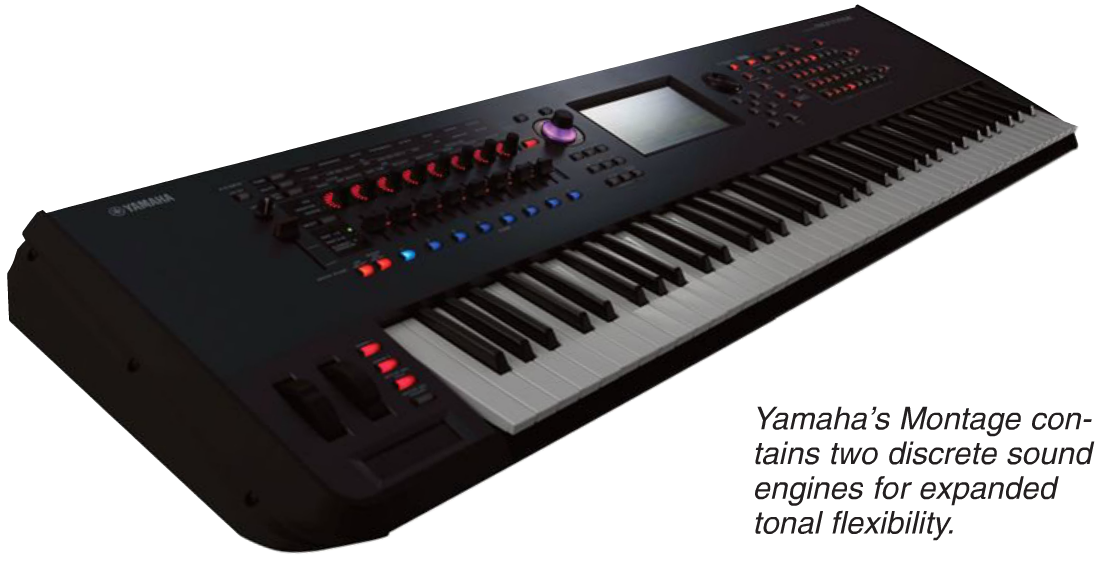
Back in January before Winter NAMM 2015, there was a lot of speculation about a new Yamaha workstation to replace the venerable Motif product line. Yamaha filed for the trademark name “Montage” in December 2014 and many wondered if this would be the name of the new workstation. (Yamaha have a teaser ad for “Reface” at https://www.yamahasynth.com with a countdown clock leading up to Summer 2015 NAMM week. Your guess is as good as mine!)

Getting a little bit Zen for a moment, it doesn’t matter what a thing is called. All that matters is what the thing is.

Periodically, I troll the United States Patent and Trademark Office (USPTO) database for interesting patents and patent applications. Yamaha carefully (and wisely!) protects its inventions through patents. Yamaha R&D, by the way, rarely publishes in the scientific literature, which is another way to stake your ground. Patent protection is stronger legally. A patent costs money, so a corporation is usually serious about a technology when it makes the commitment to file. The Yamaha patent applications cite Japanese applications/patents to establish priority in the United States. Thus, there is usually an existing Japanese application or patent that was filed at an earlier date for each US application.

Of course, a patent does not necessarily indicate that a product will follow. However, I’ve noticed a trend in some (relatively) recent filings by Yamaha.

Let’s start with US Patent Application Publication 2013/0305902, “Accompaniment Data Generating Apparatus,” published November 21, 2013. Quoting the application, “An object of the present invention is to provide an accompaniment data generating apparatus which can generate automatic accompaniment data that uses phrase waveform data including chords.” This rather lengthy patent application describes a musical instrument keyboard that uses audio waveforms in the same way that an arranger or Motif-series workstation uses MIDI phrases (AKA arpeggios). The application cites Japanese Patent Publications No. 2900753 (MIDI-based accompaniment) and No. 4274272 (MIDI-based arpeggio performance) as prior art.

US Patent Application Publication 2013/0047821 (published February 28, 2013) covers similar ground. This application adds waveform pitch shifting and time stretching. It cites Japanese Patent Publication No. 3397082 on the specific capability of pitch shifting and time stretching. Audio phrases (waveforms) need to be transposed via pitch shifting and must fit into the rhythm via time-stretching.

US Patent Application Publication 2013/0305907 (published November 21, 2013) is related to the previous two application. It covers production of chords using audio waveforms, guided by chord root and chord type.

US Patent Application Publication 2014/0033902 (published February 6, 2014) is titled “Technique for Analyzing Rhythm Structure of Music Audio Data.” The technique described in this application identifies the beat positions and intervals in a piece of music in audio form (i.e., rhythm pattern analysis). Figure 1 shows the embodiment (design) of the technique within an accompaniment generation system. The beat position information is used to synchronize playback of both MIDI and audio phrases. The diagram shows a “MIDI reproduction section” and an “Audio reproduction section.”

The most recent publication is 2015/0154979 (June 4, 2015) and is titled “Automated Performance Technology Using Audio Waveform Data.” The application deals with a specific issue that arises when audio waveforms are used for accompaniment (pitch shifting and time stretching). Quoting the application, “it is an object of the present invention to properly deal with a processing delay and sound quality deterioration that are likely to occur when audio waveform data is reproduced with time axis expansion/contraction control performed on the audio waveform data in accordance with a desired performance tempo.”

These are long documents with a lot of detail expressed in excrutiating “patent language.” They are too long and detailed to summarize here. I recommend downloading the patent applications from the USPTO, brewing coffee, and then reading the applications.

Looking at the overall trend, Yamaha are thinking about automated accompaniment that incorporates both MIDI and audio phrases. This technology could be applied to arranger instruments or a new generation of synthesizer workstation. The latest arrangers have “audio styles” which only use audio for the rhythm track. No “harmonic” phrases (e.g., bass line, electric piano comping, etc.) are available. The current Motif generation (the XF and MOXF) have only MIDI-like arpeggios. Possibly, combined audio/MIDI accompaniment was not fully cooked in time for the PSR-S950 and Tyros 5.

I am very interested to see if Yamaha rolls out this technology in future products. The definition of “montage” is “the process or technique of selecting, editing, and piecing together separate sections of film to form a continuous whole.” Hmmm.