New Yamaha workstation at NAMM 2016?

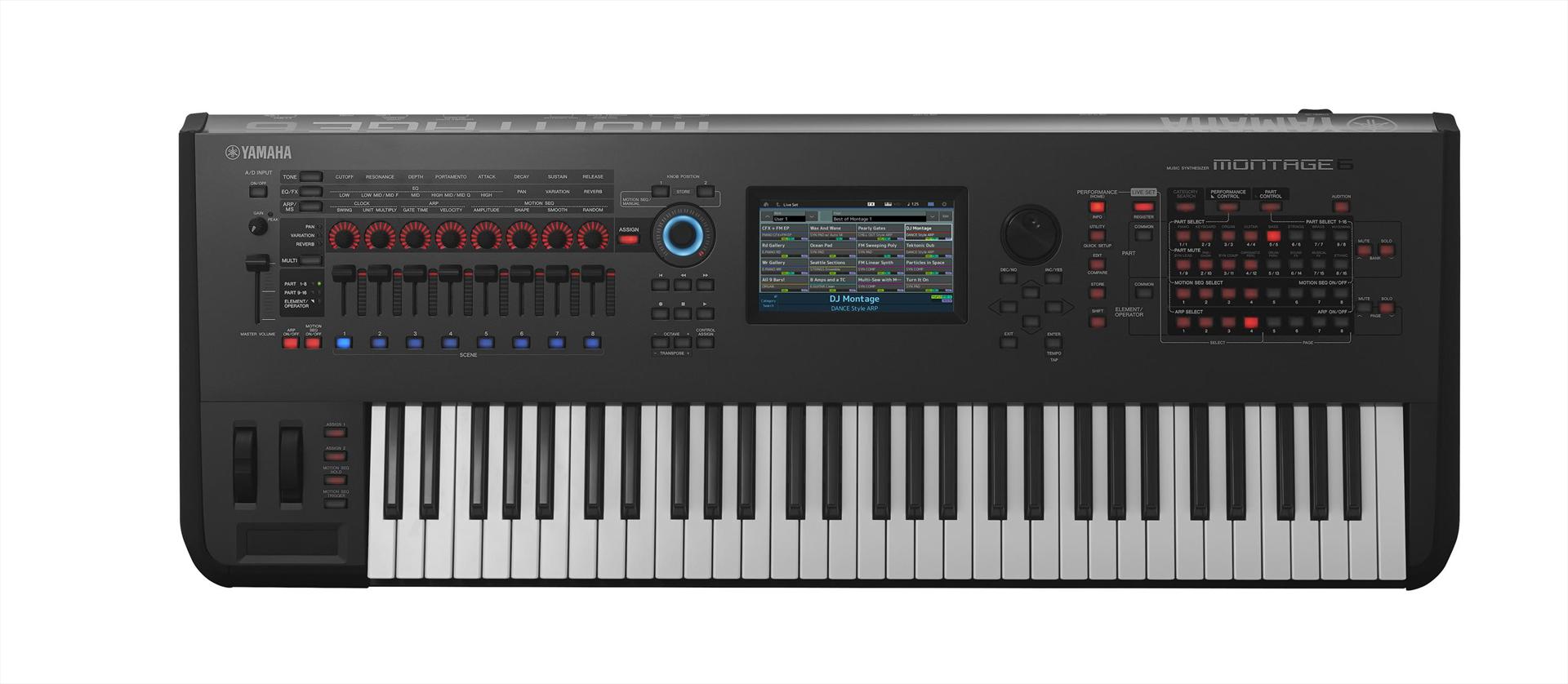
True gearheads are already making predictions and plans for 2016 Winter NAMM, January 21-24, 2016. Winter NAMM rumors abound including “Montage,” the rumored name for the rumored new Yamaha synthesizer workstation.

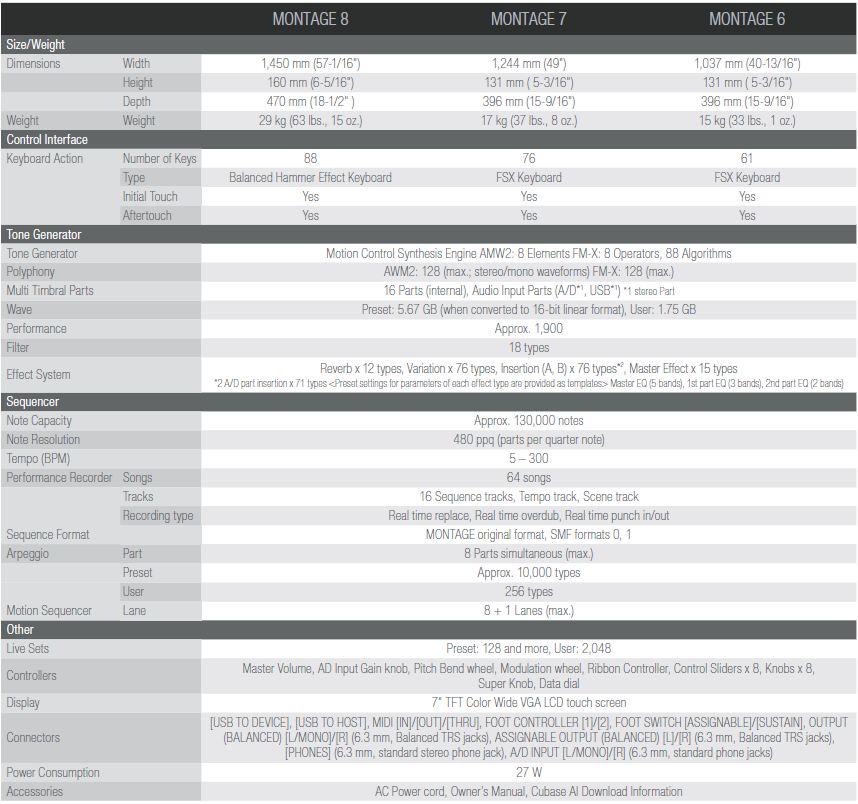
See the list of new waveforms in the Montage and read my initial review of the Montage8. Update: May 10, 2016.

Find the latest links, pictures, rumors and facts here . Update: January 21, 2016.

Check out some new thoughts about the rumored workstation and preliminary comments . Update: January 18, 2016.

Many folks — myself included — anticipate the release of a new Yamaha synthesizer workstation at the next NAMM. Much has been made of the registered trademark “Montage.” I don’t really care too much about what they call it, as I care about what it will do.

Last month, I posted two articles about the new Yamaha tone generation chip called “SWP70”:

This chip made its first appearance in the new PSR-S770 and PSR-S970 arranger workstations. Lest anyone scoff, the S770 and S970 produce Motif-caliber sounds including the REAL DISTORTION effects added to the Motif XF by the v1.5 update. The previous tone generator (SWP51L) is used throughout the mid- and upper-range Yamaha keyboard products including Clavinova, MOX/MOXF, Motif XS/XF, and Tyros 4/5. The number of tone generator chips varies by product specification and, most notably, sets the maximum available polyphony. A new tone generator chip is a pretty big deal since it will have an impact on all mid- and high-grade electronic instruments across product lines.

My earlier article about the SWP70 is written from the perspective of a computer architect and is way too nerdy for normal people. 🙂 Let me break it down.

Musicians using VST plug-ins within a PC-based DAW are familiar with the concept of sample streaming. In the quest for greater realism and articulation, sample libraries have become huge. These libraries simply cannot fit into fast random access memory (RAM) for playback. As a work-around, a software instrument reads samples from a drive-based library on demand and only a small part of the entire library is resident in RAM at any given time. The process is often called “sample streaming” because the software instrument streams in the samples on demand from a large fast secondary memory like a Solid-State Drive (SSD). The Korg Kronos workstation caught everyone’s attention because it incorporates an x86-based software system that streams samples from an SSD. (For Kronos-related articles, look here and here.)

The SWP70 combines streaming with tone generation. It does not, however, use an SSD for storage. Rather, it subsumes the functionality of the SSD. A moment to explain…

An SSD consists of three major subsystems: SATA controller, temporary storage cache (RAM) and one or more NAND flash memory chips. The NAND flash memory chips typically adhere to the Open NAND Flash Interface (ONFI) standard. This allows expansion and standardized configurability. The SATA controller exchanges commands and data with a computer using the SATA bus protocol. The temporary storage cache holds data which is pre-read (cached) from the NAND flash chips. Caching is required because random access read to NAND flash is too slow; sequential paged access is much faster. Data must be prefetched in order to achieve anything like SATA 1 (2 or 3) transfer speed.

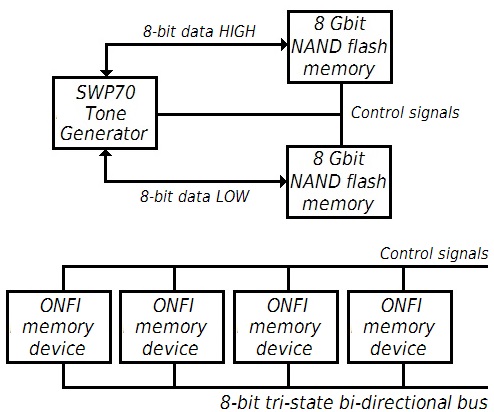
The SWP70 subsumes the SSD functionality. It has its own memory controller and has a side memory port to its own RAM for caching samples. The SWP70 reads samples from its ONFI-compatible NAND flash memory bus and stores the samples in its cache. The tone generation circuitry reads the samples from the cache when it needs them. The SWP70 solution is, effectively, sample streaming without the added cost and latency of SATA bus transfers. The samples coming into the SWP70 from flash are compressed, by the way, and the SWP70 decompresses them.

The SWP70 will very likely make an appearance in the new Yamaha synthesizer workstation. The S770 and S970 do not make full use of the SWP70, so we have yet to see what this chip is fully capable of. We can definitely expect:

  • Much larger wave memory (4GBytes minimum)
  • Greater polyphony (256 voices or more)
  • More simultaneous DSP effects (32 units or more)
  • The demise of the expensive expansion flash DIMMs

I would simply love it if the new workstation implemented some form of Super Articulation 2 voices (now supported by Tyros 5). The raw resources are there.

User-installed expansion memory may be a thing of the past. The current DIMMs plug into a two channel, full parallel memory interface. That interface is gone and the SWP70 communicates with flash NAND through an ONFI-compatible interface. The Motif and Tyros follow-ons will likely reserve space for user samples and expansion packs in built-in flash memory just like the new mid-range PSRs.

What does Yamaha intend to do with all of this polyphony? Current high-end models like the Tyros 5 use two tone generation chips. Yamaha could replace both chips with a single SWP70 and pocket the savings.

Another possibility is to provide advanced features for musical composition that combine MIDI and audio phrases. Here is a list of technologies covered by recent Yamaha patents and patent applications:

  • Beat detection and tracking
  • Chord detection
  • Synchronized playback of MIDI and audio
  • Combined audio/MIDI accompaniment (time-stretch and pitch-shift)
  • Object-oriented phrase-based composition on a time-line
  • Accompaniment generation from chord chart
  • Display musical score synchronized with audio accompaniment
  • Phrase analysis and selection (via similarity index)
  • Near ultra-sonic communication of control information
  • Search for rhythm pattern similar to reference pattern

A few of these technologies are covered by more than one patent — recurring themes, if you will. I could imagine a screen-based composition system that combines audio and MIDI phrases which are automatically selected from a database. The phrases are transparently time-stretched and pitch-shifted. Some of the compositional aids may be implemented in the workstation while others are tablet-based. The tablet communicates with the workstation over near ultra-sonic sound (no wires, no Bluetooth, no wi-fi, no time lag).

Sample-based tone generators already perform pitch-shifting. That’s how a single sample is stretched across multiple keys. A musical phrase can be pitch-shifted in the same way. As to time-stretching, stay tuned.

Some of these features, like accompaniment generation from a textual chord chart, are more likely to appear in a future arranger workstation product. Making product-specific predictions is a risky business, especially if you want to get it right!

Yamaha — the business — is keenly interested in growth and expanding markets. Management sees opportunity in growth markets like China. The need to combine audio phrases with MIDI is driven by non-Western music: time signatures other than 3/4 or 4/4, different scales, different playing techniques and articulations. These concerns are perhaps more relevant to the arranger product lines. However, phrase-based composition that manipulates and warps audio and MIDI transparently is a basic feature of many DAWs. (Think “Ableton Live.”)

One final theme seems to recur. Yamaha appear to be interested in analyzing and accompanying non-keyboard instruments. The market for guitar-driven accompaniment is much wider and deeper than today’s arranger workstations and is a lucrative target.

Here are links to a few earlier articles, including speculation about the new Yamaha synthesizer workstation:

These articles link to further background information. Of course, we’ll know a lot more once Winter NAMM 2016 is underway!

All site content Copyright © Paul J. Drongowski unless otherwise indicated.

The SWP70 tone generator

As I mentioned in an earlier post, the Yamaha PSR-S770 and PSR-S970 arranger workstations have a new tone generator (TG) integrated circuit (IC) — the SWP70. (“SWP” stands for “Standard Wave Processor.”) The SWP70 is a new TG family in a long line of Yamaha tone generators. The SWP70 replaces the SWP51L, which has been the mainstay in recent generations of Tyros, upper range PSR, Motif, and MOX series workstations.

The SWP70 has much in common with the SWP51L, but also some very significant differences. The SWP70’s external clock crystal frequency is 22.5792 MHz versus 11.2896 MHz for the SWP51L. This funky looking clock rate is a multiple of 44,100 Hz:

    22.5792MHz = 44,100Hz * 512

Samples are transferred to the DAC, etc. at a multiple of 44,100 Hz (Fs). Thus, it makes sense to derive Fs and its multiples from the chip-level master clock. The higher crystal frequency and faster memory read clocks lead me to believe that the SWP70 is clocked twice as fast as the SWP51L.

I am comparing SWP characteristics as deployed in the S970 (SWP70) and the S950 (SWP51L) workstations. This keeps the basis of comparison even although many characteristics (clock rates, DSP RAM size) are the same in higher end models like Tyros 5 or Motif. Higher end models employ two SWPs in master/slave relationship and both SWPs share the same wave memory. For more information about the PSR-S970 internal design, look here.

Five interfaces are essentially the same as the SWP51L:

  1. CPU interface: Communicate with the Main CPU (e.g., Renesas SH7731) via the parallel CPU bus.
  2. Serial audio: Send/receive audio data to/from the DAC, audio ADCs, and main CPU.
  3. Clock interface: Synchronize serial audio data transfers (generate multiples of Fs).
  4. DSP SDRAM interface: Store working data for effect processing.
  5. EBUS interface: Receive controller data messages (e.g., pedal input, keyboard input, pitch bend, modulation, live knobs, etc.) from front panel processors.

The DSP SDRAM is the same size: 4Mx16bits (8MBytes). The SWP70 read clock is 95.9616 MHz, while the SWP51L read clock is 45.1584 MHz. This is more evidence for a higher internal clock frequency.

The Tyros 4, Tyros 5 and S950 have an auxiliary DSP processor for vocal harmony. The microphone analog-to-digital (ADC) converter is routed directly to the auxiliary processor. Prior to these models, the microphone ADC is connected to the tone generator. With the SWP70, the S970’s microphone ADC is once again routed to the SWP70 and the auxiliary processor disappears from the design. Thus, vocal harmony processing (fully or partially) is located in the SWP70. See my post about SSP1 and SSP2 for further details.

The biggest change is the wave memory interface.

A little history is in order. The SWP51L (and its ancestors) were designed in the era of mask programmable ROM. I contend that tone generation is memory bandwidth limited and the earlier interface design is driven by the need for speed. The SWP51L (due to its evolved history) has two independent wave memory channels (HIGH and LOW). Each channel has a parallel address bus (32 bits) and a parallel data bus (16 bits). The two channels account for over 100 pins. (System cost is proportional to pin count.) The user-installed, 512/1024MB flash DIMMs plug directly onto the two channels.

The SWP70 wave memory interface takes advantage of new NAND flash memory technology. The interface is described in US patent application 2014/0123835 and is covered by Japanese patent 2012-244002. I analyzed the US patent application in an earlier post.

The SWP70 retains the HIGH port and LOW port structure. Each port communicates with an 8Gbit Spansion S34ML08G101TFI000 NAND flash device. Address and data are both communicated over an 8-bit serialized bus. This technique substantially decreases pin count and the resulting board-/system-level costs. Smart work.

I did not anticipate, however, the introduction of a new parallel memory interface called “wave-work”. The wave work interface communicates with a 16Mx16bit (32MBytes) Winbond W9825G6JH-6 SDRAM. The read clock is 95.9616 MHz.

The purpose of the wave work SDRAM is revealed by US Patent 9,040,800. This patent discloses a compression algorithm that is compatible with serialized access to the wave memory. The wave work SDRAM is a cache for compressed samples. The characteristics of the Spansion memory device give us a clue as to why a cache is required:

    Block erase time               3.5ms    Horrible (relative to SDRAM)
    Write time                     200us    Terrible
    Random access read time         30us    Bad
    Sequential access read time     25ns    Very good

As the patent explains, two (or more) samples are required to perform the interpolation while pitch-shifting. If there is only one tone generation channel, access is paged sequential. However, random access is required when there are multiple tone generation channels. (The patent mentions 256 channels.) Each channel may be playing a different voice or a different multi-sample within the same voice. One simply cannot sustain high polyphony through random access alone. The cache speeds up access to recently used pages of uncompressed samples.

The wave work interface takes additional pins, thus adding to board- and system-level costs. The overall pin count is still lower when compared to SWP51L. The penalty must be paid in order to use contemporary NAND flash devices with a serialized bus. This is the price for catching the current (and future) memory technology curve.

A few SWP70-related printed circuit board (PCB) positions are unpopulated (i.e., IC not installed) in the PSR-S970. There is an unpopulated position for a second Winbond W9825G6JH-6 wave work SDRAM which would expand the wave work memory to 32Mx16bit (64MBytes). A larger cache would be needed to support additional tone generation channels. Perhaps only half of the tone generation channels are enabled in the mid-grade PSR-S970 workstation.

There is what appears to a second separate wave work interface that is completely unpopulated. The intended memory device is a Winbond W9825G6JH-6, which is consistent with the existing wave work interface.

The PSR-S970 also has a stubbed out interface that is similar to the DSP SDRAM interface. The existing DSP SDRAM signals are labeled “H” for HIGH while the unused interface is labeled “L” for LOW. Perhaps only half of the hardware DSP processors are enabled for the mid-grade S970, waiting to be activated in future high-end Tyros and Motif products.

I refer to future high end products by the names of the current product lines. Yamaha may choose to rebrand future products (e.g., the much-rumored “Montage” trademark).

The Spansion S34ML08G2 8-Gb NAND device is Open NAND Flash Interface (ONFI) 1.0 compliant. The S34ML08G2 device is a dual-die stack of two S34ML04G2 die. The 8-bit I/O bus is tri-state allowing expansion e.g., multiple memory devices sharing the same I/O bus and control signals with at most device enabled at any time. The SWP70 has additional chip select pins that would support this kind of expansion. The current expansion flash DIMMs will no longer be needed or used.

In this note, I concentrated on observations and fact, not speculation about future products. I’ll leave that fun for another day!

All site content is Copyright © Paul J. Drongowski unless indicated otherwise.

SSP1 and SSP2: Designated hitter

One notable absence from the Yamaha PSR-S970 design is the “SSP2” integrated circuit (IC) which handles vocal harmony processing. The SSP1 and SSP2 appeared in the Tyros series and PSR series coincident with Vocal Harmony 2.

For you signal sleuths, the PSR-S950 and Tyros 5 microphone input is routed to an analog-to-digital converter (ADC) where the analog signal is sampled and digitized. The digital sample stream is sent to the SSP2 IC. The firmware munges on the samples and voila, the SSP2 produces a vocal harmony signal that is mixed with samples from the tone generator, etc. The SSP2 sends its results to the TG where effects and mixing are performed. The TG sends its output to the digital-to-analog converters (DAC) and digital amplifiers. The Tyros 4 has the same signal flow using an earlier model “SSP1” processor instead.

Previous machines with vocal harmony (e.g., Tyros 3 and earlier, PSR-S910 and earlier), routed the digitized microphone stream to a tone generator (TG) IC such as the SWP51L. Presumably, vocal harmony processing was performed in the TG IC. With the brand new SWP70 tone generator in the S970, the digitized microphone stream is sent to the SWP70. Looks like vocal harmony processing is folded into the SWP70 TG.

I didn’t give the SSP2 much thought or investigation, and just assumed that it was a gate array or something. On inspection, the pin-out resembles a Renesas embedded DSP processor with analog inputs and outputs, digital I/O, USB and all of the usual suspects. The SSP2 in the S950 has 2MBytes of NOR flash program ROM (organized 1Mx16bits) and 2MBytes of SDRAM (organized 1Mx16bits). The clock crystal is a leisurely 12.2884MHz although the SDRAM read clock is 84.7872MHz.

Mysteriously, a web search on the part numbers doesn’t turn up much information. The part numbers are:

    Schematic ID  Manufacturer?       Yamaha
    ------------  ------------------  --------
    SSP1          MB87S1280YHE        X6363A00
    SSP2          UPD800500F1-011-KN  YC706A0

The PSR-S950 parts list does not give a Yamaha order number for the SSP2. If the SSP2 fails, you’ll need to call Yamaha 24×7 directly.

A web search does turn up a few of the interesting places where the SSP has been seen. In addition to Tyros 4, Tyros 5 and S950, the SSP and SSP2 are featured in:

    PSR-S500 arranger (probable role: effects processor)
    EMX5016CF mixer (role: SPX effects and user interface)
    Steinberg UR22 audio interface
    Steinberg MR816 Firewire audio interface
    Yamaha THR modeling guitar amplifier

The SSP is Yamaha’s designated hitter when they need an odd bit of DSP work done.

PSR-S770 and S970 internal architecture

Yamaha just recently introduced the new PSR-S770 and PSR-S970 arranger workstations. As usual, I’m always anxious to dive into the service manual and see what’s up.

First, I’d like to thank Uli and capriz68 on the PSR Tutorial Forum for their help. Uli made a very nice table from my ramblings, so be sure to check it out there.

Without further introduction, here is a table comparing previous generation models (PSR-S750 and PSR-S950) against the new models.

                    PSR-S750  PSR-S950   PSR-S770  PSR-S970
                    --------  ---------  --------  ---------
Main CPU            SWX08     SH7731     SH7731    SH7731
Clock rate (MHz)    135.4752  256        320       320
Tone generator      SWP51L    SWP51L     SWP70     SWP70
Ext clock (MHz)     11.2896   11.2896    22.5792   22.5792
DSP SDRAM (MBytes)  8         8          8         8
DSP RCLK (MHz)      45.1584   45.1584    95.9616   95.9616
Mic ADC                       AK5381     PCM1803   AK5357
AUX IN ADC          AK5357    AK5381     AK5357    AK5381
DAC                 AK4396    AK4396     AK4396    AK4396
Digital amp         YDA164C   2*YDA164C  YDA164C   2*YDA164C
Wave ROM (MBytes)   256       256        512       2048
Wave SDRAM          N/A       N/A        32MBytes  32MBytes
SSP2 chip           No        Yes        No        No

The main CPU remains a Renasas SH4AL-DSP CPU. The clock speed is increased from 256MHz to the 320MHz, which is just shy of the rated maximum for the SH7731.

Wave memory is increased from 256MBytes (S950) to 512MBytes (S770) and 2GBytes (S970). Part of the S770 and S970 wave memory is reserved for expansion pack voices: 160 MBytes (S770) and 512 MBytes (S950). How Yamaha uses the rest of the memory is up to Yamaha. However, we are now in an era when we cannot compare products solely on the basis of physical wave memory size. Our ears and performance experience are more important than mere byte counts!

The S970 has two NAND flash memory devices labelled “audio style.” The devices are:

    4Gbit NAND flash = 512MBytes
    2GBit NAND flash = 256MBytes
                       ---------
    Total audio style  768MBytes

Yamaha specifies memory size in bits, so one must be careful to convert during analysis. The PSR-S950 has a NAND flash device labelled “Program ROM,” which presumably served the same purpose as well as holding the operating system image that is loaded at boot time. The S950 device capacity is 512MBytes (4Gbits). The S970 reserves 128MBytes for audio style expansion.

The upper mid-range model, i.e., the S970, is biamplified with two digital power amps. The older S950 is also biamplified. Not much change here.

The big news is that Yamaha have a new tone generator integrated circuit (IC), the SWP70. The SWP70 uses the serialized wave memory interface that I described in an earlier post. The SWP70 appears to operate at twice the speed of the older SWP51L. The SWP70 has implications for other future products, so I will analyze it in a separate post.

With respect to the PSR-S970, however, there is another evolutionary step. With the appearance of the new SWP70, there is also the disappearance of the SSP2 IC. The introduction of the SSP2 IC coincided with the introduction of Vocal Harmony 2 in both the Tyros line and the PSR-S950. It is reasonable to infer, then, that vocal harmony is implemented on board SSP2. With the PSR-S970, there are two possibilites.

  1. Vocal harmony is assigned to the now faster main CPU, or
  2. SSP2 functionality is integrated into the new SWP70.

The SWP70 is beefed up in other ways including a new wave working memory.

The future looks interesting as always!

Here are links to my articles on other members of the PSR and Tyros product families:
What’s inside of a Yamaha arranger?
A follow-up on the Yamaha SWP51
Yamaha arranger product family

All site content is Copyright © Paul J. Drongowski unless otherwise noted.

Sending performance data via audio

It’s a challenge to get one’s head around the recent patents filed and obtained by Yamaha. In this post, I concentrate on one kind of communication technology that pops up in several patents.

Most people would like to get rid of the cables in their studio or living room. Radio-based communication technology like wi-fi (e.g. IEEE 802.11), Bluetooth, or Bluetooth Low Energy (BLE) seems like a no brainer for wireless communication. Radio is a bit of a regulatory nightmare for a global electronics corporation, however, because radio gear needs type acceptance and approval from governmental authorities. On a functional level, both wi-fi and Bluetooth communications are subject to interference, conflict and latency.

If Yamaha knows anything, it knows about latency and how latency can adversely affect the generation/transmission of data and sound.

US Patent 8,779,267 describes an approach to CDMA-like (code division multiple access) communication via near-ultrasonic sound (18KHz). Pseudo-random spreading codes allow multiple transmitters to operate within the same frequency band. Thus, multiple musical devices in your living room or studio can communicate with each other at the same time. The sound of ongoing communication — “control tones” in the terminology of the patent — are sufficiently high as to be inaudible to humans. (I wonder what dogs will hear and think? Seriously.)

The patent deals specifically with the modulation and generation of control tones by a synthesizer. The synth CPU borrows one of 32 tone generator channels to generate the control tones to be transmitted. The waveforms for the tones are stored, ta-da!, in wave ROM. Amplitude is constant (no ADSR for you) and the tone is sent only through the left channel to avoid sonic interference with itself through the right channel (avoiding phase cancellation, no doubt).

All in all, this is quite clever. Using a tone generation channel keeps cost low — no specialized modulator. The symbol rate is about 400.9 symbols per second, so transmission speed is not blazing fast. However, the ultra-sonic approach avoids the regulatory hassles and latency of consumer data radio technology.

The application discussed in the patent is the synchronization or display of “musical score data” on a tablet. The synthesizer sends control tones to the tablet telling notation software where it is in a musical score. The low symbol rate should be OK for this kind of application. If you’re curious about this application, then check out US Patent 9,029,676 (“Musical score device that identifies and displays a musical score from emitted sound and a method thereof”).

Six futher “embodiments” of theses idea are described in US Patent 9,006,551. The object of this invention is a musical performance information output device and system which superimposes musical performance-related information (e.g., notes, tempo, expression, etc.) on an analog audio signal without damaging the “general versatility” of the the audio data. The embodiments include:

  • A guitar that derives MIDI messages from string sensors and imposes the MIDI data on the audio signal.
  • A guitar that determines fingering information and sends it.
  • An electronic piano that sends tempo clock by imposing it on the audio.
  • A guitar that controls an effect unit.

And so forth.

Data is superimposed onto an audio signal. The signal can be sent in either free-air (patent ‘267) or over an audio cable (patent ‘551). There are probably limits and restrictions on free-air transmission such as signal strength, interference from ambient noise and so forth. Patent ‘267 assumes that the tablet and keyboard are in close proximity (speaker to microphone). In the case of ‘551, combining audio and data communication over an audio cable at least eliminates the need for a separate parallel data cable.

The normal disclaimers apply: Who knows if this technology will make it into product, how, or when?

Why not high-end x86?

Last time around, I broke down the computational core of the Korg Kronos and Krome workstations. The Kronos is one of the few (only?) current synthesizer workstations based on the x86. The Kronos 2 is built around an Intel mini-ITX motherboard with a 1.86GHz dual-core Atom running a custom version of Linux. Since the x86+Linux combination is flexible and versatile, it hosts a wide variety of software-based synthesizers, including the ever popular sample-based synthesis used in so many other products from Korg, Roland and Yamaha (to name a few manufacturers).

Learning this, some folks may be disappointed to find a “lowly” Atom instead of high-end processor such as a honking 4.0GHz Core i7-4790K. It’s a quad-core processor (8 processing threads) with 1MB L2 cache, 8MB L3 cache, and integrated Intel HD Graphics 4600. Sounds like a positive screamer when compared against the D2550 Atom in the Kronos 2.

Before any fanbois freak out, I didn’t have any particular reason for choosing this particular CPU as the example. Yes, it was released in 2014, blah, blah.

First and foremost, please consider power consumption. The i7 is rated at 88W total power dissipation (TDP) while the Atom is rate at 10W TDP. High clock speed and high functionality come at a cost, specifically, power.

  • On the consumption side, the i7 needs a power supply with 8 times the capacity of the Atom-based solution.
  • On the dissipation side, the i7 solution needs to dissipate and remove 8 times the heat of the Atom solution.

It’s the laws of physics, folks. Silicon CMOS circuits at high clock speed consume gobs of power. If you want to save dynamic power, then reduce the clock speed and/or throw away unneeded functionality.

High power consumption and dissipation lead to difficult design problems at the product system level. The power supply (PSU) must be bigger and heavier. An ATX power supply is 2.5 to 5 pounds of dead weight. The PSU also generates heat of its own no matter how efficient it may be. CPU cooling requires both a heavy heat sink and a fan. Further, the heat produced by the heat sink and power supply must be removed from the product chassis by exhaust fans. Great, additional weight and fan noise. Ultimately, the musical instrument designer becomes a desktop computer designer.

Customers already complain about the weight of workstation products. Heavy synthesizer workstations are “studio queens.” If a workstation is too heavy to take to gigs, then why not use a high performance desktop or server solution in the studio to begin with?

One must take the CPU support infrastructure into account, too. Mid- and high-end x86 processors cannot stand alone — they need a companion chipset. The x86 processor and the chipset integrated circuit (IC) are the Mario and Luigi of computer design. You don’t see one without the other. The chipset IC implements the I/O ports: PCIe, USB and most importantly, the SATA interface to bulk storage. The chipset IC consumes and dissipates power, too, and must have its own heat sink.

x86 system design requires specialized expertise in high frequency electronics, thermal design and mechanical design. You’re unlikely to find this specific expertise at Korg, Roland and Yamaha. It’s not their core competence or value added. That’s why Korg very wisely adopted an existing mini-ITX solution for the Kronos. Korg design and manufacture the ARM-based user/audio interface board. Embedded electronics like that are a core competence and value-added component. The mini-ITX motherboard plus user/audio interface board solution is smart, system-level engineering.

So, in the end, we have the “good enough” solution that is appropriate for the product space. Korg build musical instruments, not desktop computers. The D2550 Atom has enough computational horsepower to deliver a range of synthesis techniques with adequate polyphony. The solution fits into a conventional keyboard chassis without noisy fans, without becoming dangerously hot to the touch, and at a tolerable weight.

You may think that I’ve conceded higher performance at this point, but here is one more idea for consideration — laptop technology. This solution will not deliver the absolute highest level of performance, but it might be the next step up from the mini-ITX solution. From the systems point of view, it might make sense to design a portable keyboard product around an OEM laptop motherboard, cooling system and processor. Laptop fans are generally quiet and heat could be vented through a modest port in the chassis. One could power the instrument from lithium ion batteries for relatively short periods of time or leave the batteries out for lighter weight. Perhaps Korg engineers considered this solution, too. They’ve clearly demonstrated their skill in the design of the Kronos.

Innards of Krome and Kronos

Plenty of discussion about Korg Kronos and x86 on the Keyboard Magazine forum, so it’s time to study up on Korg architecture and formulate an opinion.

Before diving in, I should say that I try to get my information from primary sources (e.g., service manuals) and to not rely on Internet “truthiness.” The Web is filled with people who want to believe something whether they are informed or not. Thanks, Stephen Colbert, for the notion of truthiness!

Not all service manuals are readily available (at no cost!), making the narrative a bit sparse. Nonetheless…

Korg have two distinct paths which have led to the current Kronos and Krome. My simplified take on the first thread of Korg workstation history is, starting from Triton:

  • Triton family begat the
  • M3 which begat the
  • M50 which begat the
  • Krome.

The second major historical thread is the multi-faceted OASYS which begat the Kronos series. Along side all of this “begatting,” Korg developed its professional arranger workstations, e.g., the PA80, PA500, etc. leading to the current PA900 and PA4x. The arranger workstations are kin to the Triton, M-series, and Krome, and share much of the underlying hardware technology.

Let’s take the Krome first because it is the most similar to Yamaha and Roland architecture.

The Korg Triton LE was released in 2002 and is a stripped down version (no sampling, no ribbon controller, smaller display, etc.) of the classic Triton. Its embedded CPU is a Renesas SH7043A, the same choice as Roland and Yamaha in that era. The embedded CPU handles all of the user interface (UI) processing and communicates with the keyboard, knobs, LCD and so forth. Samples are generated by a Korg proprietary tone generator chip designated “TGL96” or MB87F1710-PFV-G-BND. The TGL external clock frequency is 24.576MHz. The tone generator has a dedeicated memory channel to 32MBytes of wave ROM. Overall, the Triton LE internal architecture is similar to corresponding Yamaha and Roland products.

The TR61 was released in 2006 and resembles the Triton LE. It has more physical wave ROM (64 MBytes), USB-to-PC communication and an SD card slot. The embedded CPU is a Renesas SH7043A which, again, handles the UI components. The Korg proprietary tone generator chip is designated “TGL96” or MB87F170-PFV-S. Although the parts list uses the same identifier as the LE, this chip is probably just a slightly updated model in the same TGL family.

Korg marketing called its Triton-era synthesis “HI,” or “Hyper Integrated” synthesis. The PA80 arranger also uses HI synthesis and a Korg MB87F1710-PFV-S TGL96 tone generator. Thus, synths and arrangers using HI synthesis probably contain some variant of the MB87F1710 TGL family.

Skipping ahead to the M3 (released in 2007), the tone generator is designated TG01 or MB87M4080PB-GE1. Korg marketing switched to “Enhanced Definition Synthesis” or “EDS.” This chip is clocked using an external 24.576MHz crystal, yielding an internal clock speed of 98.304MHz. The TG01 has two dedicated memory channels (upper and lower PCM data bus) to wave ROM. The TG01 has a third memory channel to an 8MB DRAM for DSP working storage.

The main CPU in the M3 is a a Freescale MC9328MX1 ARM processor. The ARM is clocked at 196.608MHz. The M3 also uses a Renesas H8 (HD64F3687GFPV) for key scanning. H8s are 16-bit processors that are good for interface and “microcontrol.” The Freescale MC9328MX1 is the first appearance of an ARM processor in Korg synth. Yes, that’s right, folks. Korg have used embedded ARM processors since 2007.

The EXB-RADIAS is a synthesizer/vocoder option board for the M3 that uses Korg MMT (Multiple Modeling Technology). The EXB-RADIUS is no processing slouch, consisting of a Renesas SH7709S CPU and two Texas Instruments TMS320VC5502 DSP processors.

I located a service manual for the PA500 arranger from the same era (2007). The PA500 arranger implements EDS and contains a Korg MB87M4080PB-GE1 tone generator IC. The Freescale MC9328MX1 performs the work of a master embedded CPU (user interface, USB interface, LCD control, keyboard input, MIDI interface, etc.) The ARM core clock is 200MHz — fast enough for control, not fast enough for DSP. The DSP is handled by the MB87M4080PB tone generator.

Completing the early picture, the M50 (released 2008) is a reduced feature version of the M3. The M50 implements EDS and contains a Korg MB87M4080 tone generator.

I could not find a service manual for the Krome. Grainy images of its KLM-3119 motherboard show a Korg MB87M4080 TG01 tone generator and what is probably a TI OMAP ARM processor. Clock frequencies cannot be determined from pictures alone. The designers likely replaced the Freescale processor with the Texas Instruments OMAP. Korg marketing changed the pitch name to “EDS-X (Enhanced Definition Synthesis-eXpanded).” The meaning of “expanded” is not clear although the Krome supports more polyphony than the M50. The Krome employs an internal 4GByte micro SD card for sample storage. The TG01 appears to be driven by two ISSI IS42S16160G 256Mbit DRAMs which are organized 16Mx16bits. Very likely, samples are loaded into these DRAMs by the OMAP on demand. The SD card is relatively slow and continuous streaming from SD to the TG, to me, seems unlikely.

Up to this point in the narrative, we know that Korg have at least two generations of proprietary tone generator chip families:

MB87F1710     Hyper Integrated (HI) synthsis
MB87M4080PB   Enhanced Definition Synthesis (EDS)

Whether EDS-X represents a third generation is open to question. Summarizing further, Korg use ARM processors (low clock rate, low power) to handle UI and control tasks.

A desire for additional synthesis methods led to the Korg OASYS. The OASYS is built around the AOpen MX4GVR-GN micro-ATX motherboard (Intel Socket 478). The motherboard is fitted with an Intel 2.8GHz Pentium 4 processor and a minimum of 1GByte of RAM. The OASYS requires a fair bit of additional logic to handle all of the I/O and user interface including a Renesas H8 and a Texas Instruments embedded DSP. The operating system is a custom version of Linux.

Customers found the OASYS to be too expensive and about 3,000 were sold. Having learned from this experience, Korg developed the lower cost Kronos series. There are three major models in the series, where each model is built around a particular mini-ITX, x86 motherboard:

Kronos Lot A  Intel BLK D510M0      Intel 1.66GHz D510 dual-core Atom
Kronos Lot B  Intel D525MW          Intel 1.80GHz D525 dual-core Atom
Kronos X      Intel D525MW          Intel 1.80GHz D525 dual-core Atom
Kronos 2      ASRock IMB-140D Plus  Intel 1.86GHz D2550 dual-core Atom

The motherboard connects to an SSD memory device via SATA2 and to an ARM processor via USB. The ARM processor handles UI and interfacing duties just like the ARM processor in the Krome. The x86-based motherboard performs synthesis. Thus, the Kronos internal architecture is like the synths in the Krome line except the proprietary tone generator IC is replaced by an x86 motherboard running Linux! This internal organization gives Korg substantial cost savings over the OASYS.

According to Dan Phillips (Korg R&D), “… all synthesis, effects, and audio processing is done within the Intel CPU, and naturally the sequencer and KARMA as well.”

Two types of ARM processors were used: Texas Instruments Sitara AM1806BZWT3 (early models) and Texas Instruments AM1808BZWT3 (later models). I’ll focus on the AM1808. The AM1808 system on a chip (SOC) has an ARM926EJ-S core, 16KB I-cache, 16KB D-cache, 8KB RAM (vector table), 64KB built-in ROM (boot image), 128KB system RAM and a host of built-in interfaces (LCD, USB, SPI, etc.) The wealth of interfacing options makes this kind of ARM SOC ideal for embedded applications. The NEON signal processing extension supports 16-bit fixed point arithmetic including a single-cycle multiply-accumulate (MAC) unit. Hardware floating point is not supported. Although the NEON extension is handy, the heavy DSP is performed by the x86.

ARM core clock speed is a function of core voltage, external crystal frequency and software-level configuration. The external oscillator frequency (24MHz) and core supply voltage (1.2V) point toward a 375MHz core clock speed. In any case, the AM1808’s maximum supported speed is 456MHz. The ARM processor — unlike the high frequency dual-core Atoms — dissipates relatively little heat and does not require a heat sink and/or fan.

At this point, we have accumulated enough information to compare Krome’s synthesis hardware to the Kronos. Krome uses a Korg proprietary tone generator IC (TGL) to synthesize music. The TGL operates at a relatively low clock speed and does not require a heatsink or fan. The size and weight of the TGL are nearly negligible when compared with the mini-ITX motherboard. The Kronos x86 mini-ITX system has a big footprint (6.7in by 6.7in or 170mm by 170mm), needs a heatsink and fan, and weighs 0.61 kilograms (1.4 pounds). The heat generated by the motherboard (20 to 25 watts) must be externally ventilated, thereby complicating the mechanical design of the overall product. Thus, x86 motherboard synthesis comes with a significant system cost. The Intel chipset dissipates the most heat, so even if the extraneous motherboard components are eliminated, thermal design is a significant disadvantage of x86-based synthesis.

Here’s how the complete products stack up (61 key models):

                                    Krome    Kronos 2
                               ----------  ----------
    Synthesis                       EDS-X        HD-1
    Polyphony                      120/60         140
    Power consumption (Watts)          13          60
    Weight (pounds)                  15.9        31.5
    Weight (kilograms)                7.2        14.3

Performance is compared on the basis of sample-based synthesis while disregarding differences in tone quality. The Krome implements only sample-based synthesis, so the basis for comparison on this dimension is limited. As a complete system, the Kronos out-weighs and out-dissipates the Krome two-to-one.

Finally, here are a few words comparing Kronos SSD versus Krome Micro SD for sample storage and transfer. The Kronos SSD is SATA2 with a raw 3Gbit/sec transfer rate. Although the maximum transfer rate is 300MBytes/sec, the 30 GB Toshiba SSD (THNSNB030GBSJ) is specified at:

    Read transfer rate:  180MBytes/sec
    Write transfer rate:  50MBytes/sec

The Class 10 micro SD card is specified at:

    Read transfer rate:   10MBytes/sec
    Write transfer rate:  10MBytes/sec

According to the SD Association, these are minimum speeds and actual devices may operate faster. Further, two different SD bus speeds are rated: 12.5 MB/sec default speed and 25 MB/sec high speed. Without further testing or knowledge of the particular SD card in use, no further conclusions can be drawn properly. One should note, however, that Krome device-to-tone generator bandwidth is significantly lower than Kronos even when best SD performance is assumed.

SD device communication is simpler than SATA. SD is designed for low cost. An SD card interface is a frequent, integrated feature of an ARM SOC. The SD interface favors lower system cost and complexity.

SSD storage devices, on the other hand, are not simple devices. They contain a SATA bus controller, RAM cache and cache controller. Data caching gives SSD its speed advantage over naked flash memory. The SATA interface is part of the Intel NM10 Express Chipset IC on the Intel motherboard. Comparatively speaking, the SD card and bus win on the basis of cost and simplicity.

The complexity of the SATA interface would tend to preclude direct communication from SATA to a proprietary tone generator like the TGL. Cost and simplicity favor “raw” communication between tone generator ICs and RAM/ROM.

Whew! That’s quite a lot of detailed information. To keep things short and focused, I’ll address the suitability of x86 for conventional synthesizer design in another post.

Here is a link to my dive into some old Roland gear. You might also want to read my post about Yamaha MOX internal architecture. There are also three posts (here, here and here) about Yamaha arranger internals.

TC-Helicon Play Electric

Sometimes the best inexpensive multi-effect stomp box is pitched as a vocal harmony processor.

The built-in effects on the Korg Triton Taktile (TT) are rather plain and unpronounced. So, I cast the net for stomp boxes to beef up the keyboard sounds with reverb, chorus, phaser, flanger, tremolo and the rest of the usual suspects. Something to spice up the guitar sounds is also nice. Vocal harmony processing never entered my mind since I rarely sing.

My first thought was to build a small pedal board of stomp boxes. Based on Internet reviews, I bought a TC-Electronic Hall of Fame (HOF) Reverb pedal. It’s stereo, clean and the preset algorithms are terrific. I love this little red box! Its Toneprint capability is really a gas. Through Toneprint, you can actually add chorus or flanger, making it a good, small, one pedal solution for keyboard effects. I also use the HOF for recording — the algorithms and cleanliness are that good.

Based on that success, my next thought was to add more TC-Electric pedals. TC’s guitar pedals hit the street in the $100 to $150 (USD) range. Thus, you can run up a bill pretty fast covering all of the bases!

Enter the TC-Helicon Play Electric (PE). After finding a very attractive price for the PE at ProAudioStar, I investigated its capabilities. Thanks to smart signal routing, the PE is really like two multi-effect processors in one — one side is a guitar chain and the other side is vocal harmony and effects processing. I’m going to concentrate on the guitar side here as I haven’t explored the vocal harmony processing yet.

The guitar effects chain consists of amp simulation, compression, modulation, delay and reverb. It covers all of the major effect food groups except phaser. What it does cover, it does very well. There are a small number of “greatest hit” algorithms from the Corona Chorus, Vortex Flanger and the HOF — all very usable. The user interface is a breeze and I quickly pulled together presets for chorus, flange, rotor, pan, tremolo and auto filter. The Triton Taktile electric pianos sound great through the PE effects. Thanks to the factory presets, U2 can sound like The Edge (pun intended). The rather lame electric guitars sound huge through the PE presets.

The quality of the rotor effect is a real surpise. Although the Neo Instruments Ventilator doesn’t have anything to fear, the rotor is not bad and it compensates for the TT’s inability to switch between slow and fast rotor speed. (If you can stand the sometimes maddening swirl of rotor-on-rotor violence.) I programmed slow and fast rotor presets in adjacent locations and can switch between fast and slow via the increment and decrement switches on the pedal.

What does the Play Electric give up in favor of lower cost? The individual pedal approach has the advantage of immediacy — lots of knobs and switches to play with. The PE effects are easily tweaked through the UI, but lack the immediacy of front panel knobs. Further, the PE exposes only the most important parameters through the UI, emphasizing convenience over tweaking. The compressor parameters roll up the whole lot of attack, release, etc. into “Amount” and “Makeup” parameters. TC-Helicon offer deeper editing in the much more expensive (and heavier) Voice Live. The Voice Live also has a wider range of effects. From what I’ve heard so far, however, I’m good with the Play Electric.

I look forward to trying the vocal side. The PE does not have MIDI IN for scale detection — it’s all audio, baby. The PE has built-in microphones and will detect scale out of the sonic ether as well as processing the audio signal at the guitar input. I’ll post results after experimenting.

The TC-Helicon Play Electric is normally advertised in the live sound section of on-line and print catalogs. Thus, it’s worth checking out vocal processors when looking for keyboard/guitar effects. You might be surprised at what you’ll find.

There is one alternative to the PE that looks viable for keyboard players. Keyboardists don’t usually chain effects together like a guitar player and often one additional effect through a reverb will do. The Line 6 M5 pedal is the “Swiss Army Knife” of effects. It does one effect at a time and has a very wide range of available effects (much greater than the PE). The M5 has stereo inputs (while the PE is mono). An M5 coupled with the HOF would be a capable duo at a reasonable total cost.

Switching gears a little bit, I don’t know why Keyboard Magazine and other keyboard-oriented publications don’t review effect pedals very often. These pedals are just as vital and useful to keyboard players as they are to guitarists. The Keyboard Magazine guys need to drop by the Guitar Player offices while they are writing their massive annual pedal round-up.

Clear the decks?

Yamaha have announced a truly stellar promotion to move Motif XF workstations. The Motif XF Fully Loaded expansion pack includes a FireWire expansion board, two FL1024M memory modules and an USB drive filled with content including Chick Corea’s Mark V electric piano. (See the promotions page at the Yamaha web site for additional details.)

Wow! This promotion really caught my attention and if ever there was a time to upgrade to an XF, it’s now.

Of course, this aggressive promotion could also mean that a new synthesizer workstation will be announced in the not-too-distant future. Winter NAMM 2016, perhaps? Old inventory has got to go!

After the Reface surprise, I’ve given up predicting specific product features, especially based upon a (rumored) product name. The word “Reface,” for example, means something completely different to a saxophone player and, yes, Yamaha manufacture saxophones and mouthpieces. 🙂 So, “Montage”, harumph. I am willing to predict, however, that the next high-end workstation will have a new member of the Standard Wave Processor (SWP) family — the hardware chip that underlies the tone generation infrastructure. (See Serial Memory and Tone Generation.) This is big step for Yamaha because the current SWP51L, for example, is used in everything from mid-range arrangers, to MOX/MOXF, to Motif, to Clavinova.

Just taking in the gestalt of Yamaha’s recent patent filings, they have been actively building their portfolio in at least three areas: human vocal processing and synthesis (VOCALOID), music analysis and combined MIDI/audio accompaniment.

VOCALOID has been a commercially successful software product. The tech has, by the way, some similarities to the “connective” capabilities of Articulated Element Modeling (AEM), known more broadly as “Super Articulation 2” on Tyros. VOCALOID requires frequency domain signal processing, so unless Yamaha have knocked down some real computational barriers, VOCALOID will probably remain a non-real time synthesis technique.

“Music analysis” is a broad area and a rather vague term. At a fundamental level, this area includes beat (tempo) detection and scale and harmony (chord) detection. I think we already see some of these results at work in the Yamaha Chord Tracker app. Chord Tracker analyzes an audio song. It detects the tempo and beats, and partitions the song into measures. Chord Tracker identifies the chord on each beat and displays a simplified “fake sheet” for the song. Chord Tracker can send the “fake sheet” to a compatible arranger keyboard for playback.

Music analysis also includes high-level analysis such as extracting the high level characteristics of a piece of music. This kind of analysis could allow a rough categorization and comparison between snippets of music (similarity index). We haven’t seen the fruits of this technology (yet), but one could imagine a tool that suggests an accompaniment based on what the musician plays or based upon an existing musical work. BTW, the word “musician” here includes guitarists, woodwind players, etc. and not just keyboardists. The world-wide market for non-keyboard instruments is bigger than the market for keyboard-based instruments. (Guitars alone outsell keyboards nearly 2 to 1 in the United States.)

The third main area of exploration and filings is combined MIDI/audio accompaniment. Up to this point, Motif arpeggios are MIDI-like phrases, not audio. Arranger workstation styles are MIDI (SMF in a Halloween costume). Neither product works with MIDI and audio phrases in a transparent way like the very successful Ableton Live. Yamaha’s patent filings disclose arpeggio- and/or style-like accompaniment using a mix of MIDI and audio phrases. Audio phrases are warped in time and pitch to match the current tempo and key scale.

Now, let’s throw these technologies into a bag and shake them around. Imagine a compositional assistant that analyzes a piece of music (recorded or played live), determines tempo, beats, chord changes and more, and automatically whips up an accompaniment or track. MIDI and audio phrases are selected from a library based upon a similarity index between the reference track and phrases in the library. If this is Yamaha’s vision, then double wow! The combination of these technologies would raise the level of music composition substantially from it’s tedious, point-and-click existence. It finesses the problem of listening to the phrases in the Motif/MOX arpeggio library, selecting the most applicable phrases and combining them. DigiTech TRIO is already sniffing around this territory.

Naturally, patents do not imply product. Therein lies the danger of making predictions.

Which brings me, finally, to US Patent 8,779,267 (July 15, 2014). If someone can explain this patent to me, thanks. The invention seems to analyze an incoming musical signal (using some heavy DSP), generate almost ultra-sonic (>18KHz) “control tones,” and produce a multi-timbral accompaniment or track. Amazing stuff.

The near ultra-sonic technique is already in use. The AliveCor Mobile ECG monitor uses ultrasonic tones to communicate with iPhone/iPad. The AliveCor doesn’t require power-sucking Bluetooth (and its emissions certification.) The monitor runs on a CR2016 battery. The downside, in the case of AliveCor, is that its monitor pad must be near the mobile device for reliable communication.

All site content is Copyright © Paul J. Drongowski unless otherwise indicated.

Whither XG?

Once upon a time, the hardware tone module was king of “desktop music production.” A wide range of options were available from pro-level tone modules to desktop tone generators to ISA/PCI cards. The General MIDI (GM) standard came about in this era because people wanted to have consistent playback across hardware platforms.

Every manufacturer offered one or more modules. Two players — Roland and Yamaha — jumped in big. Each company offered desktop tone modules adhering to their own semi-proprietary extensions of the General MIDI standard. Roland had its GS while Yamaha had its XG.

Then, software plug-ins killed the tone module.

Native, computer-based signal processing became fast enough that hardware tone generation was no longer required.

Roland GS, meanwhile, has gone on relatively hard times. Today, Roland offers two products that are up-front GS: Mobile Studio Canvas and Sound Canvas for iOS. The Mobile Studio Canvas is a pricey little number that streets out at $429 USD. Not exactly cheap. Sound Canvas for iOS is an iOS app supporting Inter-App Audio and Audiobus. Roland claim that the app and its host can act as a tone module through a suitable Core MIDI compatible interface. Mobile Studio Canvas is $19.99 through the Apple App Store.

The Virtual Sound Canvas was a VST- and DXi-compatible, multi-timbral soft synth. Unfortunately, for desktop users, the Roland Virtual Sound Canvas (VSC-MP1) was discontinued.

Yamaha XG is battered, but is still breathing. XG-based hardware tone modules are nearly extinct. (Check ebay…) However, current arrangers from Yamaha offers XG compatibility, even if it’s only the XGlite subset. In fact, XG is the de facto voice architecture on arranger keyboards. Edit a voice on an arranger and you are tweaking XG parameters. Of course, this means that you must have space for an arranger on your desktop. A half-rack 1U tone module is far more compact and desktop-friendly.

“Pro” keyboardists still turn up their noses at GS, XG and arrangers. A large part of this is guilt by association with General MIDI. Beneath it all in Yamaha-land, the synths and the arrangers share hardware technology such as CPUs and tone generation circuits. XG is essentially a wrapper around pro-level samples and tone generation.

XG also lives at the heart of the Yamaha Mobile Music Sequencer (MMS) app. MMS has a software-based XG engine inside. It supports 9 reverb, 4 chorus and 26 variation effects. Yamaha cut down the XGlite sound set to just 42 GM voices plus 42 or so synth voices. In case you’re interested, I’ve documented many of the XG features in MMS here:

Mobile Music Sequencer Reference
Make music with MMS on PSR/TYROS

MMS demonstrates that it’s possible to host XG on an iPad with an ARM processor. Will Yamaha answer Roland’s Sound Canvas for iOS?

Needing an XG-compatible VST soft synth on Windows, I went in search of one and stumbled onto a retro cult. Turns out, there are a whole lot of other people who would like an XG-compatible VSTi on Windows, too.

First, there are enthusiasts who are trying to resurrect the S-YXG50 soft synthesizer on Windows 7 (and earlier). The S-YXG50 uses either a 2MByte or 4MByte wave table, so we’re not talking stellar sound quality. I experimented with S-YXG50 on Windows 7 with no success.

Then, there are enthusiasts who take old daughter boards (DB50XG or DB60XG) and fashion standalone tone modules from them. (Just add a power supply and a MIDI interface.) These daughter boards have a 4MByte wave table. Like XG tone modules, XG daughter boards are scarce as hen’s teeth.

The issue that always rears its head with this old tech is the availability of drivers. You can find the occasional Yamaha-based sound card or SW1000XG, but driver support usually stops with Windows XP (at best).

Finally, another sub-cult has discovered the joys of Yamaha MidRadio. MidRadio is a MIDI player application for Windows 8 (and earlier). It is XGlite compatible with 361 regular voices, 10 drum kits and 2 SFX kits. A few of the regular voices are so-called “panel voices” in the PSR E-series — an added bonus! Wave table size is about 11MBytes. And, guess what? It sounds pretty darned good. Here are links to the list of voices and effects in MidRadio version 7:

List of MidRadio voices and effects

If you try MidRadio, be prepared to use Google translate and be prepared to wade through a Japanese-only user interface.

A few intrepid souls discovered that the MidRadio sound engine (SGP2.DLL) is just a few bricks short of being a VST software instrument (VSTi). They developed a patch which turns the DLL into a VSTi. Yes, the patch works and I can send XG-compliant MIDI from Steinberg Cubase, Ableton Live and VSTHost to SGP2. It plays rather nicely.

In general, I do not recommend this approach. Anytime you download a patch from the Web and execute it, you put the privacy and security of your computer and its information at risk.

Given this enormous red flag, I wish that Yamaha would sell an XG-compatible VSTi for Windows and Mac. There are users waiting for properly a supported, street legal XG plug-in soft synth at a reasonable price. And certainly, we wouldn’t turn down a free one.