Capturing Yamaha DJX styles

I’ve capture roughly 30 MIDI styles from a Yamaha DJX (PSR-D1). Contrary to popular claims on the Web, the DJX will send MIDI messages in its Style mode. You must send MIDI to an external sequencer (like a DAW) and switch patterns using DJX front panel buttons. The DJX wants to be the master clock in Style mode, so the receiving sequencer must be set for external clock.

I’m using the same basic set-up as my Yamaha AN200 adventure. The DJX sends 5-pin MIDI to an HP personal computer running good old (and I mean old!) Cakewalk Home Studio on Windows 11. Because the DJX is clock master, you need to prime Cakewalk to RECORD, turn to the DJX, and fast finger those front panel buttons.

I decided to lay down the Style parts in the following order:

    Lead In | Beat A | Break AA | 
            | Beat A | Break AB |
            | Beat B | Break BB | 
            | Beat B | Break BA | Lead Out

In normal arranger style lingo, the lay down order is:

    Intro A | Main A | Fill In AA | 
            | Main B | Fill In BB |
            | Main C | Fill In CC | 
            | Main D | Fill In DD | Ending A | Fill In BA

This lay down order makes it easier to find style sections and to drop in MIDI markers for the sections. I added an extra section above, Fill In BA, which usually appears at the end of a style file. I add Fill In BA manually when editing the PSR/Genos style file. Usually, Fill In DD makes a good BREAK section.

The DJX sends style data on eight MIDI channels (3 to 10):

    PSR/Genos       DJX          Mapping
    ------------    ----------   ----------
 3                  Hi-hat       -> PSR 15
 4                  Percussion   -> PSR 16
 5                  Bass         -> PSR 11
 6                  Phrase 1     -> PSR 12
 7                  Phrase 2     -> PSR 13
 8                  Phrase 3     -> PSR 14
 9  Rhythm Sub      Kick
10  Rhythm Main     Snare
11  Bass
12  Chord 1
13  Chord 2
14  Pad 
15  Phrase 1
16  Phrase 2

I created a template with eight tracks where each track receives a particular style part (MIDI channel). Thus, the MIDI data is broken out into separate tracks, ready for editing.

You’ll notice from the table that basic PSR/Genos styles operate on channels 9 to 16.

One can also use channels 1 to 8 in a PSR/Genos style by making the appropriate CASM settings. I’m going to keep things simple. My styles, my choice. 🙂

I created a separate Cakewalk template to start a PSR/Genos style. The template has the same track order, but different channel assignments along with initial voice and drum kit assignments. I simply copy and paste the captured MIDI to the style template. Track order is maintained and channels are auto-magically mapped.

The RAW style data from the DJX does not include voice, volume, effect, etc. settings. In a way, this is good because I will re-mix the style, anyway. The DJX has a FUNCTION (number 87) to send MIDI set-up data. I capture the set-up data to its own MIDI file then reverse engineer it. (Michael Bedesem’s Style Dump program is invaluable.) See the example set-up below.

The RAW style MIDI needs a little bit of time correction due to capture skew. The incoming timestamps are consistently 20 ticks too early. Cakewalk lets me nudge all of the messages 20 ticks later (i.e., to the right on the time-line). After nudging, the very first MIDI messages are 20 ticks too late. So, those timestamps need to be changed to 1 : 1 : 0 (measure : beat : tick). These simple steps properly align the RAW data to the timing grid. MIDI notes from the DJX are quantized to a grid, so you can tell if notes are aligned in Cakewalk by inspection.

As to scales and chords, the DJX programmers designed its styles for one-finger players. (Hate to say it.) If you strike a single key (C, for example), the DJX will use the preselected key scale, major or minor. Most of the DJX styles are in a minor key (e.g., Cm). The preselected scale may be based on a chord extension such as Cm7(9).

PSR/Genos styles are very flexible allowing major and minor scales taken from a wide range of chord types. I’m trying to keep things simple and target a single scale. A converted DJX style should always respond correctly when the played chord matches the original preselected chord (and scale). A converted DJX style might do the right thing (sound in-scale) or it might not.

Another complication is built-in chord progressions. Yes, some of the DJX styles have preselected chord progressions, e.g., |: Cm7(9) | Fm7(9) :|. Try as I might, I cannot shoehorn such chord progressions into a single chord type and scale. The DJX uses a lot of extensions (7th, 9th, 11th, 13th) and it isn’t always possible to find a single scale.

If a DJX style follows a progression, I take the simple approach and produce a one-finger style. If you’re familiar with arrangers, a one-finger converted style is similar to so-called “DJ Styles“, or INTROs and ENDINGs. Yamaha INTROs and ENDINGs are often complicated affairs which mimic popular songs and have non-trivial built-in chord progressions. It lets one-finger players sound like virtuosos. 🙂

Before ditching out, I’ll leave you with an example set-up. The only way I can keep my sanity is to make a table like this for each style to be converted.

********************************
098 On Hit   86 BPM
********************************

Minor key, chord progression, can override.  |: Cm7 | F7 :|

Ch Part       MSB/LSB/PC0 Level Pan Rev Cho Var
-- ---------- ----------- ----- --- --- --- ---
 3 Hi-Hat     126   0  22    92  C    0   0   0  B900 Kit
 4 Percussion 127   0  32    86  C   15   0   0  Jazz Kit
 5 Bass         0   0  35    90  C    0   0   0  Fretless Bass
 6 Phrase 1     0   0  73    86  C   50   0  52  Flute
 7 Phrase 2     0   0  90    60  C    0   0   0  Pad 3 (polysynth)
 8 Phrase 3     0   0  28    76 L63   0   0  26  Electric Guitar (muted)
 9 Kick       126   0  22    76  C    0   0   0  B900 Kit
10 Snare      126   0  22   100  C    0   0   5  B900 Kit

Reverb Type     Hall 1        F0 43 10 4C 02 01 00 01 00 F7
Chorus Type     Chorus 1      F0 43 10 4C 02 01 20 42 11 F7
Variation Type  Cross Delay   F0 43 10 4C 02 01 40 08 00 F7

Hi-Hat     B900 Kit   58  HH 2 Closed         --> Drum Machine OR HipHop Kit
                      59  HH 2 Open

Percussion Jazz Kit   49  Crash Cymbal 1      --> Jazz Kit
                      53  Ride Cymbal Cup
                      54  Tambourine
                      63  Conga H Open
                      64  Conga L

Kick       B900 Kit   37  BD T8 2     -> 44   --> T8 Kit  OR  Bass Drum Kit
                      38  BD Jungle 1 -> 55
                      39  BD Jungle 2 -> 54
                      40  BD T8 2Cont -> 45

Snare      B900 Kit   49  SD HipHop2          --> HipHop Kit

The channel table summarizes basic voice settings. These settings give me a starting point for new voicing and mixing decisions. The drum info at the bottom lists the specific kits and drum instruments in the rhythm tracks. The DJX uses non-standard drum kits (B900, DJX kit, etc.) and its drum notes (instruments) need to be mapped to standard PSR/Genos kits and drum notes. Mapping is a major pain, but somebody has got to do it. 🙂

Hope you found this post informative!

Copyright © 2026 Paul J. Drongowski
Yamaha DJX in the house

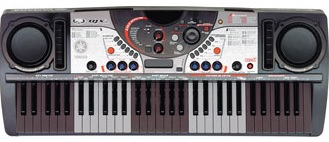
I mentioned the Yamaha DJX-II and its older brother, the PSR-D1 (DJX), in my article about vibe and why we need it. I converted a large number of DJX-II patterns to Genos/PSR styles and always wished to convert DJX styles, too.

Browsing around the Interwebs, one is led to believe that DJX patterns (“styles” in PSR-D1 lingo) were locked away in the DJX and couldn’t be tapped. Yes, the DJX does not send MIDI in SONG mode, but it does transmit MIDI style data in STYLE mode.

So, yeah, I’m crazy — I bought an old DJX (PSR-D1). Guitars 4 Vets was selling two DJXs on the Sweetwater Gear Exchange and I purchased one of them. Like most 25+ year old gear, it’s a bit scuffed up. It cleaned up nicely and is operational enough to yield its “secrets.” Here are a few observations.

Ancient weapons

Fortunately, the DJX Service Manual is available on Elektrotanya in case something goes wrong. The DJX dates back to June 1998 which were truly early days for Yamaha PSR, XG and AWM. Still, we see the beginnings of the classic Yamaha arranger architecture. The clock rates and capacities have changed drastically since 1998, but the general shape (structure) was there.

The key scanning board (MKS3) contains an HD63B05V0F07P CPU. The CPU is an Hitachi 8-bit CMOS microcomputer (8MHz clock) loaded with Yamaha’s custom firmware. The CPU communicates with the tone generator over a serial link. Shades of the E-Bus!

The tone generator is the first member of the Yamaha SWX processor family, the SWX00 (HG73C201FD). SWX processors integrate a host processor, AWM tone generator and effect units onto a single chip. The SWX minimize overall part count and are intended for low-cost keyboards. (The famous RM1x incorporates an SWX00, too.) The SWX00 is clocked by a blazing 8.4672MHz crystal oscillator, demonstrating that you don’t need gobs of gigahertz to perform basic sample-based synthesis.

The SWX00 isn’t going to knock anyone out with sound quality! Hey, it’s DJ-stuff, it’s naturally lo-fi! 22,050Hz evenly divides into 8.4672MHz; that’s 384 clocks per sample which is just about right for early AWM. 22,050 is consistent with sampling time: 6 seconds into 128KBytes of memory. Yes, “kilobytes.”

Caveat: The base sample rate could be as low as 11,025Hz. That divides evenly, too.

Polyphony is 32.

The SWX00 drives an NEC UPD6379AGR DAC. This is a 2-channel 16-bit audio DAC in an 8-pin plastic SOP. The post-DAC LPF is an UPC4570C-based -12dB/octave filter with a 27kHz corner frequency.

Speaking of sampling, the DJX does not have a discrete ADC. The incoming audio signal is routed to one of the SWX00’s analog inputs. The other analog inputs sense the front panel knobs. You ordered lo-fi, right? 🙂

The wave ROM — which contains the front panel voices, GM voices and drum kits — is an enormous 4MBytes. The program ROM is 2MBytes. Working memory consists of a 512KByte DRAM and two 128KByte SRAM devices. SRAM contents are kept alive by its own non-switched power bus. If you want to keep your memory contents alive, you’ll need six D-cell batteries or a reliable power adapter (12V center position 1.5A) — and don’t turn that adapter off! The batteries will slowly drain in the STANDBY power state.

Characteristics

Lo-fi aside, what you get isn’t bad:

  • Front panel voices and General MIDI (GM) sound set
  • GM drum kits plus several “DJ” kits
  • Basic effects: 8 reverb types, 4 chorus types, 33 DSP types
  • 100 styles
  • Two amplified speakers (2 x 6W, 2 x 12cm)
  • 5-pin MIDI IN and MIDI OUT
  • Sustain pedal input
  • PHONES output doubles as the AUX OUT
  • MIC/LINE In for sampling
  • Realtime knobs: cutoff, resonance, groove, assignable, bass boost
  • Ribbon controller and pitch bend wheel

The real-time knobs and master volume control are sturdy enough. The master volume control is a bit scratchy, but it’s set it and forget it. The pitch wheel has taken a real beating, unfortunately.

Arranger people will recognize a lot of basic Yamaha arranger features:

  • One INTRO (“LEAD IN”) and one ENDING (“LEAD OUT”) per style
  • One MAIN A (“BEAT A”) and one MAIN B (“BEAT B”) per style
  • AA, AB, BB and BA fill-ins (BREAK OUTs)
  • SYNC start
  • Chord recognition

That’s where the similarities end. Yamaha was quite creative in those days. There are different key zones and functionality beyond the usual arranger stuff, so be sure to read the manual if you get your own DJX.

Oddities

Here’s a few notable differences and quirks after working with the DJX and making first attempts at style conversion.

Like the DJX-II, the DJX has its own custom drum kits in addition to the GM drum kits (e.g., Standard kit, Jazz kit, etc.) The DJX “Special Kits” are:

  • Analog Kit 2 (T8)
  • Analog Kit 3 (T9)
  • Electronic Kit 2 (T8 + T9)
  • B900 Kit
  • DJX Kit

The Analog Kit 2 and Analog Kit 3 appear to be the predecessors of the well-known T8 Kit (808) and T9 Kit (909). Layout is somewhat different from the modern kits, but the content is similar. Electronic Kit 2 is a zany amalgam of 808 and 909 hits and noises. Maybe Electronic Kit 2 is analogous to the modern Drum Machine kit? Its instrument layout is totally non-standard.

The B900 kit was lifted from the B900 EOS workstation. One must assume that its inclusion was due to an affinity for sound designer Tetsuya Komuro and 1990’s J-Pop. “EOS” stands for “Entertainment Operating System” and is the bridge from QY- and QS-like products to the early Motif era.

The DJX kit was built purposely for the DJX. It includes vocalizations (“Yeah!”, “Go!”, etc.) and scratches. Neither the B900 kit or DJX kits have modern equivalents. The non-standard layouts of the “Special Kits” make style conversion a true PITA.

The DJX-II patterns have chord progressions cooked in. They are the ultimate for the one-finger player. The progressions are hip and are one of the reasons why I like the DJX-II.

The DJX hasn’t decided yet what it wants to be when it grows up. I hear simple progressions in some of the DJX styles. Other styles cater to a single type of extended chord like Cm7(9). Then there is the following description in the DJX manual:

When you play single notes, the DJX automatically produces chords that are based on the root note you play and are best suited to the selected style. For example, all single note chords in the Techno style (#001) are minor, all chords for Trip Hop (#002) are minor 7th 11th, etc. This lets you quickly and easily play the most musically useful and stylistically appropriate chord changes — just by pressing a single key!

Playing full chords may not change the pattern chord as intended. For example, playing major seventh chords will not change the chords of a pattern that has minor and dominant seventh phrases and lines.

There are definitely DJX styles like that. Yikes! It’s going to be difficult to find a consistent transformation from DJX chord behavior to modern arranger fingering behavior. I might need to freeze the chord progressions and make everything one-finger.

Please don’t get me wrong. These differences in behavior might seem like oddities and quirks after using Yamaha gear for so many years. I kinda wish Yamaha would get the old creative mojo again. Both the DJX and DJX-II were nifty inventions.

Copyright © 2026 Paul J. Drongowski

Free DJX-II styles: Version 2

I’m happy to announce version 2 of my DJX-II styles for Yamaha Genos, Tyros and PSR arrangers.

These DJ styles are converted from the original Yamaha DJX-II patterns. If you would like to know more about the conversion process, please see: Mining the Yamaha DJX-II.

These are DJ styles, so they only respond to changes in the root note. The chord progressions are cooked into the patterns (just like intros and endings in regular PSR styles). I tried to find the best mapping from DJX-II patterns to style sections. Therefore, some of the DJXII styles have auto-fill, some do not. Longer “fill” patterns are assigned to the intro and ending sections which can play more than one measure.

Feel free to edit, rearrange and customize the styles in order to make them your own. I recommend Jørgen Sørensen’s excellent tools. Jørgen’s site also has documentation and tutorials about styles and style creation to help you along. Please check it out and support his work!

Click on this link to download the ZIP file.

Version 2 includes all of the files in the first collection. Version 2 adds Drum ‘n’ Bass, Disco, House and Trip Hop styles. The ZIP file includes a README.TXT file which should help you get started with the styles. I have also included PDF notation files for people who read music and want to know about the chord progressions, bass lines, and so forth.

Enjoy! The DJX-II style collection is free.

Copyright © 2021 Paul J. Drongowski

Free DJX-II styles/patterns for PSR/Tyros

Once upon a time (around the year 2000), Yamaha was into beat boxes and other spiffy tools for creating dance, hip hop, and other forms of “electronic” music. The DJX-II groove machine was an entry-level keyboard designed for budding DJs and musicians. It combined a funky looking 61-key keyboard, pattern-based sequencer and basic sound engine into an all-in-one, battery-powered instrument with built-in amplifier and speakers. Genres included techno, trance, garage, hip hop, old skool and trip hop.

DJX-II

The musician or DJ could select from 70 preset patterns, each pattern with ten variations. The variations were further categorized into six MAIN patterns and four FILL patterns. The keyboard was divided into five 12-key zones where each octave performed a specific performance function. One of the zones selected the current variation allowing the player to switch between pattern variations. Another zone transposed the pattern into the current root key.

Yamaha still makes the original DJX-II patterns available through its support site. Each of the files is a standard MIDI file (SMF) containing a single pattern. Although they are in SMF format, the files are not immediately useable. The rhythm tracks are programmed for some truly ancient and arcane Yamaha drum kits, none of which adhere to GM or XG layout conventions. Further, the files cannot be imported and played as an arranger workstation style, i.e., they do not contain the information and format needed by a PSR/Tyros style.

Last December, I developed a process for converting a DJX-II pattern file to a PSR/Tyros style file. I wrote and posted an earlier article on the DJX-II style format and conversion process. I then got to work and converted fifteen patterns to PSR/Tyros style format.

The patterns are all on the jazz tip and they include some pretty hip chord changes! I quickly found that I needed to transcribe the chord changes and bass lines in order to play along. I used Sibelius First to notate the MIDI data in each pattern and saved the lead sheets in PDF files. Knowing the changes makes jamming easier and a lot more fun.

At long last, I’m ready to distribute the converted patterns. Here is a link to the the ZIP file. The ZIP file contains fifteen style files (one for each DJX-II pattern), fifteen PDF lead sheets and a README.TXT file with performance tips.

Update: Check out version 2 of the DJX-II style collection. It’s still free!

I strongly recommend reading the README.TXT file before using the new styles. The converted patterns behave like the new Yamaha DJ styles on the PSR-S670. You only need to play a single note in the left hand accompaniment. No chords are necessary because the chord progressions are cooked into the patterns. The note sets the root note for the progression and the arranger and DJ style take over from there.

Current and recent workstation arrangers should play these styles without problem, save the occasional kit or voice substitution. Good news for musicians with entry-level models (e.g., PSR-E443) as the style files are SFF1 and no OTS. Thus, entry-level arrangers should load and play these pattern styles, too.

Please enjoy playing with these “DJ styles.” In terms of the future, the DJX-II trip hop styles are genuinely sick and I hope to convert them one of these days!