Yamaha synthesizer sneak peek

Blake comes through! [Thanks, Blake.] If you’re interested in Montage M, go direct to the official sneak peek on YamahaSynth.com. Do not pass GO. Save $200 for your new Montage M, if you collect it. 🙂 The sneak peek page has Soundcloud audio demos.
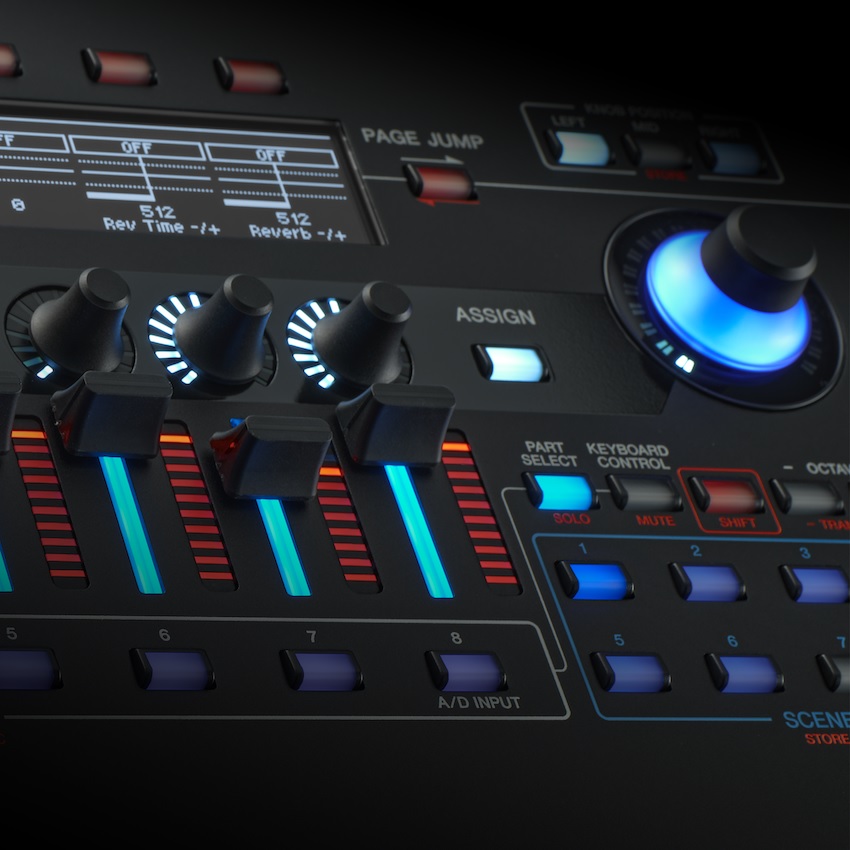
Check out the large subdisplay on Montage M!

The “Vegas nightline” shots pretty well confirm the leak pictures. I loves that subdisplay above the knobs and sliders. It’s much bigger than Genos, can handle graphics, and will prove to be more informative than Genos. I wonder if GENOS2 will get the same subdisplay? That would be grand!

Jason’s labelled flow diagram (from YamahaSynth.com)

I’m trying to make sense of the fuzzy screenshot which looks like an effects routing diagram. Yamaha have clearly done some user interface work, here. Maybe the boxy icons open into parameter tables?

[Update: Jason at YamahaSynth.com did everyone a service by labelling the fuzzy flow diagram. It is the classic synth signal flow. At Yamaha Musicians Forum, a member noted the AN1x color scheme, and then Saul let on that AN-X is included in the M. Good times ahead!]

I don’t see texturing on the white piano keys (in the picture with the ribbon controller). I suspect that the “spy pictures” are an earlier prototype or sound development ‘board. I still have hopes for a decent 88 keybed. The grand piano audio snippets have that distinctive CFX brightness and clarity. The fusion-y “bass effect” audio example is 70s cool and I dig the playing.

The organ Soundcloud snippet has many pulses running fast — my own included. Dare we hope for Stage YC technology? I’ll settle for the improved, Stage YC rotary speaker sim. Yamaha must and will keep reserve special tech in order to differentiate product lines (Montage M vs. Stage vs. P-series).

The Soundcloud examples skew toward bread and butter sounds. The selection of examples will not please the synthbois. Maybe Yamaha is holding AN-X fire for the full Montage M announcement?

This is the way to create excitement for a product instead of boga-zoid teaser videos. The Genos (gen 1) pre-announcement teaser, for example, had nothing to do with the actual instrument — it was a promotional video for some idiotic, boring producer. I hope the GENOS2 roll-out is intelligent, too. Customers are not stoopid.

Now we have something to look at! See you later… If info is slow to appear on my site, it’s because WordPress has suddenly decided to inflict the Gutenberg UI on me. 🙁

Copyright © 2023 Paul J. Drongowski
 

Yamaha NU1XA upright hybrid

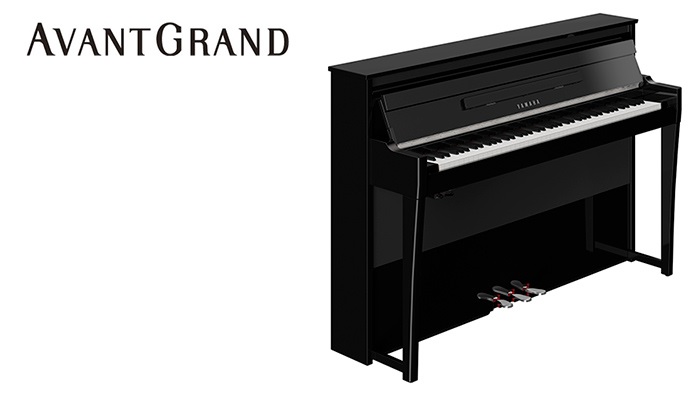
Yamaha’s big reveal of the week is the AvantGrand™ NU1XA with a “renewed sensor and sound system” — a substantial update to the NU1X hybrid piano.

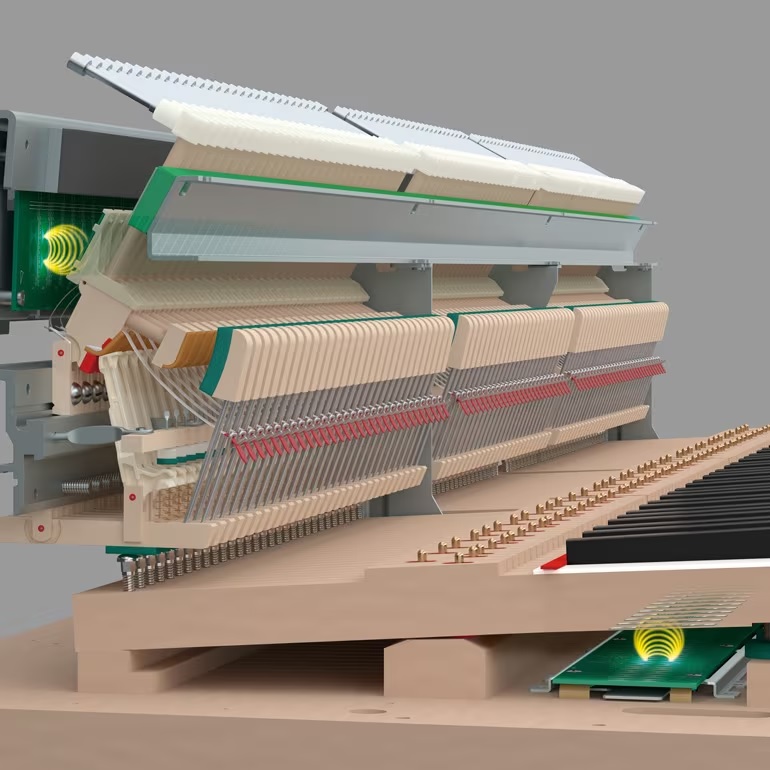
The NU1XA combines the action of an acoustic upright piano with sensors, digital sound generation and immersive audio system. Yamaha claim improved key touch and repeatability. The updated double sensor detects movement of the keys and hammers and incorporates an “Articulation Sensor System” which is responsive to performance gestures (force and timing). The NU1XA has a GrandTouch™ pedal.

Yamaha Articulation Sensor System

The sound system is a new design which reminds me of the CSP-295 digital piano. The sound system uses a tweeter horn structure that allows high-frequency sounds to resonate in front and behind the instrument. Woofer speakers near the player’s feet radiate upward so that sound resonates through the instrument. The goal, of course, is to create an accurate, immersive sound field similar to an acoustic grand piano.

The sound system specs out this way. Amplifiers: (40 W + 45 W) × 2. Speakers: (16 cm + 2.5 cm (dome) with Bidirectional Horn) × 2. Not tri-amplified like the CSP-295 and CLP-785, but respectable and similar to the current NU1X.

The NU1XA has the digital technology that we’ve come to expect from the Clavinova line:

  • Virtual Resonance Modeling (VRM)
  • Grand Expression Modeling
  • Yamaha CFX and Bösendorfer Imperial main piano tones
  • Binaural sampling (both CFX and Bösendorfer)
  • Four fortepiano tones

It has the touch-sensitive control panel from upper-end CLPs and Smart Pianist support.

Taking a quick browse through the manual, the NU1XA has all of the Clavinova’s song playback and recording features. It also has 5-pin DIN MIDI! The voice list is a little short on tones tailored for pop and jazz — just one jazz organ tone, for example. No XG or rhythms.

Newly announced Yamaha NU1XA hybrid piano

The Yamaha AvantGrand NU1XA will be available starting November 2023. Suggested retail prices (Japan):

  • Black mirror polished finish: 473,000 Yen (~$3,200 USD )
  • White mirror polished finish: 539,000 Yen (~$3,700 USD)

Of course, release and pricing depend upon region. Allowing for tariffs and such, those are reasonable prices (hopefully). I presume that the NU1XA will replace the current NU1X which sells for $7,400 (USD MAP) in polished ebony. Who knows where USA pricing will land?

The overall product form resembles a short upright (tall spinet?) and is not as big and bulky looking as the AvantGrand™ N1X. I could see having an NU1XA in our home where the more expensive N1X ($10,000 USD) would appear out of place.

Without hesitation, I’m going to give this one a try once it becomes available. I’ve already established the need for a decent practice instrument leaving orchestra instrument sounds, organs, etc. for MODX and GENOS (gen 1).

Copyright © 2023 Paul J. Drongowski

“M” for multi-core? Multi-touch?

One phrase from the Sayonara Montage announcement sticks in my mind: “As much as we would have liked to, we cannot develop the current MONTAGE any further.”

So, how might the current Montage platform be improved?

SWP70 Standard Wave Processor

The current Montage platform has two SWP70 Standard Wave Processors arranged in a so-called — and somewhat offensively named — master/slave configuration. This tandem has been the mainstay of top-end Yamaha synth and arranger keyboards since the early days of Advanced Wave Memory (AWM). The pair are interconnected by a dedicated, addressable 16-bit data bus (ABUS).

The SWP70 is highly tailored for AWM2 and FM-X synthesis. The tone generation channels are dedicated hardware feeding an internal mixing/effects complex. Digital audio is conveyed on- and off-chip via I2S format serial audio streams. The SWP70 can support up to eight input and eight output I2S streams.

I doubt if this microarchitecture will change much. It seems to be entrenched in the Yamaha engineering DNA. There are two possibilities for improvement.

First, the current Master SWP70 uses only one of its two available WAVE SDRAM memory channels. The WAVE SDRAM is where the SWP70 caches samples fetched from ONFI 4.0 NAND flash waveform memory. The Master SWP70 handles AWM2 synthesis alone. (The second SWP70 handles FM-X synthesis and does not have any wave-related memory.) The unused WAVE SRAM channel is marked “Not Installed” and “For Future Model”. Most likely, the second channel would be used to increase the polyphony spec.

Next, Yamaha could re-spin the SWP70, perhaps producing an SWP71 variant. There is precedent for a re-spin. The Motif ES is based on the SWP50 and its successor, the Motif XS, is based on the SWP51. What Yamaha adds to silicon is anybody’s guess. 😉

ARM host processor

The current Montage host processor runs Linux and has many duties — none of which perform synthesis. The host processor is a Texas Instruments AM3352BZCZ80 processor operating at 800MHz.

The AM3352 Texas Instruments Sitara processor has a spec which is nearly quaint by today’s standards:

  • ARM Cortex-A8 32-bit RISC processor
    • Single core
    • NEON SIMD coprocessor
    • 13-stage superscalar pipeline
  • PowerVR SGX Graphics Accelerator

The modest 800MHz clock lets Yamaha hit the desired power/heat operating point, thereby avoiding active cooling.

The key limitation that catches my eye is “single core”. This means that only one computational thread can run at any given time. Yamaha engineers must positively envy Korg’s use of Raspberry Pi 3 (Broadcom BCM2837):

  • Quad-core ARM Cortex-A53 (ARM V8 ISA)
  • 2 wide issue, in-order pipelines
  • 1.2GHz clock

With RPi3, one gives up superscalar for simpler in-order pipelines, but you do get to run four threads simultaneously.

I’m sure Yamaha engineers have studied newer, available embedded ARM processors for Montage M. Does the “M” stand for multi-core?

Guesses, anyone?

If Montage M goes multi-core, this opens the possibility of software instruments (and effects) running on one or more of the host processor cores. Current Yamaha synths allow expansion through sample libraries only, while competitors support the addition of new engines. Kind of ironic considering that its captive Steinberg developed VST plug-ins in 1996.

Even the lowly Korg NTS-1 supports the development and addition of new oscillator and effect models through the logue SDK (API) and librarian.

So, readers of Yamaha Musicians Forum, does the prospect of software plug-ins get Saul’s pulse racing, again? 🙂

The new choice for host processor and its embedded display controller may also give Montage M a new multi-touch display. Could “M” also stand for “multi-touch”. Using the Montage touch screen as an X-Y pad always seemed like a no-brainer… Then there are new possibilities for multi-touch articulation.

It’s worth noting that the new Montage M platform may leave MODX+ in the dust. I don’t expect much functional trickle-down from Montage M to MODX+. The MODX+ platform is riding the profit-pumping, low-cost technology curve and won’t be able to keep up with its jacked brother.

Copyright © 2023 Paul J. Drongowski
Random weekend thoughts

A bunch of crazy thoughts after the long holiday weekend…

Yamaha P-S500 price drop

The Yamaha P-S500 is a baby Clavinova Smart Piano (CSP) in the P-series portable digital piano line. The P-S500 has a greatly simplified front panel: ten touch-sensitive control buttons and a 2 line by 16-character display. [Hey, the 1990s called and want their display back!] This user interface parsimony simplifies the overall appearance of the instrument and makes space for the streaming (falling) light display above the keybed. The P-S500 has the CFX piano, of course, and the rather nice Bösendorfer — both enhanced by VRM

Like its CSP brethren, You need the Yamaha Smart Pianist app in order to dig deeper. Once you get below the surface, you’ll find auto-accompaniment and a slew of secondary voices taken from Yamaha’s mid-range arranger keyboards. The S500 voices are roughly equivalent to the PSR-SX600 arranger. Some people trash arrangers, but many of the arranger voices are taken from Motif XF! These voices are much better and cover a wider range of sounds than the recycled string, synth pad, choir, bass and vibraphone in much of the digital piano line. [My only beef with the P-515.]

Why mention any of this? September 1 and new price lists are out. Initially, the P-S500 was offered at $2,000 (MAP). Presto chango, and the new MAP price is $1,600 USD, same as the P-515.

At the new price, I think it’s worth considering as an alternative to the P-515. Unfortunately, the S500 has only the GHS action, losing the rather wonderful, P-515 NWX action. You also give up 5-pin MIDI. Worth a look if these things aren’t important to ya.

Hey, Yamaha!

Wanna sell more P-S500s? Put them in Music & Arts retail stores where people can find them. I have yet to see an P-S500 in the flesh…

While you’re at it, rename the “Smart Pianist Specifications” PDF to something meaningful to a customer. I installed Smart Pianist on my iPad to see see its tricks. Without Smart Pianist being connected to a compatible keyboard, I didn’t get clue one about what it can do. Open “Smart Pianist Specifications,” however, and I see the Smart Pianist features supported by each of the compatible keyboards — quite helpful to a prospective customer who wants to know what Smart Pianist can do.

Yamaha, do real people actually test your keybeds? I can’t imagine inflicting the GHC (P-225) keyboard on beginners. Stop being so secretive and get these things into the hands of real customers! The GHC needs to be fixed, now, before production ramps up. Try before buy, folks, as GHC is not merely an improved GHS.

Finger drum pads

The Yamaha FGDP Finger Drum Pads have dropped (finally). Thanks go to all of the sleuths who uncovered the FGDP trademark and so forth. The FGDP-30 and and FGDP-50 will advertise for $199 USD (USA MAP) and $299, respectively.

Yamaha FGDP-30 and FGDP-50: Recognize that trademark logo?

Yamaha, since the Montage M doesn’t have drum pads, did you test the FGDP-30 and FGDP-50 with Montage M? 🙂

Presence, absence.

I’m not the only person to notice the absence of Montage M leak stories on MusicRadar, Gearnews, and a few of the other big-name Web sites. Yet, there were the FGDPs big as life on MusicRadar this morning.

My guess? They all have Montage M review units and are under NDA. Expect Montage M reviews when the news embargo is lifted on announcement day.

Copyright © 2023 Paul J. Drongowski
Yamaha P-225 review: It’s not for me

One of the drawbacks of playing high-end instruments is that it is hard to go back to entry- and mid-tier keyboards. Therefore, I’m going to use the Yamaha DGX-670 as my reference point in this review. Comparing the new Yamaha P-225 against DGX-670 is both fair and informative. Both instruments feature the CFX grand, both have VRM Lite and both sell for $750 USD (MAP). I’m going to focus on acoustic piano, electric piano and, to some extent, basic secondary sounds.

The big question in everyone’s mind is the new Grade Hammer Compact (GHC) keybed which helps make the P-225 slim and (lighter) weight. The DGX-670 has the well-known Yamaha Graded Hammer Standard (GHS) keybed. The GHC keys have a solid feel even though they are plastic through and through. No texturing.

The DGX-670 GHS is enjoyable to play. The P-225 GHC is not. In one word, its “work.” GHC has a springy resistance that is felt immediately. The one and only up-side is the ability express dynamics with more ease than the DGX-670 GHS. You can get some relief by increasing the volume slider or, perhaps, by changing the touch response.

My hands are 72 years old and somewhat arthritic. My hands hurt after playing the P-225 for one hour. I spent an hour with the DGX last Saturday with no ill-effect at all; It was downright fun to play it. Not so, the P-225.

Organ, strings and pads are difficult to play on GHC. Forget smooth organ-like playing gestures — GHC makes you dig in. I question whether I would want GHC for MIDI control as legato gestures would be labored.

If you’re buying on-line, please do not assume that GHC is a clone of GHS with a similar touch. Nothing could be farther from the truth. Try before buy. Do not buy a GHC-based keyboard on speculation! (Same goes for the Yamaha P-145 as it, too, has the GHC action.)

The CFX grand is the 225’s featured piano. I preferred the mellower sounding Ballad Grand variation. The front-firing speaker system does not do the CFX sound any favors. The 225 AP sounds thinner than the DGX-670. The DGX, with its upward firing woofer and tweeter, sounds richer than the 225. If you want better sound, expect to add external monitors to your P-225.

The P-225’s electric pianos are typically Yamaha. They are decent enough and do not offend. The string sounds — also typically Yamaha — do offend me and need a serious update. The Synth Pad voice is pleasant and usable. The pipe organs are OK and, like the strings, are Yamaha perennials.

Frankly, I would take DGX-670 over P-225. The sound system is better and the available secondary voices are numerous, varied and quite good. The DGX secondary voices are taken from Yamaha’s arranger series. The P-225 secondary voices are very limited in comparison. The P-225 wins only on portability (size and weight).

If you need a light-weight slab piano, I recommend trying the deprecated P-125 wide-by-side with the P-225. The P-125 is a decent sounding instrument and you may be able to buy one at a reduced price. I suspect that retailers have P-125 inventory to sell through.

Wish I could be more positive, but the P-225 is not for me.

Copyright © 2023 Paul J. Drongowski
Montage M preseason

Forum folks are picking over the Yamaha Montage M leak photos, so no need to duplicate that here! Wish we spent as much attention on world peace. 🙂

Many comments — my own included — are reading personal hopes and dreams into the new boxen. My own special hope is a decent keybed action for piano practice. I’m seriously looking for a practice digital piano in order to work out arrangements and get ready for Sundays when I need to sit down at the Petrof acoustic grand. That’s why my own guess of “X” for “escapement” is an act of wishful thinking. Dare I hope for Virtual Resonance Modeling?

The time period between leak and reality is much like football preseason. Right now, it’s the perfect season. Your team looks pretty good, no major injuries, and “Superbowl here we come!” Then, like a perennial Browns fan, your hope is slowly extinguished week by week. [Well, that was bleak.]

When I saw Yamaha’s parting gift — the character pianos — I thought, “We’ll be seeing these, again, shortly.” So, I won’t be surprised to find CFX, Bösendorfer, U1 Felt, U1 upright, Nashville C3 and friends in Montage M. Even if the pianos aren’t factory installed, there’s always expansion flash memory. Could I hope for the CK pipe organs? Same answer.

The most striking features in those horribly blurry, low-rez, leak pictures are the textured keys, six new knobs below the main touch screen and a new subdisplay above the bank of eight knobs and eight sliders. The subdisplay is a feature borrowed from Genos. On Genos, it’s called the “Live Control” subdisplay. Instead of fixing internal parameters to TONE, EQ/FX and ARP/Motion FX, the user can assign internal parameters to knob/slider groups and switch between groups in real-time. The subdisplay tracks current parameter values, updates and so forth.

Of course, the big question is “What are the internal engines?” AWM2 and FM-X are givens. Wishes include AN-X and the YC stage tonewheel organ. More engines means more parameters, so that Live Control subdisplay seems like a really good idea™.

The more I contemplate functional details, a larger question arises: “How will Yamaha keep the Montage M, Stage CP and Stage YC in their own lanes?” Yamaha need to make Montage M inviting while keeping the CP and YC specialists special. I think Montage M will follow the Montage line and remain a jack of all trades, integrating multiple engines into motion control, sequencing and studio audio/MIDI channels. Sound designers and players who need a generalist keyboard will still turn to Montage M.

Organists and pianists will turn to Stage YC and Stage CP. The simplified, focused user interfaces have proven successful — little or no menu-diving required. Yamaha have learned a lot after introducing the Stage CPs at January NAMM 2019. [The Stage CP tech is even older; check dates in the manuals.] The Stage YC interface is an improvement on the Stage CP. Hopefully, some of this experience has trickled over to the Montage M.

Which brings me to my concluding question. Even if we see AN-X in Montage M, will we eventually see an AN-X specialist keyboard, a Stage AN? Montage M would need to fit AN-X into its generalist usage model and I don’t think that will satisfy analog purists/players. [How ’bout alternate MPE control, too?] I think there is an open lane for a control-studded Stage AN specialist.

Copyright © 2023 Paul J. Drongowski
Yamaha P-525 on the way

Most eyes are on the Yamaha Montage M series leak. However, the list of new Yamaha products revealed on Yamaha Musicians Forum includes “P-525B” and “P-525WH”, indicating a successor to the P-515 digital piano. (The P-515 was released in 2018.)

Further evidence popped up on a Yamaha regional site. The digital piano accessories page shows the L-515 stand and refers to an “P-525” as well as “P-515”. This situation is not unlike the pre-announcement days of the CK88. “Hey, look, there’s a music rest for the unannounced CK88!”

Should we expect a Yamaha P-525? I think so!

The new P-225 and P-145 models each received matching stands: L-200 and L-100, respectively. The P-525 will use the same old stand as P-515. Therefore, I don’t anticipate any big change in the P-5×5 form factor.

Given the modest bump in model name, I wouldn’t expect much more than a functional spiff (i,e., a small refresh). Maybe a few more voices? Maybe a few more rhythm patterns? I wouldn’t mind “Grand Expression,” but I’m not holding my breath.

We’re coming up on the September/October triple-witching hour: new product roll-outs, new price lists, and “Back to School”. If you’ve worked in electronics retail, you know there are three selling seasons in North America: “Back to School”, holiday, and “Dads and Grads”. We’re about one month into the Back to School season.

I stopped into Guitar Center last weekend to try a P-225 (no luck). I saw the same deep stacks of P-45 and P-125 digital pianos. Big retail stores are over-stocked on some models and I expect to see price reductions or promotions for deprecated products in the near future. Maybe you can pick up a digital piano at a blow out price while the new models trickle in?

There are rumors that Roland will try to spoil the Montage M announcement with a major Fantom update. Yamaha never like to pre-announce, so the Montage announcement in July 2023 was a big deal. Was Yamaha trying to spoil Fantom sales? Watch these two daikaiju duke it out!

Update: Accessorize!

Don’t forget to accessorize!

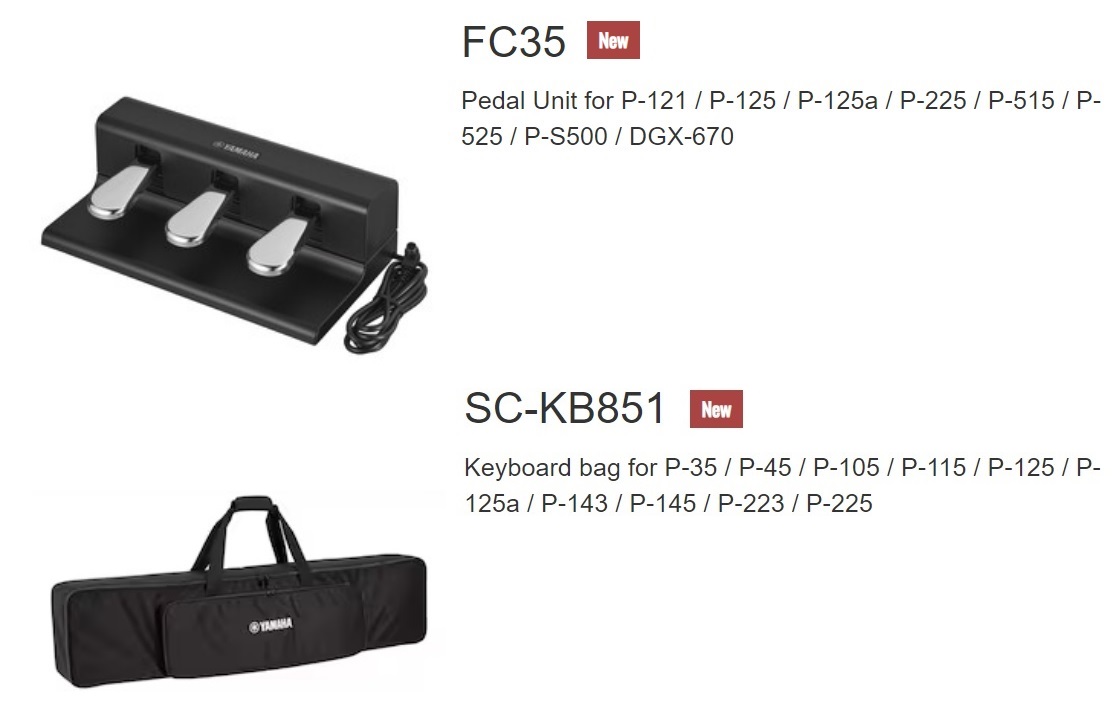
Yamaha will be introducing a new triple pedal unit, the FC35 — a stand-alone unit which you can throw into a (large) gig bag. The FC35 will be compatible with models having the 6-pin DIN LP-1 connector: DGX-670, P-121, P-125, P-223, P-225, P-515, P-525 and P-S500.

New Yamaha digital piano accessories (Sept 2023)

Need a keyboard gig bag? The new SC-KB851 will handle P-35, P-45, P-115, P-125, P-142, P-145, P-223 and P-225. Availability may be limited by region.

Copyright © 2023 Paul J. Drongowski

Patience is a virtue

But, wait! There’s more!

mx49 posted this list of new product names extracted from a Yamaha warranty registration site:

    147641 - MODX6+ //E 
147642 - MODX7+ //E
147643 - MODX8+ //E
147752 - P-125AB
147753 - P-125AWH
147970 - CK88
147971 - CK61
149017 - P-143B
149018 - P-145B
149019 - P-225B
149020 - P-225WH
149496 - GENOS2 //Y2
149720 - MONTAGE M6 //E
149721 - MONTAGE M7 //E
149722 - MONTAGE M8X //E
149729 - P-525B //Y2
149730 - P-525WH //Y2

Oh heck, might as well throw in the new STAGEPAS 100 BTR and STAGEPAS 200 BTR:

    STAGEPAS100 //B 
STAGEPAS100BTR
STAGEPAS200 //B
STAGEPAS200BTR

Thank you, mx49, and the rest of the folks at Yamaha Musicians Forum.

The Montage M series leaked yesterday. Now we know that GENOS2 is on-the-way sometime in the near-term future, too. 🙂

Regular readers know that I’m trying out 88-key digital piano keyboards and developed a fondness for the Yamaha P-515. The P-515 was release in 2018 and it will be replaced by the P-525, again, sometime in the near-term future.

Wow, the new Montage MX8 and P-525 — both are worth waiting for and both potentially fill an actual need. Patience is a virtue. Keep repeating that. 🙂

I’ll have more thoughts about all of this tomorrow. Today is a typical Sunday — gig, God and football. Take a breather and start the new week fresh!

Copyright © 2023 Paul J. Drongowski

Yamaha Montage M6, M7, M8X

Is this the real life? Is this just fantasy?

Pictures of the new Montage M8X have surfaced on the Facebook. I thank the folks at Yamaha Musicians Forum and the Musicplayer Keyboard Corner for the pictures and off-the-cuff comments. I suggest reading the ongoing discussions at these fine and well-informed Web sites.

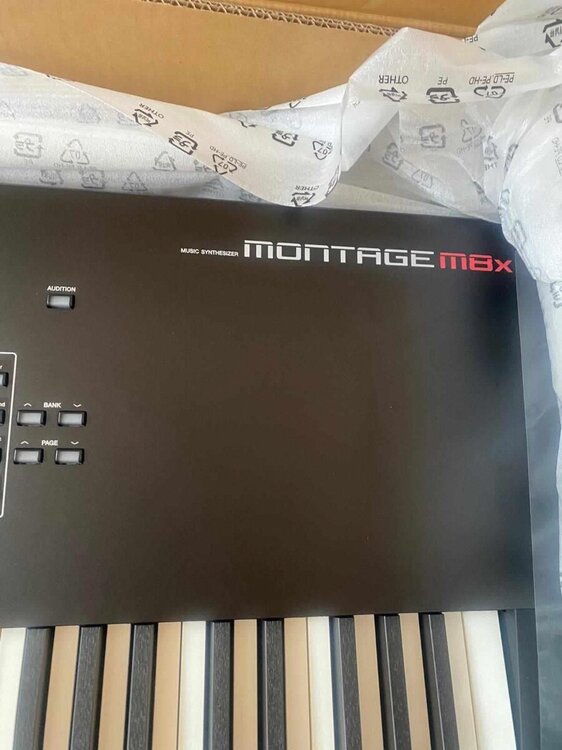
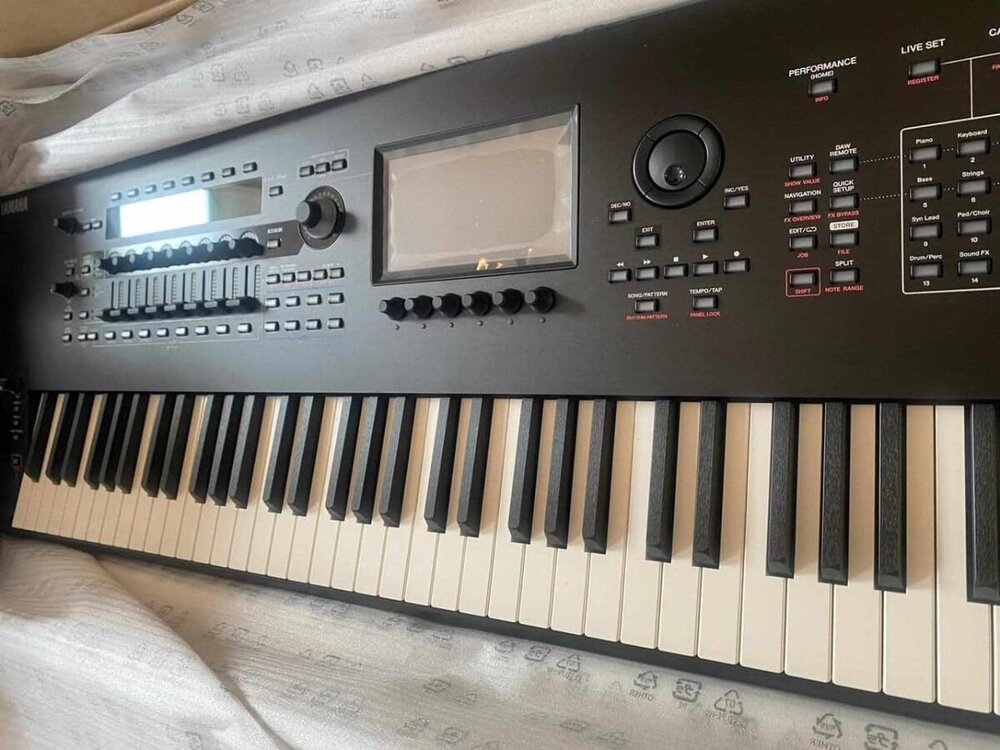
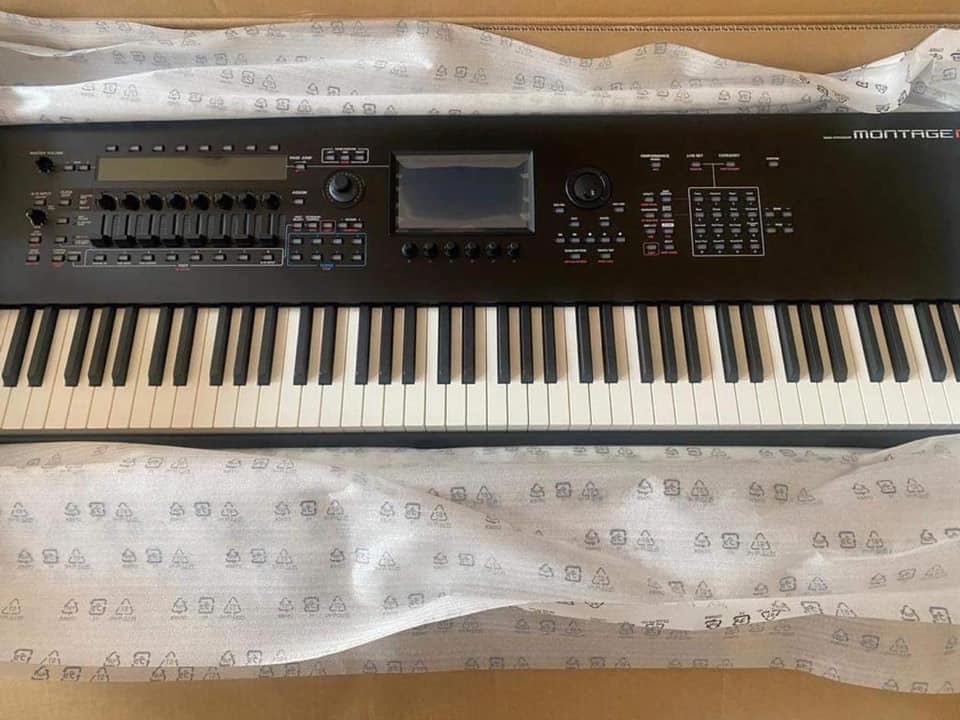
Montage M8X in da box

The names “Montage M6”, “Montage M7” and “Montage M8X” are also confirmed.

Montage M8X — Does “X” stand for “escapement”?

Astute forum members at The Keyboard Corner noted the textured keys on the 88 model (Montage M8X). This raised my hope that Yamaha put the Natural Wood, Graded Hammer (NW-GH) keybed into the new Montage M8X. I’m hoping that the “X” stands for “escapement.” Will it have the triple sensors like the CP88? Will it have Virtual Resonance Modeling (VRM)?

Montage M8X — 8 sliders and a simplified button matrix

Yamaha have my attention now and I will hold any decision on a piano for home until I see all of the details. At the premium price tier, I can be patient.

Let the kvetching commence! 🙂 I’m off to Saturday breakfast with the fam.

Copyright © 2023 Paul J. Drongowski

Field trip: N1X and CLP-785

Having tried Yamaha‘s lower-end digital pianos, I decided to try the upper end. So, I took a short field trip to Classic Pianos Bellevue, WA.

First, a shout out to Classic Pianos! They have a huge piano showroom in Bellevue, WA covering the full range from entry-level to the concert stage. Their manager was super friendly and helpful. I recommend visiting if you are questing (lusting) for a digital or acoustic piano.

My original goal was to try the top of the line spinet-style CLP-785. The general manager suggested trying the N1X hybrid, which proved to be an excellent idea even though the N1X is beyond my budget. The CLP-785 is expensive, but within striking distance price-wise. Playing the two instruments gave me a basis for comparison between higher-end, digital instruments.

Overall, this was a worthwhile trip. I have a better idea of the tangibles offered in each price tier. Furniture aside, it all comes down to the piano playing experience: touch (action), expression, and sound (sound system). Secondary features like extra voices, recording, touch display, and so forth are less important in the Yamaha product line. All models have similar, equivalent or identical secondary features (e.g., maybe a different number of voices or effects).

Yamaha N1X

Even though I didn’t spend as much time with the N1X, I thought I would mention it first in order to draw comparisons. The N1X is a hybrid digital with a for-real grand piano hammer action, digital synthesis and a superb sound system. Quite frankly, one can play the N1X and forget that it uses electronic audio reproduction. The response and acoustic sound field are authentic. In other words, you believe that you are playing a for-real acoustic piano.

Anybody can bang away at a piano. (I’ve been guilty of this sin, mea culpa.) To me, the real test is how an instrument responds to delicate gestures. Can a player bring out quiet nuance? Can a player swell and ebb across a large dynamic range? The N1X ably passes this test.

Amazing. The only thing better is the real thing. I briefly played a Yamaha C7 grand at the end of my session of trials. Yes, the C7 is fantastic and excels at response. We’re talking $10,000 USD (N1X) versus $68,000 (C7), folks. I didn’t dare profane one of the Bösendorfers on display… 🙂

Yamaha CLP-785

Uppermost, I wanted to try the CLP-785’s GrandTouch action. The 785 has the most refined action in the CLP range with linear-graded, wooden (white) keys and counterweights. The 785’s sound system is tri-amplified (woofer, mid-range, tweeter) and has transducers to add soundboard emulation.

After waxing rhapsodic about the N1X, it seems like anything I say about the 785 is faint praise. However, the CLP-785 ($6,400) is a solid citizen and I would be happy to own and play one. The action and key-to-sound connection allows subtlety and nuance. Practice on the 785 should translate well to the Petrof acoustic grand at our church — my top requirement. And, playing the 785 was down-right enjoyable without overtaxing my hands. [71 years old and somewhat arthritic.]

The 785 synthesis and amplication system produces a pleasant sound field. Not as authentic as the N1X, but a definite step up from the CLP-775. I think Yamaha are on to something with these transducers. They have added bi-directional horns to the new CSP-295 for soundboard emulation. Thus, I’d like to give the CSP-295 ($7,300) a spin when it’s available at Classic Pianos. Finally, I’d like to try a CP88 — if I can ever find one — just to round things out.

Well, there you have it. The quest goes on and I’m in no hurry. The N1X and CLP-785 are serious money, so careful and slow is the way to go. Plus, we’re heading into the Fall product announcement season. Will Yamaha celebrate the 40th anniversary of the Clavinova with new CLPs?

Copyright © 2023 Paul J. Drongowski