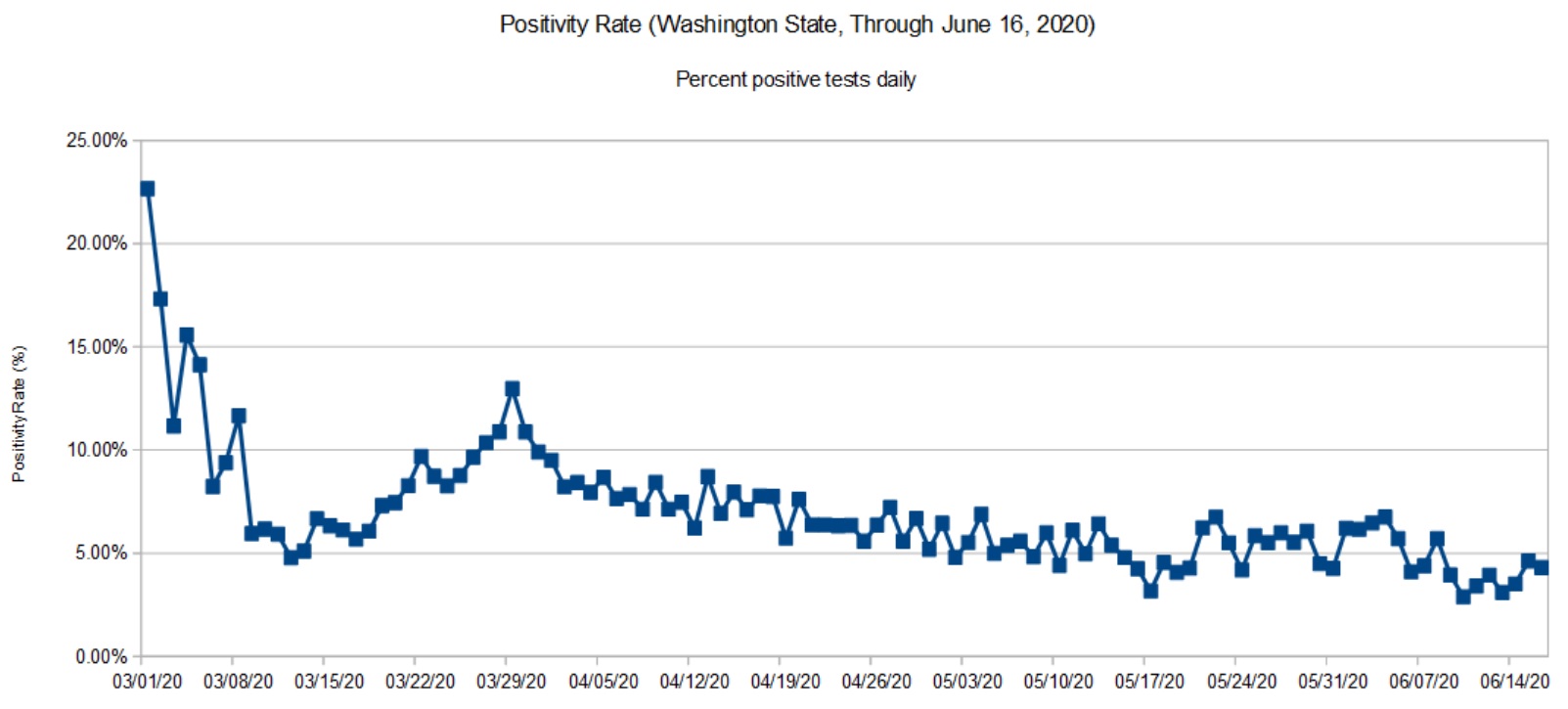
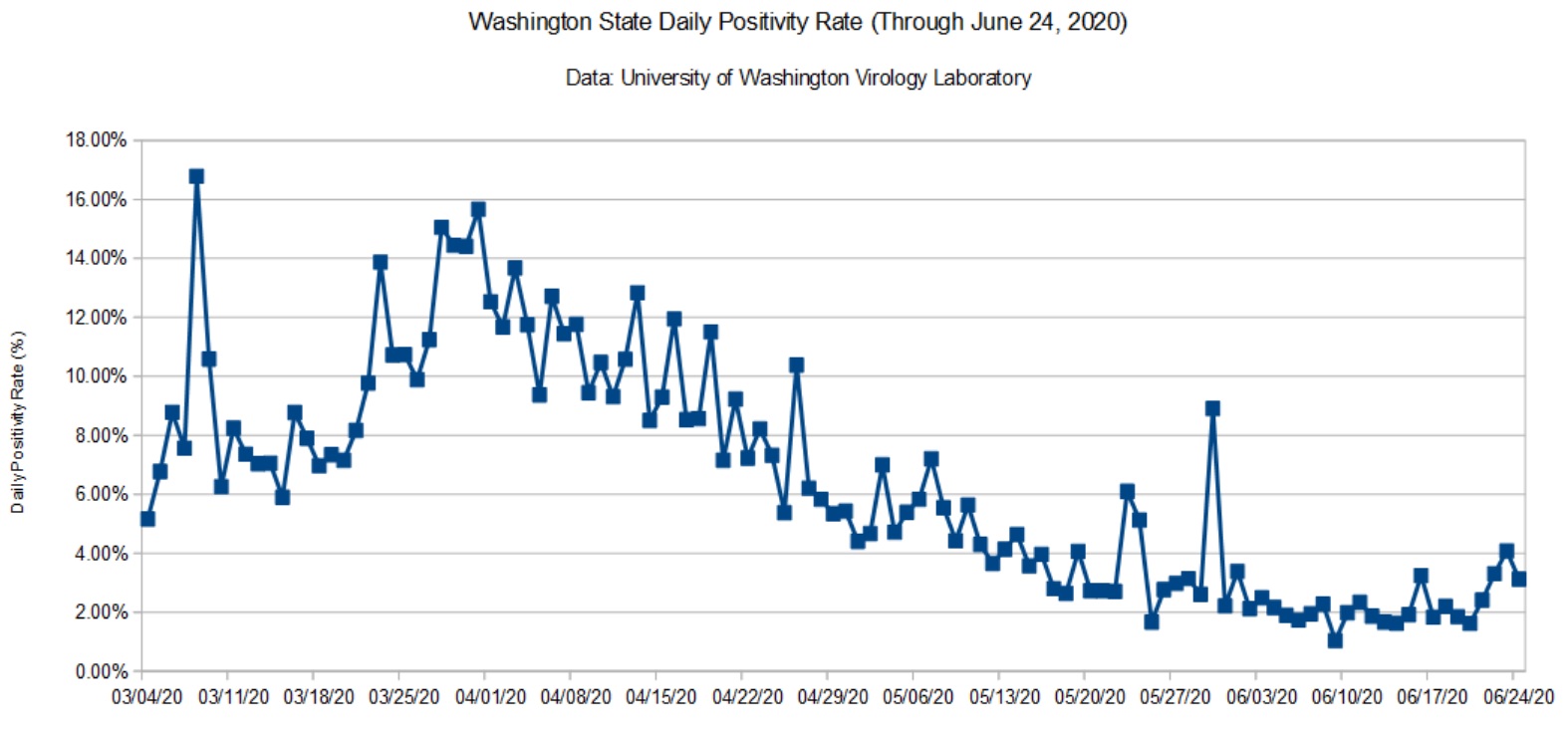
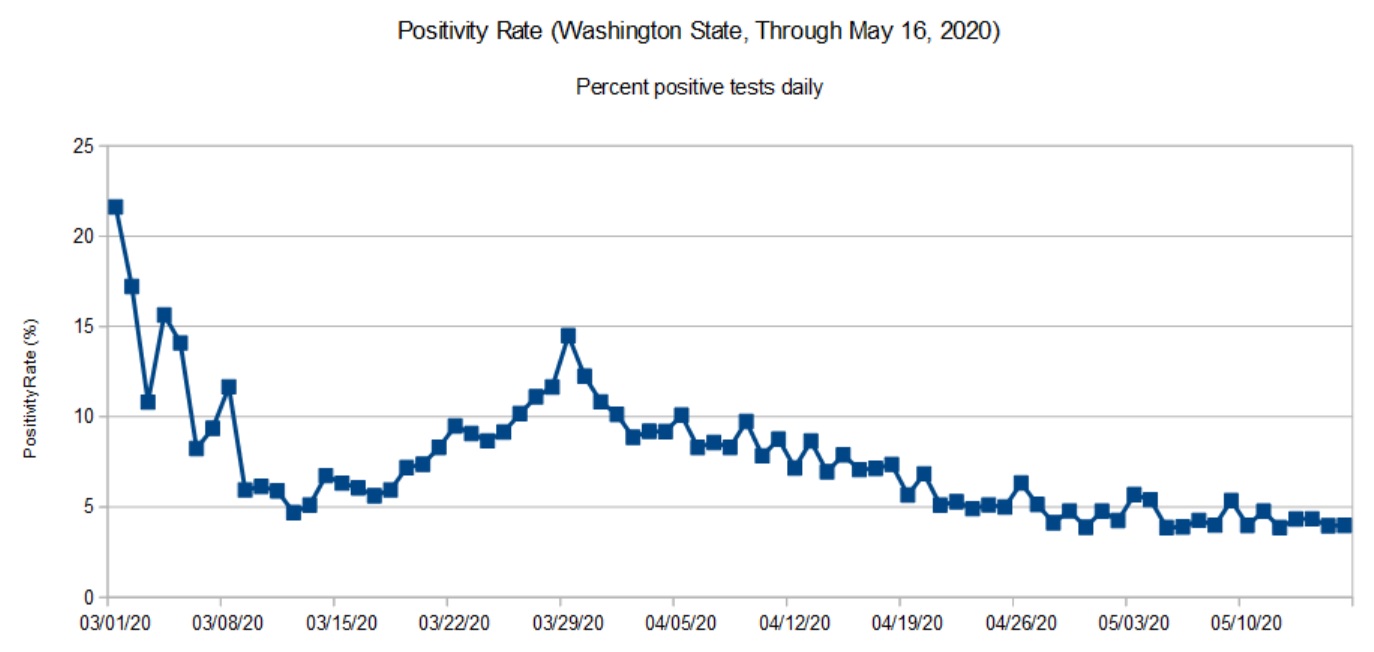
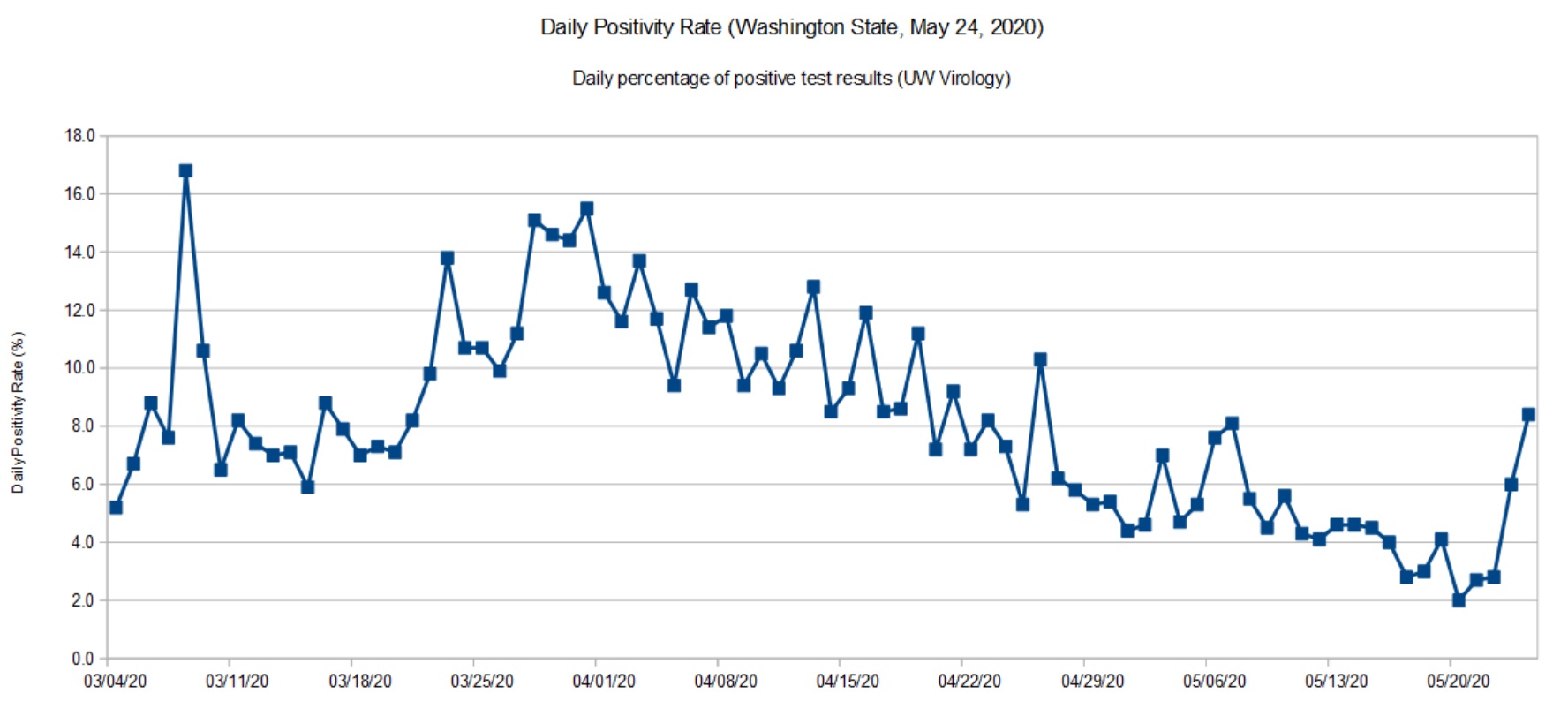
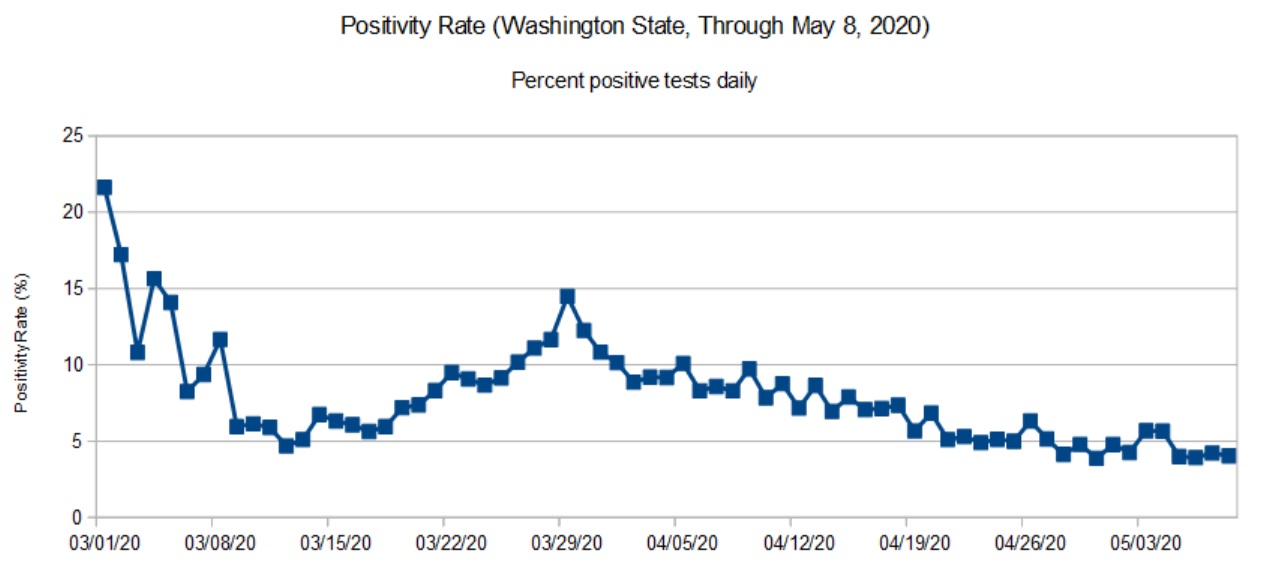
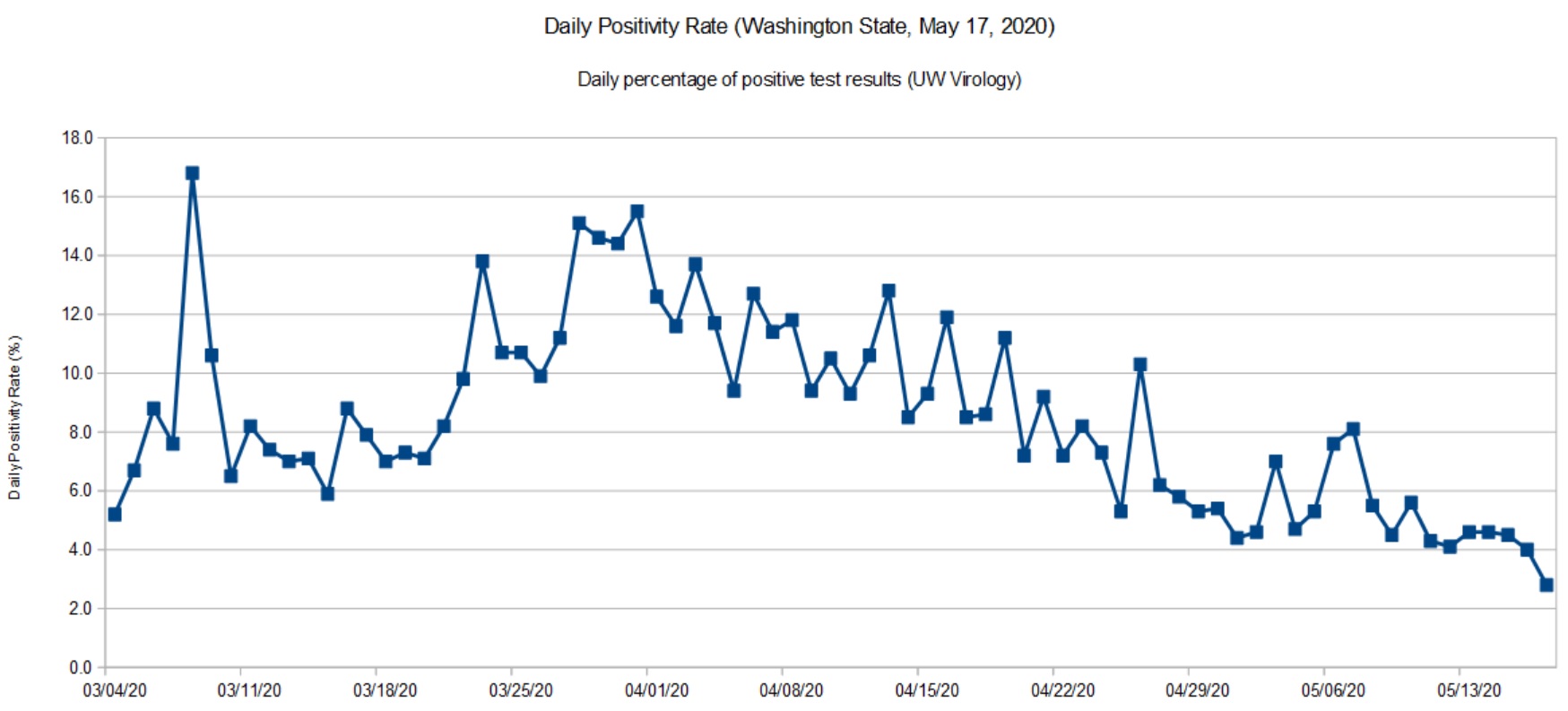
Here is my COVD-19 update taking us through June 24, 2020. Data are taken from the Washington State Department of Health (DOH) and the University of Washington Virology Lab (UW). The DOH data are complete through June 16, 2020 and that is what is shown here. [Click images to enlarge.]
Washington State Positivity Rate (DOH, June 16, 2020)Washington State Positivity Rate (UW, June 24, 2020)
We’re seeing a small uptick which is probably due to the BLM protests in Seattle (early June) and the worsening situation in Yakima County. My daily tracker indicates a roughly 5% positivity rate that is consistent with the charts above.
The recently announced NY/NJ/CT travel quarantine initially included Washington State. That really surprised me and sent me diving into the data. However, it appears that the NY/NJ/CT authorities reacted to a temporary “condition” in the data. Giving them the benefit of the doubt, the DOH did a massive update recently, taking seriology tests out of the daily testing statistics. I took a numerical tour of the hottest states recently and was appalled at the inconsistency and shortcomings in reporting. (CDC? Hello? Anybody home?) Confusion is somewhat understandable.
Several weeks ago, I decided to record the church tunes that I enjoy playing. It’s best to start with favorites, as most of you know how you come to detest a track after playing it over, and over, and over again during production. Energy quickly dissipates when micro-editing MIDI events or digital audio…
Before getting into production notes, here are links to the final tracks (all MP3). The goal was to crank out a new tune each week and send it to the folks in our music ministry. Some tunes are a little more polished than others. Please consider them “demo quality.”
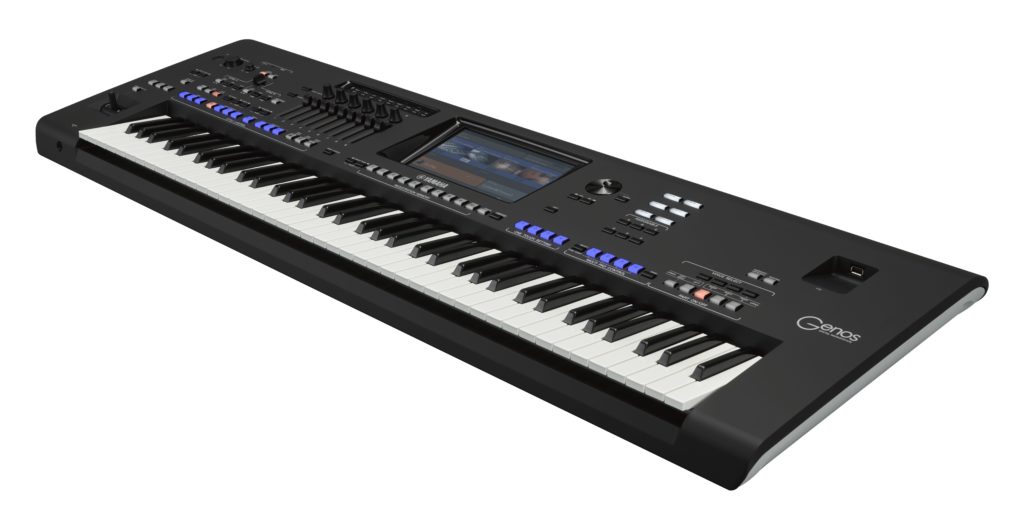
Without going too far into the technical weeds, the primary sound source is Yamaha Genos™ and the primary vocalist is my spouse Fran. With the Mill Creek Chorale on hiatus — aren’t we all? — I was happy that she could contribute and have fun, too.
Production notes
So, how did all of this go down?
These demoes show off the Yamaha Genos as a sound source and production tool. I had two main subgoals:
Learn how to record a demo with Genos in either audio or MIDI format.
Learn how to mix down with Steinberg Cubase Artist and try out a few of the freebie plug-ins that I’ve collected.
By and large, Genos and Cubase were the main production tools although I back-slid into SONAR on a few occasions for MIDI editing. Old habits die hard. Workflow was not strictly linear from Genos to Cubase. In a few cases. MIDI and/or audio (stereo 16-bit 44,100 WAV) were slung back and forth between tools.
Yamaha Genos
Genos is the sound source with one big exception: drawbar organ. When you hear B-3, you’re hearing Yamaha MODX through an Electro-Harmonix Lester K. I wanted to hear Lester K in musical context. It sits in a song pretty well and has more guts than the Yamaha MODX Leslie simulator. By itself, though, Lester K has some high-end swirliness in the upper drawbars, but in a track, it seems to mesh. You be the judge.
Emphasis was on speed. Get the tracks down quickly and finish a song each week ASAP. The Beatles used to call this recording “on heat.” Even so, it’s amazing how modern technology will drag you into the dank chasm of production minutiae. Don’t you just love hearing the same three measures fifty times while tweaking and tweezing. Not.
All vocals were recorded directly to Genos using its microphone input. Full backing and raw vocal tracks were exported to Cubase via WAV. Everything was processed and mixed in Cubase. The final mix was exported from Cubase as WAV, and then trimmed and converted to MP3 using Sound Forge Audio Studio.
Our God Is Here This was the first demo in the series and the process doesn’t get any simpler than this. All was recorded into Genos Audio Multi Recording. Find a beat, turn it on, lay down the organ part. Unfortunately, I didn’t plan for the ending, which is quite ragged. The organ is Genos in this case (not MODX). Kinda plain, huh? The bass is an overdub.
Audio Multi Recording is a nicely done sound-on-sound recorder a la Les Paul, minus tape hiss. There are two stereo tracks: main and sub. You can record directly to either main or sub, and bounce (sub+main) to main. There are options for punch in and overdub. Audio Multi Recording provides WAV import and export, functionality which eventually got a true work-out.
Audio Multi Recording keeps digital audio in a persistent project. A project resides in the internal Genos 60GB user solid-state drive and is always ready. The project remembers audio and mix settings without requiring explicit save and load user operations. That makes for a clean workflow. Export is the way to get digital audio into a WAV file and it mixes the main and sub on the way to WAV. In order to export a solo vocal track from sub, one needs to dial down the main and then wait while Genos writes the WAV file in real time. I wish there was a simple, direct fast export to WAV supporting both main to WAV and sub to WAV.
In The Day Of The Lord I quickly realized that I do need to think ahead and assemble a basic skeleton on which I could build a tune. (Duh!) In this case, Toontrack EZDrummer provided the drum patterns which I pulled together in Cubase. Genos played the MIDI drum track while I recorded the flute as a melodic guide and layered in the bass and organ — all recorded as audio. We then did a few vocal takes to Genos. I transferred all of the Genos audio as WAV into Cubase for the final mix. Vocal processing typically was light: a little pitch correction, EQ, and maybe double tracking. A touch of reverb (Cubase Revelation) blends everything together here.
Stop By, Lord This tune makes use of the Genos rhythm accompaniment consisting of main patterns and one-bar fills. I recorded a basic guide track in MIDI using the “BigBandBallad” style as the drummer. This meant switching the main and fill patterns with my left hand while playing the melody with my right hand. I layered in the piano, bass and horns, discarding the guide melody along the way. I added the B-3 organ (MODX through Lester K) in an audio pass. Everything was recorded and produced on Genos since we didn’t record vocals.
Psalm 95 If Today “If Today” makes full use of the Genos arranger features. I played the basic accompaniment track using the “Sunny Reggae” style. Whoever built that style, it must have been a labor of love and it fits this song quite well. I vocoded my voice. Both the accompaniment and vocal tracks where exported to Cubase for final assembly and mix down. I had a lot of fun adding dub effects and tons of reverb, Long live King Tubby!
Rise Up With Him “Rise Up” was recorded to MIDI, again using the Genos rhythm accompaniment as the drummer. The electric piano went down first followed by the bass. The B-3 organ is MODX through Lester K. Backing and vocal audio were exported to Cubase for final mix down. Overall, a pretty simple demo to pull together.
O Sacred Head I recorded the MIDI for this tune a long time ago — in the early 2000s on a Roland XP-60. The guitar picking was carefully edited and assembled (years ago!) from Twiddly Bits. I imported the XP-60 MIDI into Cakewalk, choosing Genos voices and effects. The Genos result versus the original XP-60 is amazing. Fran encouraged me to leave it as an instrumental.
This Is The Day This psalm is long out-of-print. A few years agao, I transfered a scruffy copy of the piano score into Sibelius. So, to kickstart this tune, I exported MIDI from Sibelius, restructured the sections, and humanized the piano as much as possible. I tried to keep the accompaniment simple adding just bass and horns. Once again, the backing and vocal tracks were mixed in Cubase. This demo is a good example of Arturia’s Plate-140 reverb — a freebie that Arturia gave away during the Christmas holiday. I love it.
Lead Me, Lord Another simple turn-on-the-beat-box, sound-on-sound production. Everything was recorded to Genos with the backing and vocal tracks exported to Cubase. (Another example of Plate-140, BTW.) The vocal harmony was generated by a TC Helicon Play Electric added in real time. Recording and production was dirt simple although it took a while to get the TC Helicon configured.
Alleluia! Love Is Alive This was the penultimate demo in the series. The basic track is a stripped down Genos “6-8PopBallad” style. Yamaha tends to over-orchestrate styles, so I kept drum, bass and guitars, tossing the rest. Instead of playing the basic track, I created the accompaniment using chord step-record. This MIDI Multi Recording feature lets a musician enter chords and sections from a lead sheet, quickly creating the song skeleton. You can even try different styles if you haven’t chosen one already. Once the skeleton is set, you expand the chord track into MIDI events, thereby obtaining the full backing track in a Standard MIDI File (SMF).
I added the Celtic violin by playing it into a free MIDI track. Using Sonar, I tweaked the tempo in the full MIDI song in order to add energy as the song progressively builds to the end. Finally, with the MIDI finished, I froze the backing tracking to WAV audio. The backing and vocal tracks were mixed down in Cubase with a little automation here and there to add vocal depth and double tracking.
Conclusions?
The preceding discussion is already a lot to absorb and to process. I’ll take a step back in a future post and try to summarize. All the best to ya.
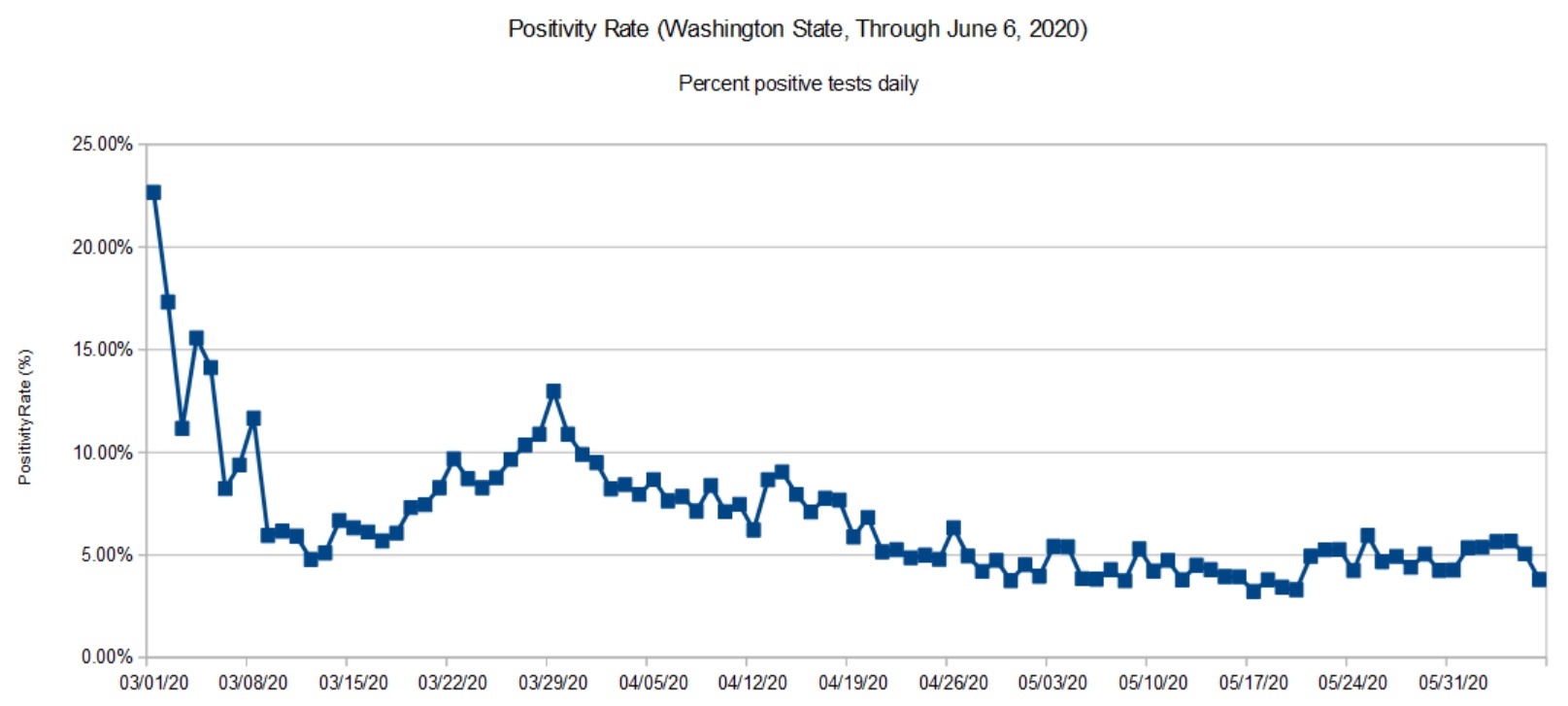
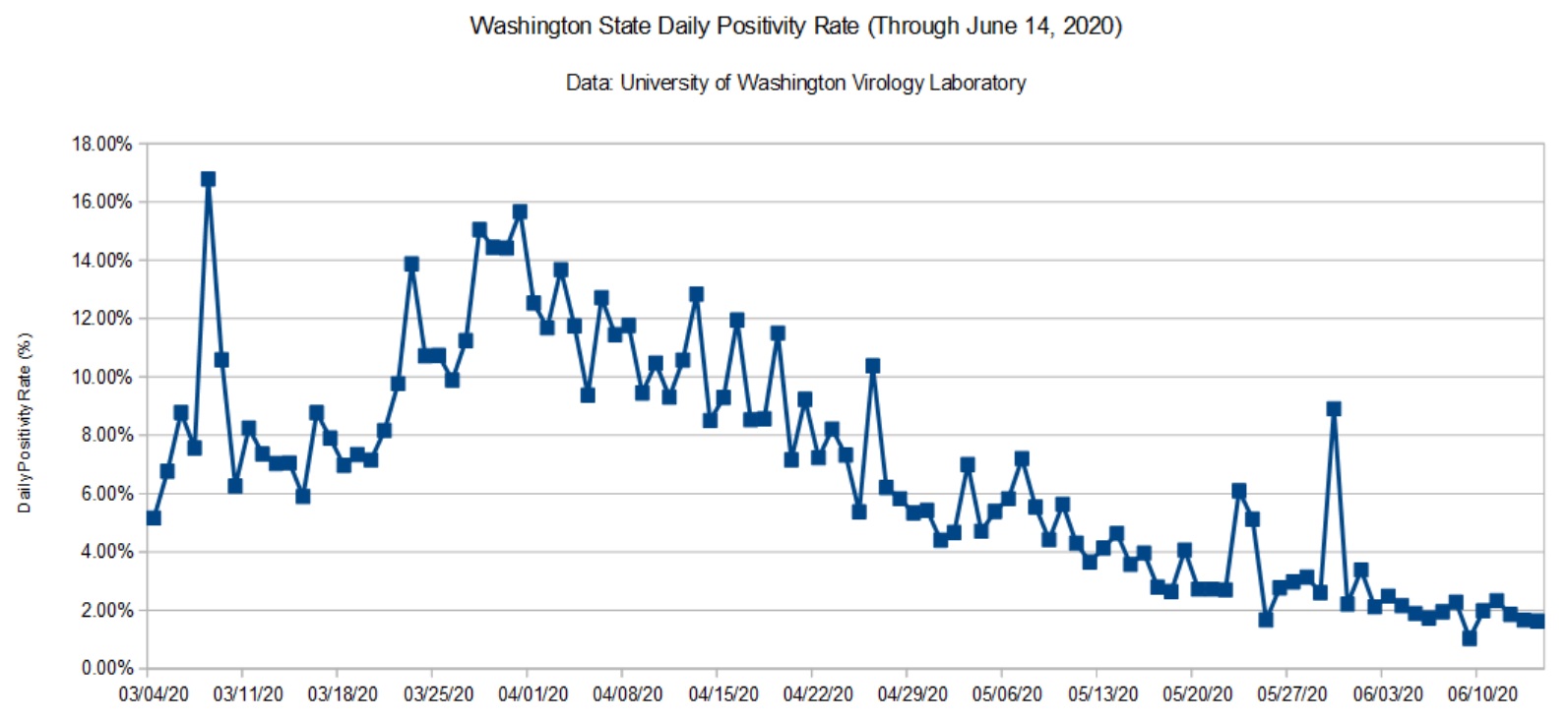
Here is my latest update for the COVID-19 positivity rate in Washington State. The Department of Health (DOH) data are relatively complete through June 6, 2020 and the University of Washington Virology Lab (UW) data are complete through June 14. [Click images to enlarge.]
Washington State daily positivity rate (DOH, June 6, 2020)Washington State daily positivity rate (UW, June 14, 2020)
The DOH rate was roughly 5% at the beginning of June. The UW rate is slightly lower, around 3%. The UW rate and my daily tracker do not indicate a rise due to the recent protests in Seattle (King County). I hope the rate remains low or declines further.
Washington State has added considerable test capacity in recent days. During most of May, the State performed about 4,000 to 5,000 tests per day. Now, the State is performing about 10,000 tests per day. The UW dashboard shows a big increase in their test capacity.
Although the situation in King and Snohomish Counties has improved, a few counties in eastern Washington — most notably, Yakima County — are deteriorating.
Mobility
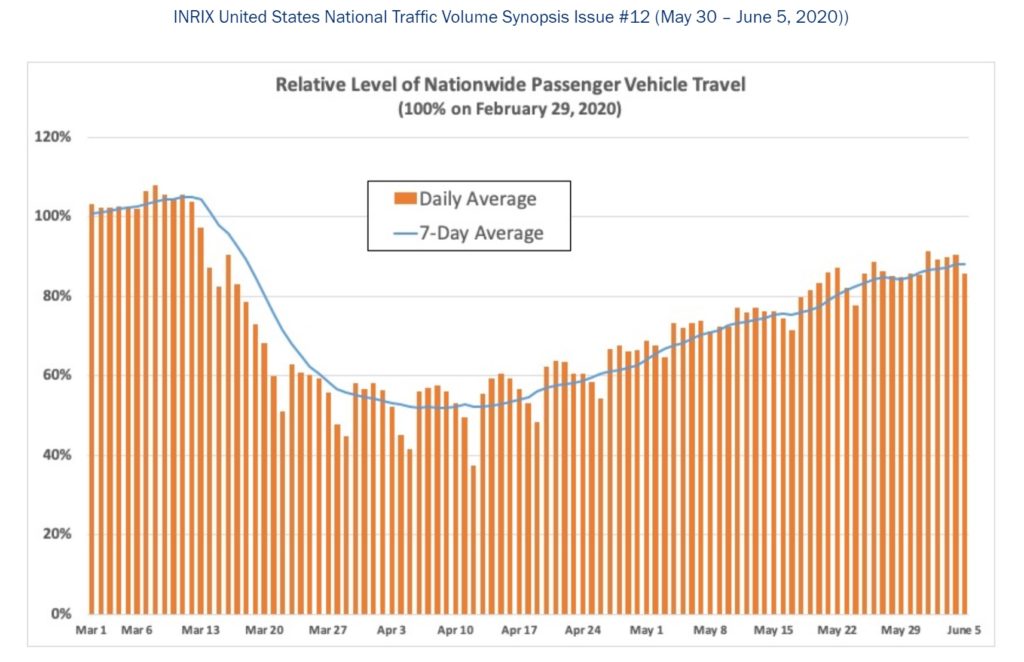
INRIX is a traffic management company which bases its analysis on road sensors and vehicle data. As a public service, INRIX posts an analysis for nationwide vehicle travel data to assist the COVID-19 fight. I recommend visiting the INRIX COVID-19 pages. You will find several informative tables like the one below, plus a national heat map depicting the change in travel at a few snapshot dates (April 11, May 24, May 29).
Traffic volume hit a lull in early April and has been steadily increasing in many parts of the United States. Travel is still lower in certain urban centers, especially those which were hardest hit by COVID-19. Rural travel has come roaring back.
INRIX has heat maps for key urban centers. So, if you want to see how your city is doing, be sure to visit their pages. The Seattle area heat map shows higher traffic, which is consistent with my personal (anecdotal) observations.
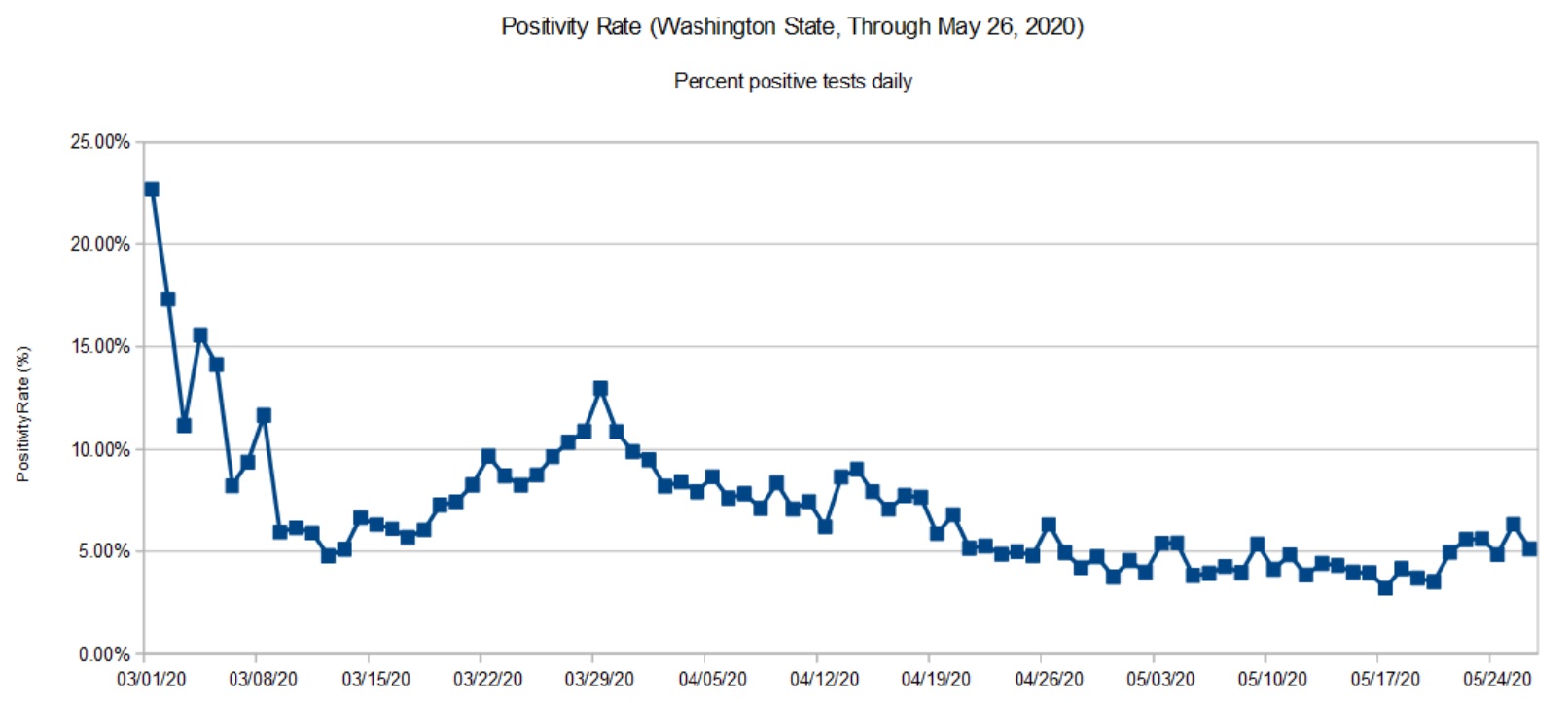
Washington State Daily Positivity Rate (DOH, May 26, 2020)
The DOH positivity has taken a definite upswing during the last week. Folks are getting antsy and highway traffic is noticeably heavier. The morning traffic report is back to yellow and red trouble spots on the local highways. Mobility has definitely increased as we will probably see in the next report from the Institute for Disease Modeling.
It will be 10 to 14 days before we see the effect of protests in the Seattle area. Large gatherings of people are definitely spreader events.
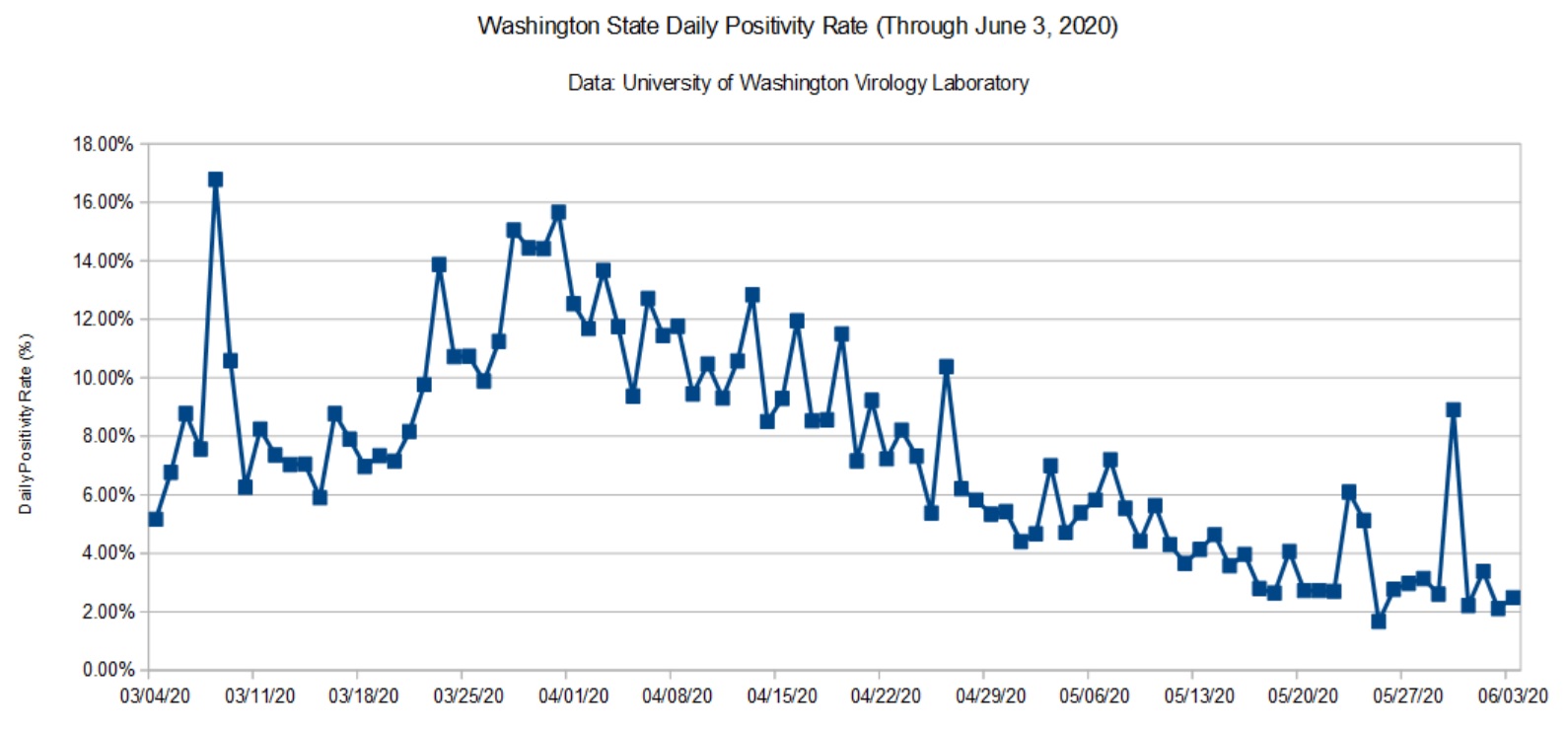
Washington State Daily Positivity Rate (UW, June 3, 2020)
The data from UW had a localized bump. This may be the result of contact tracing within a cluster. I wish the UW site was a little more informative, but interpretation is really DOH’s job.
I still see and hear local media reporting observations like “The number of cases dropped dramatically yesterday.” Raw case counts are relatively meaningless unless the number of tests are taken into account. That’s why I’m tracking the daily positivity rate — the percentage of positive test results for each day.
Here’s an example to show what I mean. Testing (and reporting) dips over the weekend. The number of weekend (Saturday and Sunday) tests is typically less than half of weekday tests. Here are the mostly values reported in the media
The first three columns are the cumulative metrics published by DOH. The last three columns are the number of positive tests, tests performed and positivity rate for each day. The date is the reporting date, so June 1 (Monday) covers the preceding Sunday.
Please note how fewer tests are performed on Sunday than Monday. Sure, the number of raw positive cases on Sunday is dramatically lower Monday. However, the positivity rate is higher for Sunday is actually higher. Yep, the local news station was touting the Sunday number! This is fundamental numeracy, people.
As noted in previous posts, data from the Washington State Department of Health (DOH) lags a little bit as reports arrive from county health departments. So, the DOH chart (below) covers the period up to May 16 (about ten days ago at the time of this writing).
Washington State daily positivity rate (DOH, May 16, 2020)
The trend in the DOH daily positivity rate (percent positive tests per day) is decidedly downward. It’s worth noting, however, how fast a community can move up the curve than down. The difference between the upward slope and downward slope should make people cautious — we don’t want to be on the wrong side of the curve again. It’s better to knock the disease to its knees and keep it there than to suffer a series of waves, even small waves.
Washington State daily positivity rate (UW, May 24, 2020)
I don’t see a similar up-turn in the latest daily stats from the DOH, so I’m quite curious as to the cause for a higher positivity rate in UW’s most recent data. Did the lab test more samples from a COVID-19 cluster under investigation? Are there quality issues with the samples or test materials? I hope that they are looking into these questions.
I recommend reading this excellent report from the Imperial College COVID-19 Response Team: H Juliette Unwin, Swapnil Mishra, Valerie C Bradley et al. State-level tracking of COVID-19 in the United States (21-05-2020), doi: https://doi.org/10.25561/79231
The report provides a timely analysis and summary of COVID-19 in the United States, including an estimate of the effective transmission rate (Re) for each state. The report is licensed under a Creative Commons Attribution NonCommercial NoDerivatives 4.0 International License.
Daily positivity rate for Washington State (DOH, May 8, 2020)
The DOH reports (relatively) complete data through May 8. That’s why the title of this page refers to “May 8” even though I’m posting these charts on May 18.
The UW Virology Laboratory performs a significant portion (about 40%) of the COVID-19 testing in Washington State. Approximately 90% of the tests performed by UW are for patients in Washington itself. [Click images to enlarge.]
Daily positivity rate for Washington (UW, May 17, 2020)
The UW data is current up to the present date (May 17, 2020). So, you may think about UW’s positivity rate as a glimpse at the past week before the DOH statistics roll out. Like the DOH trend, there was a slight up-tick at the end of April and beginning of May, which is now settling back down.
I’m quite happy to see the downward trend and that we are keeping the disease in check. We are going to the dentist tomorrow (!) and it will be interesting to see how they handle the situation.
The virus is still out there. The CDC MMWR should make everyone wonder about choir/music rehearsals and performance in the near- to medium-term future. We need to take this health threat seriously until people are vaccinated.
After making slow progress against COVID-19, Washington State lost a little ground during the last two weeks. We aren’t heading up the steep slope, but the unusually good weather has brought people out of isolation.
Here we see a more definite up-tick in recent days. As a state, we need to double-down on social distancing — it’s too soon to give up! I don’t think anyone really wants to go through another long lock-down. It’s better to quash COVID-19 and keep it down. Anything less delays economic recovery.
The Institute for Disease Modeling (IDM) estimates the effective reproductive number (Re) for King County, Washington. King County is the most populous county in Washington covering much of the Seattle metropolitan area. (Snohomish County fringes on the metro area, it’s main population center is Everett.)
IDM reports both a likely range for Re (95% confidence interval) and a best estimate for its value on a particular date. The table below summarizes their findings:
    Date            Lower  Upper  Best Est
    --------------  -----  -----  --------
    March 25, 2020   0.30   1.20      0.73
    April 4, 2020    0.55   1.33      0.94
    April 15, 2020   0.28   1.00      0.64
    April 27, 2020   0.47   1.32      0.89
IDM base their analysis on data from the Washington Department of Health and mobility (traffic) data. IDM’s best estimate of cumulative incidence through April 20 is 2.1%, meaning that 2.1% of the community has or has had COVID-19 as of April 20.
Worrisome, IDM hasn’t found Re to have dropped definitively below one for Eastern Washington. Although Western Washington has made progress, Eastern Washington is not improving. The number of new cases tracks Re. When Re increases, the number of new cases increases, too, lagging in time by the COVID-19 incubation period.
Please remember that we are shooting for an Re less than one, meaning that the spread of SARS-CoV-2 (the virus which causes COVID-19) is slow enough to prevent a rapid rise in new cases. Social distancing, contact tracing and isolation are all about keeping Re as far below one as possible.
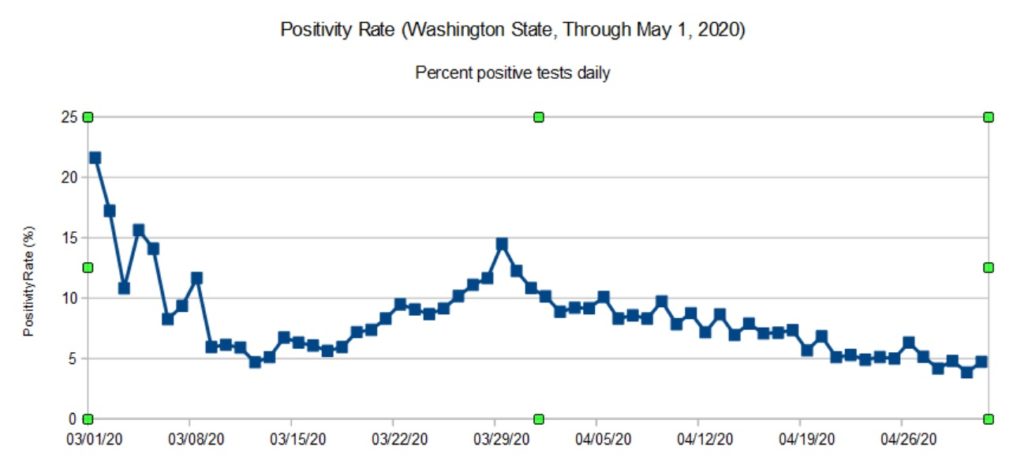
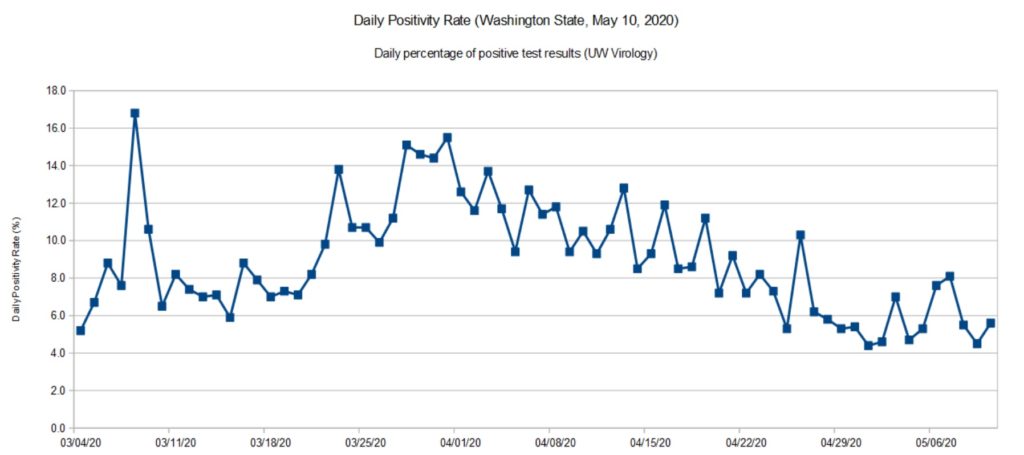
To kick things off, here are my latest graphs for the Washington State COVID-19 positivity rate. The positivity rate is the daily percentage of positive COVID-19 tests. Like the daily new case count, we’re hoping to see a downward trend over time as community mitigation (AKA “social distancing”) slows the effective infectiousness (REFF) of SARS-CoV-2.
Washington State daily positivity rate (DOH, April 21, 2020)
The first graph is based on data from the Washington State Department of Health (DOH). DOH aggregates data across the entire state. Data for most recent days are incomplete and I have not included partial results in the graph.
Washington State daily positivity rate (UW Virology, April 30, 2020)
The second graph is based on data for the University of Washington (UW) Virology Laboratory. The UW chart is up-to-date because they don’t have the same aggregation and reporting responsibility as DOH. For UW, it’s specimens in, and test results out. The UW results are sent to DOH where they are eventually folded in.
Both graphs show a steady decline. In terms of positivity rate, we’re back to where we were in mid-March. The peak occurred around March 28.
SARS-CoV-2 is still circulating in the community. I think Governor Inslee has made the right decision to go slow on “re-opening.”
The positivity rate is an imperfect indicator of the actual infection rate in the general population. Given the total number of confirmed cases (14,327) and assuming that ten times as many people are actually infected (143,000), that’s an overall infection rate of 2%. Normally, a disease doesn’t slow down until the infection rate is 50% to 60% (so-called herd immunity). Two percent is insignificant and SARS-CoV-2 could easily “burn” through the population if it is left unchecked.
Are we heading toward 1918, again?
The Centers for Disease Control and Prevention (CDC) site has an extensive section about the 1918 influenza pandemic in the United States. The pandemic was caused by an H1N1 virus. The disease was first identified in the United States during the spring of 1918, eventually killing 675,000 people in the U.S. The number of deaths worldwide is estimated at 50 million people.
Due to poor record keeping and other factors, a true accurate tally of infections and deaths is not possible. All figures are estimates.
If you’re at all familar with recent events in the United States, the 1918 pandemic timeline should make your hair stand on end.
March 1918: Outbreaks of the flu are first detected. This is the beginning of the first wave.
April 1918: Cases and deaths are reported by public health officials.
Summer 1918: The first wave crests and declines.
September 1918: The second wave emerges.
October 1918: 195,000 Americans are killed by the virus during October alone.
November 1918: The fatal second wave subsides. America celebrates World War I Armistice (parades, etc.) setting up a third wave of infection.
December 1919: A third wave begins.
April 1919: The third wave subsides.
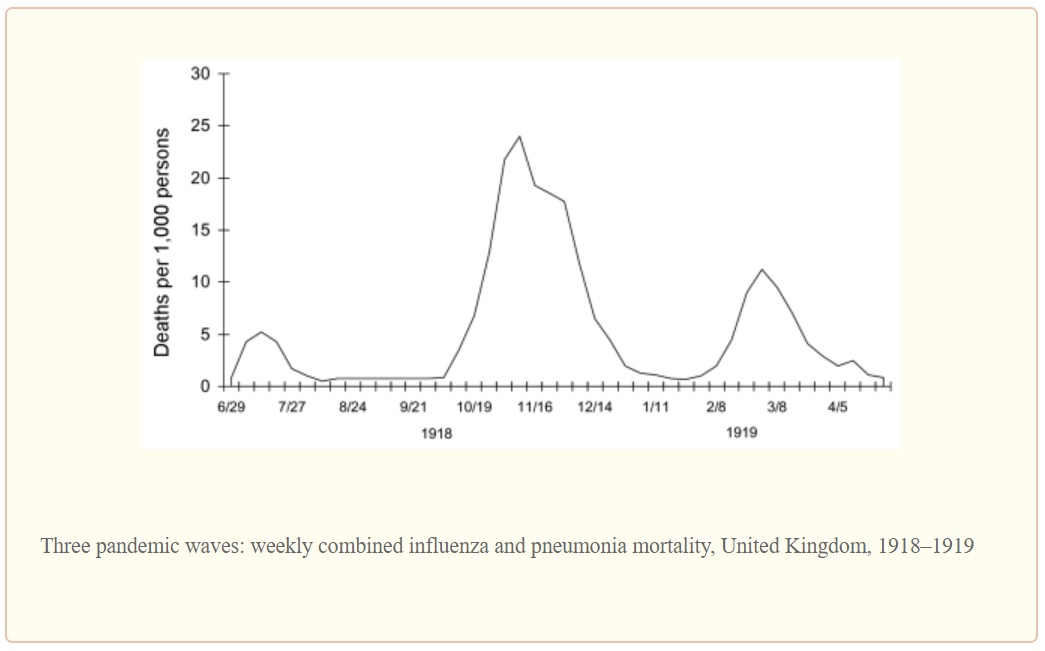
The second wave was the most deadly wave and was responsible for most of the losses in the U.S. The timing is eerily similar to the COVID-19 outbreak in the U.S.
The graph below illustrates the lethality of the three waves (as measured in the United Kingdom).
1918 Influenza: The Mother of All Pandemics, Taubenberger and Morens, January 2006
Barely two months into the COVID-19 pandemic, seventeen states are reopening partially and six states are lifting orders or reopening soon. [The New York Times, May 1, 2020] Some of the states have not satisfied the WhiteHouse/CDC gating criteria for reopening.
I fear that this is too soon to declare victory or to even imagine a return to a normal (pre-pandemic) state of affairs in one or two months. Dr. Anthony Fauci (NIH), Dr. Robert Redfield (CDC) and other health officials have warned about a second wave in Fall 2020. Be assured, SARS-CoV-2 will continue to circulate in the population during the summer months just like the 1918 H1N1 influenza virus. The American populace is just as vulnerable to an COVID-19 outbreak as it was in January 2020.
I genuinely hope and pray that we haven’t set outselves up for an extremely fatal second wave of COVID-19. Are we doomed to repeat history?
Stay the course and stay healthy — P.J. Drongowski
COVID-19 testing is very much in the news these days. Let’s take a look.
There are two main types of testing: detection of the pathogen (SARS-CoV-2) itself and antibody testing. In detective-speak, the first kind of testing looks for the perpetrator while the second kind of testing looks for the perpetrator’s footprints. The science and machinery are quite different. This article discusses the first kind of test: pathogen detection.
SARS-CoV-2 detection looks for the presence (or absence) of the pathogen’s genetic material. Genetic testing doesn’t try to match a sample against the entire SARS-CoV-2 genome. Instead, genetic tests target specific genes within the genome. It looks for specific sequences within SAR-CoV-2 genetic RNA. Unlike cells which store genetic information in DNA (deoxyribonucleic acid), the SARS-CoV-2 virus stores genetic information in RNA (ribonucleic acid).
The World Health Organization guidance recommends five target sequences which can be used to identify the presence of SARS-CoV-2:
Nucleocapsid gene (N)
Envelope gene (E)
Spike gene (S)
RNA-dependent RNA polymerase gene (RdRP)
The capsid and envelope genes code for the proteins forming the shell around the virus. The spikes are the proteins protruding from the shell and are the attachment points for cell infection. The RdRP gene codes for the chemical enzyme (polymerase) that assist the replication of virus RNA. The RdRP in this case is specific to SARS-CoV-2. All of these genes are SARS-CoV-2 fingerprints. (See “COVID-19: Know Your Foe.”)
The amount of RNA in a sample is very minute and is not sufficient for immediate chemical analysis. The sample RNA must be amplified, a fancy way of increasing the concentration (amount) of targeted RNA. These kinds of tests are called nucleic acid amplification tests (NAAT).
One form of NAAT is the reverse-transcription polymerase chain reaction (RT-PCR). You may have seen the term “RT-PCR” in the news. RT-PCR is a bread-and-butter technique in genetics research and drug development. Reverse transcrption (RT) turns the RNA into DNA which is amplified using polymerase chain reaction (PCR).
Without deep diving PCR (there are many good on-line tutorials), the term “chain reaction” hints at the technique. We know how an uncontrolled nuclear chain reaction leads to explosive fission. One nucleus splits causing two other nuclei to split and so on. PCR is a chain reaction in which DNA splits into two halves producing two new complete strands of DNA which split into four halves and so on. Each cycle doubles the concentration of the DNA in the sample. Eventually, enough DNA is available in the sample to reliably detect the presence of target genetic sequences.
Real time RT-PCR uses flourescent dyes to reveal the presence of targeted genetic material. Results are produced much faster than older methods employing radioactive isotope markers. Because speed matters, real time RT-PCR is widely used throughout the research and medical communities.
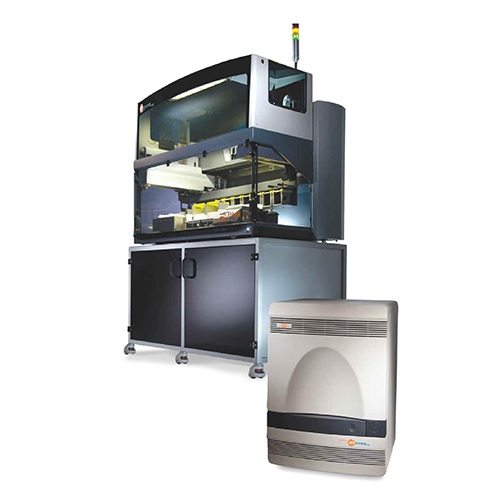
Real time RT-PCR is automated and many manufacturers, like Abbott Molecular, sell machines. Real time RT-PCR machines run a sample through multiple amplification cycles, typically, 30 to 40 cycles. Fluorescence is measured after each cycle. When fluorescence exceeds a threshold, the test is positive, confirming the presence of the targeted genetic sequence (and the pathogen). The machine counts the number of cycles needed to exceed the threshold. Severe infection (i.e., more pathogen RNA in the original sample) requires fewer cycles.
The Abbott M2000 RealTime System is one example of a real time RT-PCR testing machine. The M2000 can test up to 96 samples in one run: 93 patient samples and 3 control samples. Control samples are required to assure valid results. Both positive and negative control samples are required.
Abbott M2000 RealTime System
The M2000 is a large machine suitable for a laboratory setting.
Like the RT-PCR machines from other vendors, the M2000 requires consumable supplies. Consumable supplies are usually machine-specific. If you own a laser or inkjet printer, you’re already familiar with this concept. 😉 The vendor develops and manufactures pathogen-specific test kits in the form of cartridges, etc. that are physically compatible with their machines.
The Abbott RealTime SARS-CoV-2 EUA test is Abbott’s COVID-19 test for the M2000. “EUA” means “Emergency Use Authorization.” Authorization is issued by the U.S. Food and Drug Administration (FDA). EUA limits the use of the SARS-CoV-2 EUA test and is not full FDA approval. The Abbott RealTime SARS-CoV-2 EUA test is designed specifically for the M2000 real time RT-PCR system for use by authorized laboratories in the U.S.
The M2000 can process up to 470 patient samples in 24 hours, roughly five runs per day, 93 patient samples per run. Abbott planned to ramp up U.S. production to one million tests per week by the end of March. This goal is far short of the millions of tests which experts believe are needed in order to re-open the economy.
Reagents are one of the consumables and you’ve probably heard the term “reagents” in the news as an item which is in short supply. Reagents are one of the main components of the Abbott SARS-CoV-2 test kit. The reagents break open the SAR-CoV-2 virus and release its genetic material (viral RNA). The reagents recognize targeted segments of the SARS-CoV-2 genome, ignoring genetic material from other viruses. The reagents select targeted genes for amplification. The Abbott RealTime SARS-CoV-2 test (assay) targets the RdRP and N genes.
The fine print notes “Negative results do not preclude SARS-CoV-2 infection and should not be used as the sole basis for patient management decisions. Negative results must be combined with clinical observations, patient history, and epidemiological information.” Thus, Abbott acknowledges that false negatives are possible.
The M2000 made the news in early April when Dr. Birx (White House coronavirus response coordinator) stated that 80% of the 175 Abbott machines in 120 laboratories across the U.S. were not being fully utilized. The machines are located in academic medical centers and hospital laboratories [Bloomberg News]. I suspect that the bottleneck is collecting samples and getting samples to the central laboratories. New York State plans to have pharmacies collect samples thereby increasing the number of tests per day and improving RT-PCR utilization.
Other big players in the market are Thermo Fisher Scientific (Applied Biosystems TaqPath), Roche )Cobas 6800/8800 System) and BD Molecular (BD MAX System). These tests target other SARS-CoV-2 genes like S and ORF-1AB in addition to N and RdRP.
Abbott ID Now
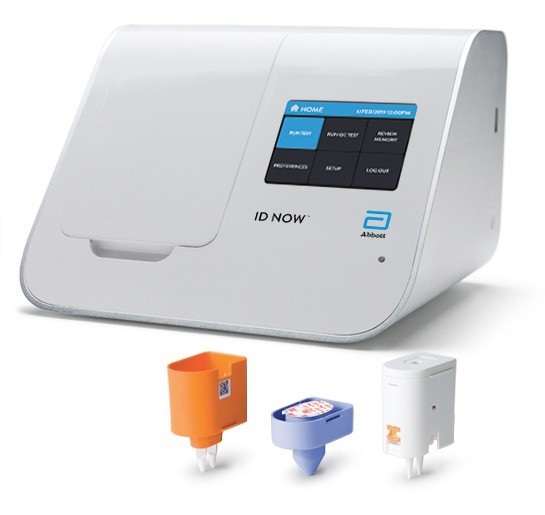
The Abbott ID NOW™ system is a small machine suitable for a doctor’s office or portable use (8.15″W x 5.7″H x 7.64″D). The Abbott machine was developed originally by Alere. (Abbott acquired Alere in October 2017.) The ID NOW is used to detect the influenza A and B2 viruses as well as COVID-19. ID NOW costs about $12,000USD.
Abbott ID NOW™ system
Multi-cycle RT-PCR tests raise and lower the sample temperature during each cycle. ID NOW operates at a single constant temperature, so-called isothermal chemistry. Thus, ID NOW can obtain results faster than conventional real time RT-PCR.
The overall test process is similar. Reagents break open viral RNA in the sample. The reagents recognize the target sequence in the pathogen. The isothermal amplification chemistry amplifies the selected genetic sequence. Fluorescent probes recognize and attach to each replicated sequence. The probe molecules fluoresce. The ID NOW hardware monitors fluorescence. When fluorescence exceeds a trigger threshold, a positive result is displayed.
Like the M2000, it uses consumable supplies like its reagent test cartridge, e.g., the ID NOW COVID-19 assay. A single test costs about $50USD.
The COVID-19 assay targets the SARS-CoV-2 RdRP gene. Results come fast — a positive result in 5 minutes (minimum) or a negative result in 13 minutes. The ID NOW COVID-19 assay is available for use under FDA EUA and is only available in the U.S. The ID NOW COVID-19 test is not yet approved or cleared by the U.S. FDA.
Machines like the Abbott ID NOW™ could greatly speed up COVID-19 testing. Big M2000 machines are centrally located and patient samples must be sent to the lab. The sample may await other samples for a full run. Then results must be reported back to the physician and patient. The round-trip takes too long; a delay of several days is not uncommon. The Abbott ID NOW can be located on site, potentially reducing the round-trip to an hour or two.
The chief disadvantage is cost. The ID NOW single test, cartiridge approach is nore expansive than M2000’s batch testing. ID NOW targets a single SARS-CoV-2 gene, RdRP, making it vulnerable to a mutation in this one gene. The M2000 targets three genes and is less vulnerable to a mutation.
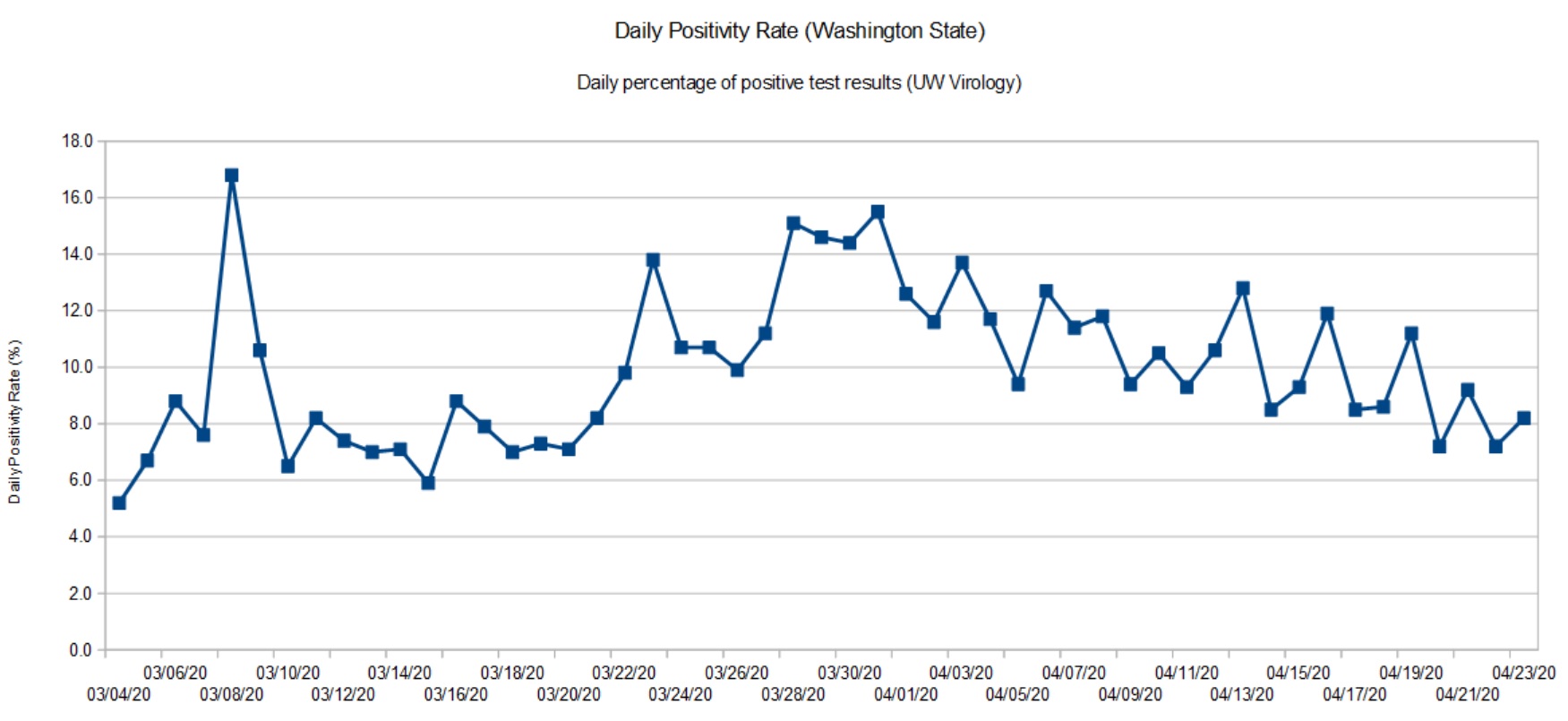
The daily positivity rate is the percentage of positive COVID-19 test results for each 24 hour period. The rate adjusts for the number of tests which varies from day to day.
The daily positivity rate is a useful metric, but an imperfect one. As I’ve said in previous posts, we need a proper epidemiologic study of COVID-19.
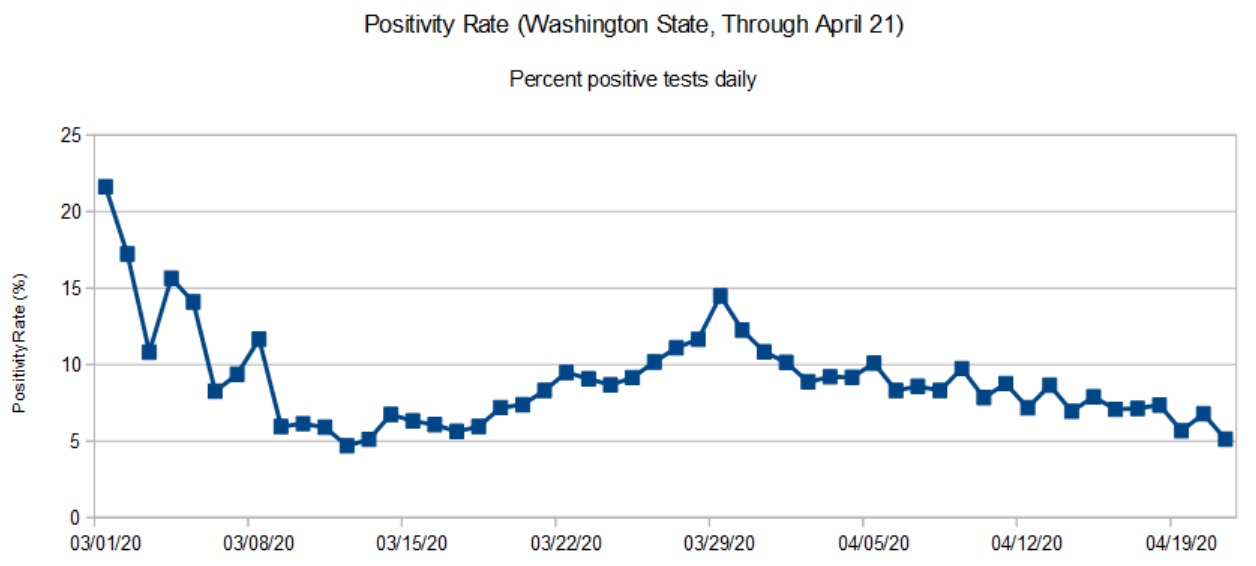
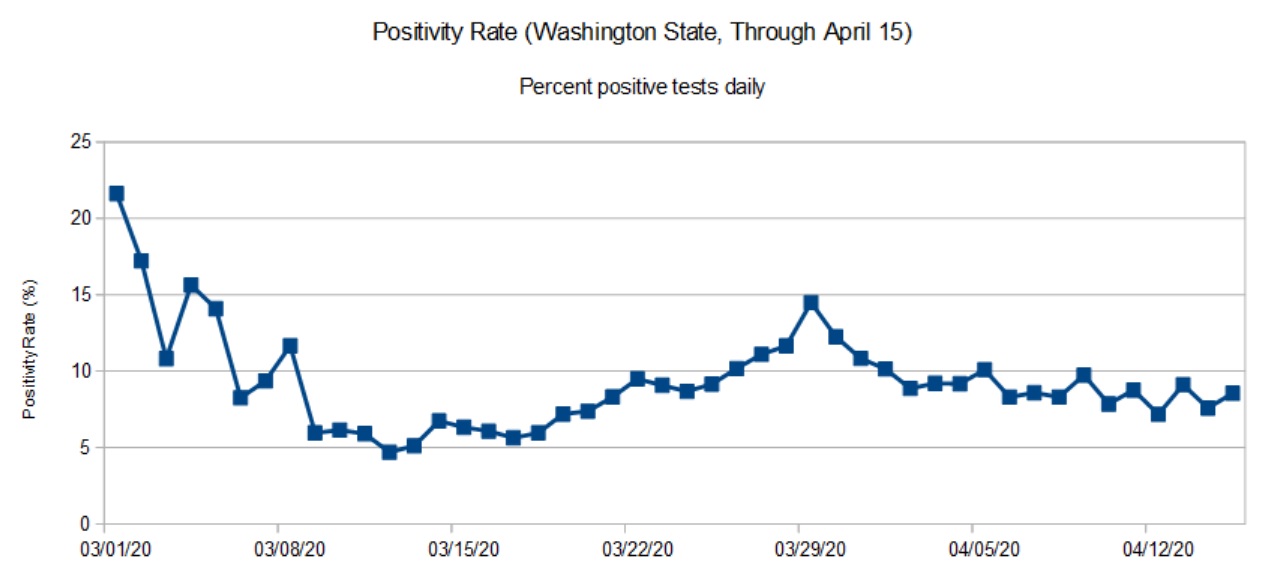
The first graph (below) is the daily positivity rate for Washington State though April 15. Why April 15 and not today, 24 April 2020? The Department of Health does not guarantee complete data for the most recent days. The data through April 15 is (nearly) complete although a few test results still trickle in.
Washington State daily positivity rate (April 15, 2020)
As noted in the graph posted last week, the state is past the peak and is in a slow decline. The peak occurred in late March. The daily positivity rate has declined to where it was in mid-March.
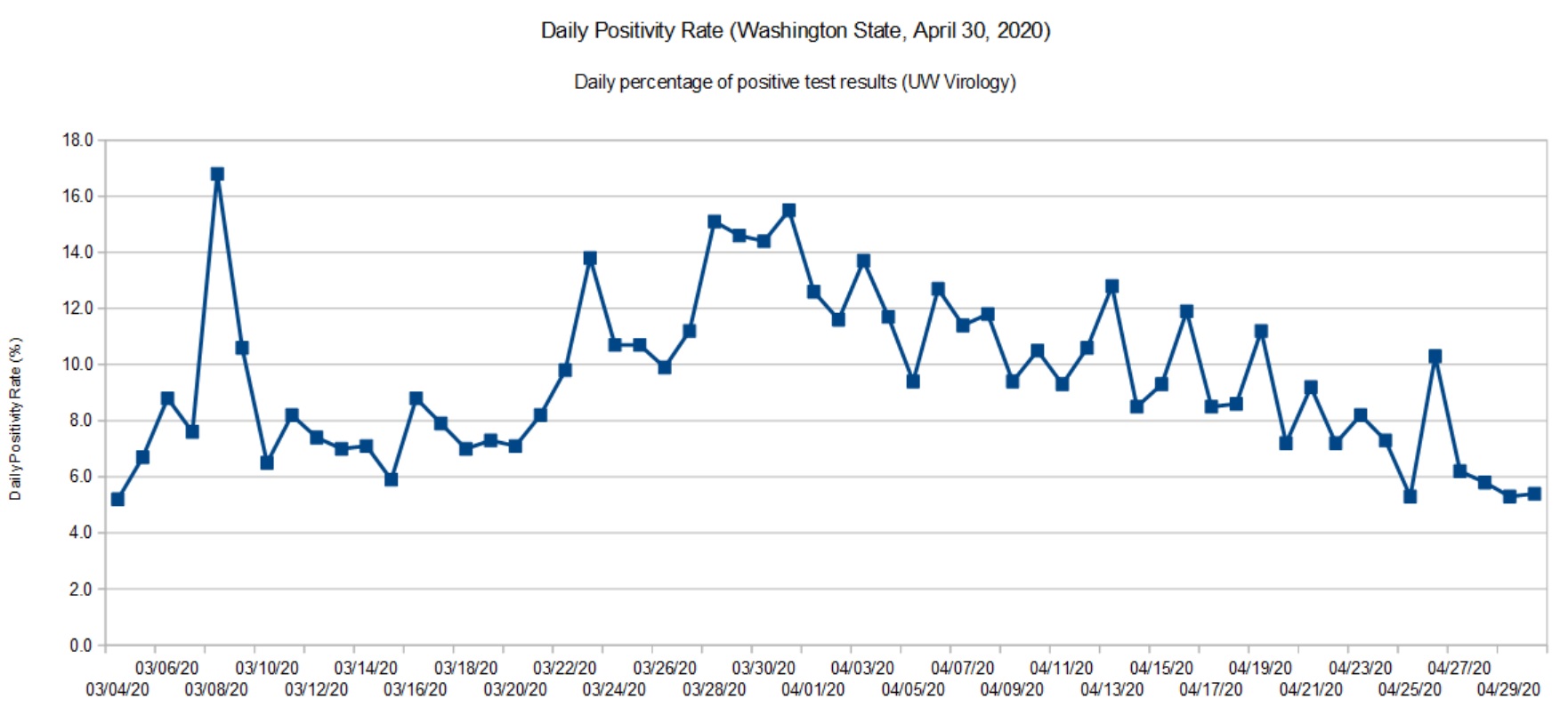
For comparison, here is the data from the UW Virology Lab. UW performs testing for and county and state health authorities. [Click images to enlarge.]
University of Washington positivity rate (April 23, 2020)
The shape of the graph is consistent with the overall state data. The Virology Lab data is up-to-date since they just report daily results for the lab itself (samples in, results out).
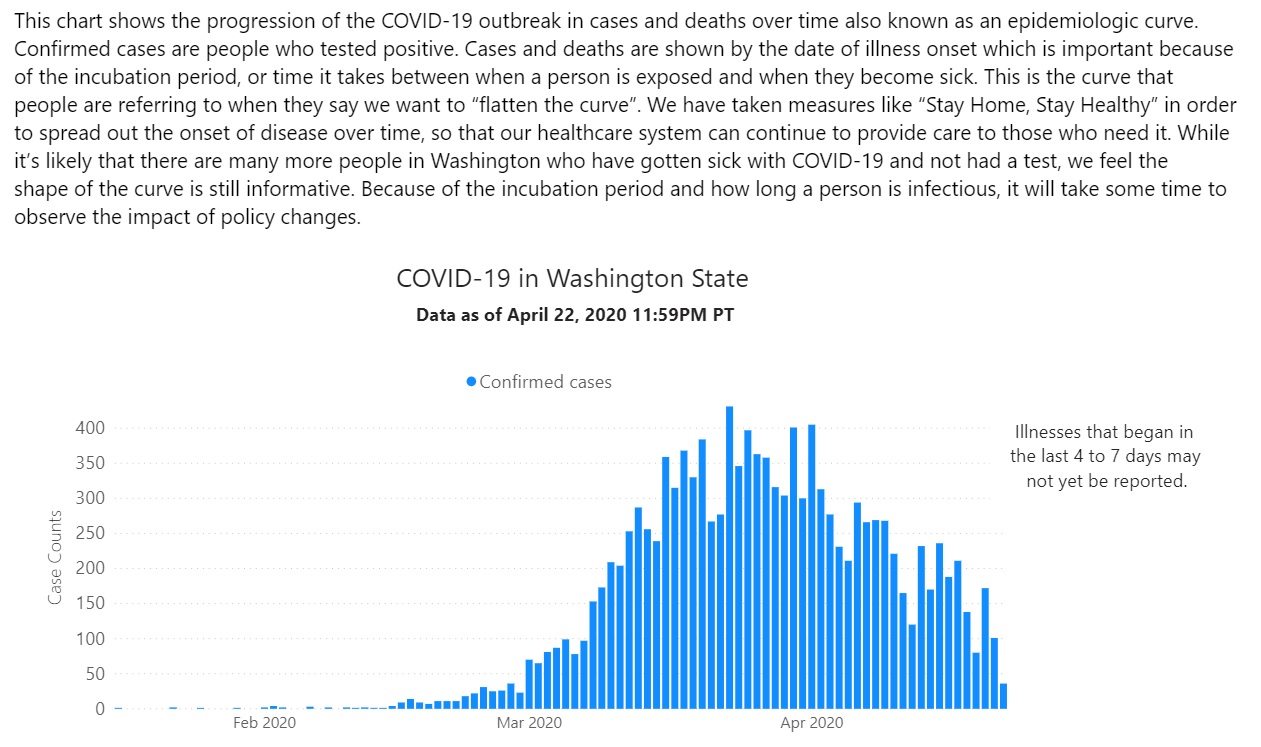
The Washington State epidemiologic curve (below) is informative, too. Known cases are tallied by the date of illness onset.
Washington State epidemiologic curve (April 22, 2020)
The epidemiologic curve shows a steady decline due to community mitigation, also known as “social distancing.” This is good news.
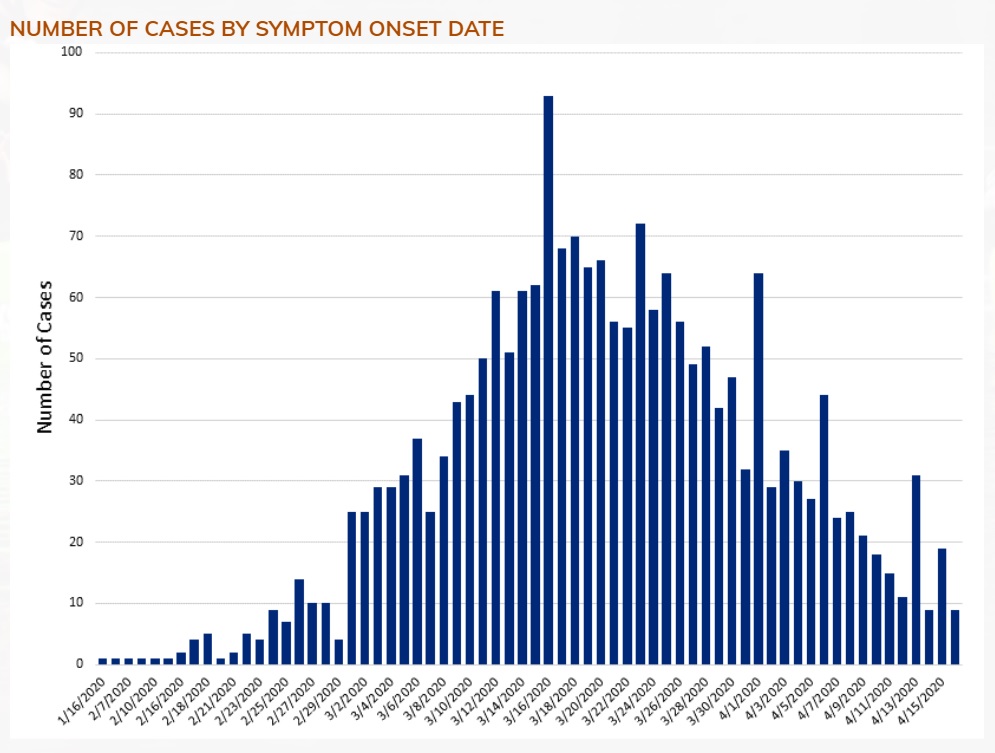
To complete the picture, here is the epidemiologic curve for Snohomish County, where I live.
Snohomish Country epidemiologic curve (April 15,2020)
Snohomish County shows a similar decline in new confirmed cases. Again, this is good news.
The big question for Governor Inslee and other decision makers is “How low is enough?” The answer to this question determines when social distancing can be relaxed. Currently, social distancing is expected to be in place until May 4th at the earliest. Hopefully, Washington will beef up contact tracing and isolation over the next two weeks. Then, it’s whack-a-mole.
Stay distant and stay healthy. Science works — P.J. Drongowski