It’s been difficult to sniff out any big reveals at Winter NAMM 2020 (January 16-19, 2020).
There’s one credible looking leak — the Korg Wavestate. It’s a 37-key ‘board with lots of knobs, buttons, mod wheel and pitch wheel. A modern re-make of the venerable Wavestation? Filters include MS-20 and POLYSIX settings along with the usual LPF, etc. [$799]
Korg Wave Sequencing 2.0
Full size keys
Vector joystick
Up to four sound layers each containing a sequence of PCM samples
64 stereo voices
Filter types: MS-20, POLYSIX, LPF, etc.
Price: 699 British pounds
It’s the only leak worth a headline — so far. 🙂 [Now that it’s official, I recommend the interview with Dan Phillips about the concepts and process behind the Wavestate.]
Good to hear about the SV-1 update — the Korg SV-2.
To fill the time, I’ve been browsing on-line retailers looking for bargains. The retailers are getting smacked with Christmas returns and you never know what might turn up. I got a good deal on a Yamaha SHS-500 Sonogenic and I’m eagerly awaiting delivery.
Even though sound tweaking via the Sonogenic front panel is limited, there may be an opportunity to edit and save patches using the MIDI Designer iPad app . I’ve been learning and experimenting with MIDI Designer, driving the Yamaha Genos via Bluetooth MIDI. MIDI Designer is a solid tool even though it’s a little price-y at $25USD. I wish it had a scripting capability in order to modify MIDI on-the-fly. Still, it’s worth considering if you need to implement a custom MIDI controller on iPad. Stay tuned for more.
Here are the goods Roland are hawking this week at CES 2020:
ZENBEATS Music Creation app
BOSS WAZA-AIR Wireless Personal Guitar Amplification System
V-MODA M-200 hi-res headphones
V-MODA Crossfade M-100 Master headphones
JUPITER-Xm Synthesizer
MC-101 Groovebox
MC-707 Groovebox
Roland Cloud
GO:LIVECAST Live streaming studio for smartphones
Hey, Roland! What’s up with ALL OF THE CAPITAL LETTERS?
At NAMM, look for the Roland A-88MKII MIDI 2.0-ready controller. Ivory feel PHA-4 action. $1,000USD. That is one long slab! As a player, I would be concerned about the long reach to the left hand pads, joystick and controls. I understand the desire to have a slender instrument — wrestling a deep, heavy behemoth is a nasty schlep. That’s still a long reach, however, and could become tiresome at a long gig.
Discussions about Yamaha Montage/MODX AWM2 and FM-X sent me digging into the past to unearth early AWM and FM implementations in order to get insight into today’s tone generation hardware. Although Yamaha do not publish design information about their proprietary SWP, SWX, SWL, etc. processors, they have published datasheets for their merchant line of LSI products. Yamaha were very active in the mid- to late-1990s when desktop music (Soundblaster, XG, Sondius, etc.) was king.
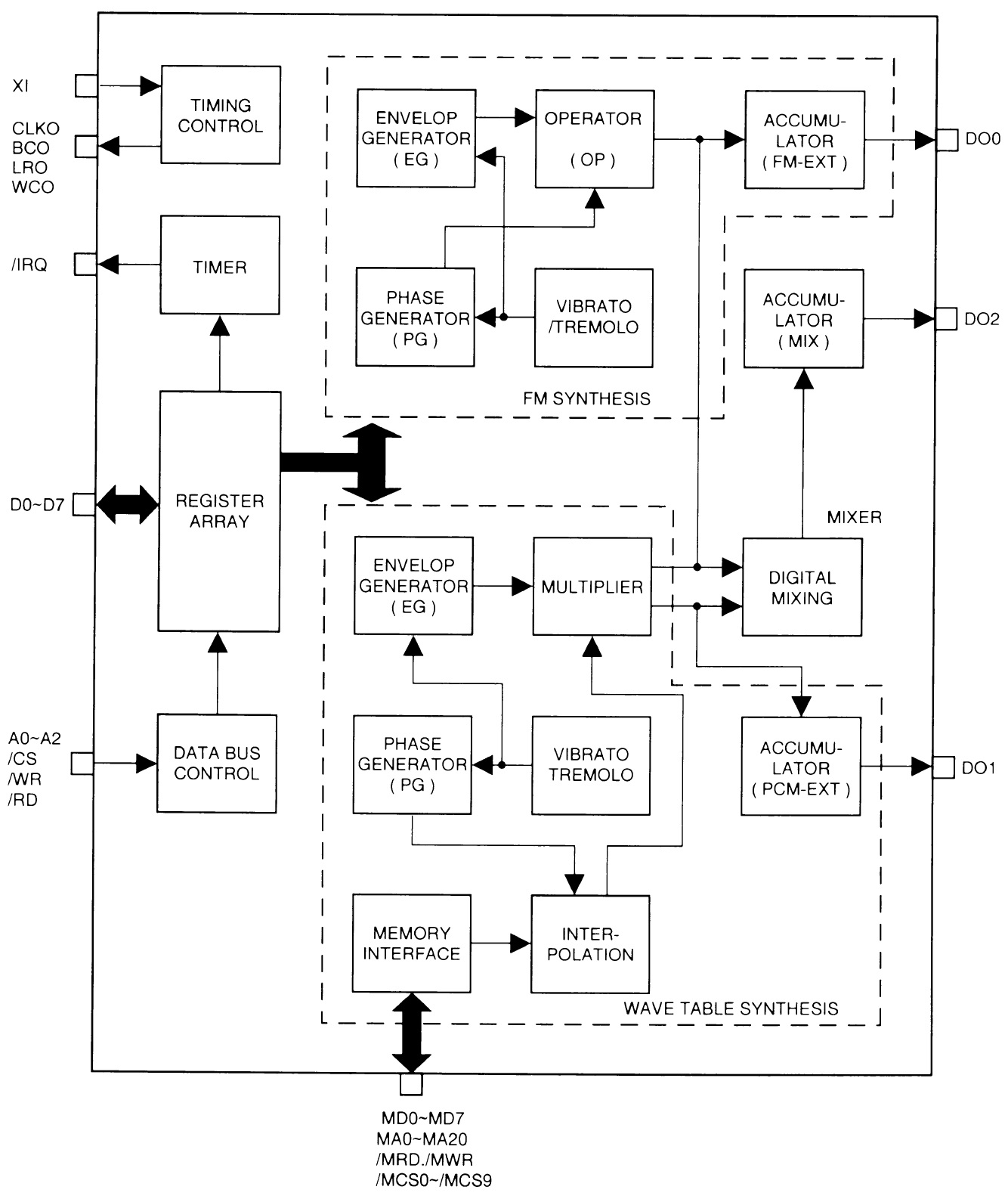
The Yamaha YMF278B OPL4 was one such LSI component. The OPL4 combines a 2-/4-op FM synthesizer and a wave table synthesizer on a single 80-pin quad flat pack (QFP). The FM synthesizer can:
Generate 18 voices in 2-op modes or 15 2-op voices plus five rhythm sounds.
Generate 6 voices in 4-op mode with an additional 6 voices in 2-op mode, or 6 voices in 4-op mode with an additional 3 voices in 2-op mode and five rhythm sounds.
The FM synthesizer has eight selectable waveforms and generates a stereo output. The wave table synthesizer can generate 24 voices simultaneously (i.e., 24 voice polyphony) producing stereo output at a 44.1kHz sampling rate with bit depths of 8-, 12- and 16-bits. Wave ROMs up to 32Mbits are supported with up to 512 wave tables.
The OPL4 has six sound channels which can be sent to an external DAC (YAC513) or a digital effects processor (YSS225). Sadly, documentation for the YSS225 cannot be found on-line. The YSS225 is said to perform reverberation, echo, flange and other effects.
The FM and wave table synthesizers are two separate hardware units. I wouldn’t be surprised if this is still the case in the modern day SWP70 Standard Wave Processor. Separation lets the engineers optimize the synthesis hardware for a particular synthesis type.
Wave table synthesis
The OPL4 does not implement AWM2 synthesis. The synthesizer does not have the AWM2 filter hardware. This is not too surprising because in that era, Yamaha regarded AWM2 and its analog-like filter as a special competitive advantage. Why would they give that same advantage to other sound card vendors? It’s a safe bet, however, that the XG-compliant variants are full AWM2.
Nonetheless, a peak inside gives us a look at Yamaha’s wave table machinery. The synthesizer consists of a synthesis core that fetches waveform samples and waveform meta-data from external wave memory.
YMF278B block diagram
Quoting the OPL4 data sheet:
The wave table synthesizer can generate up to 24 sounds simultaneously. Each sound is referred to as a “channel”. The channels are numbered from 1 to 24. These numbers are called “channel numbers”.
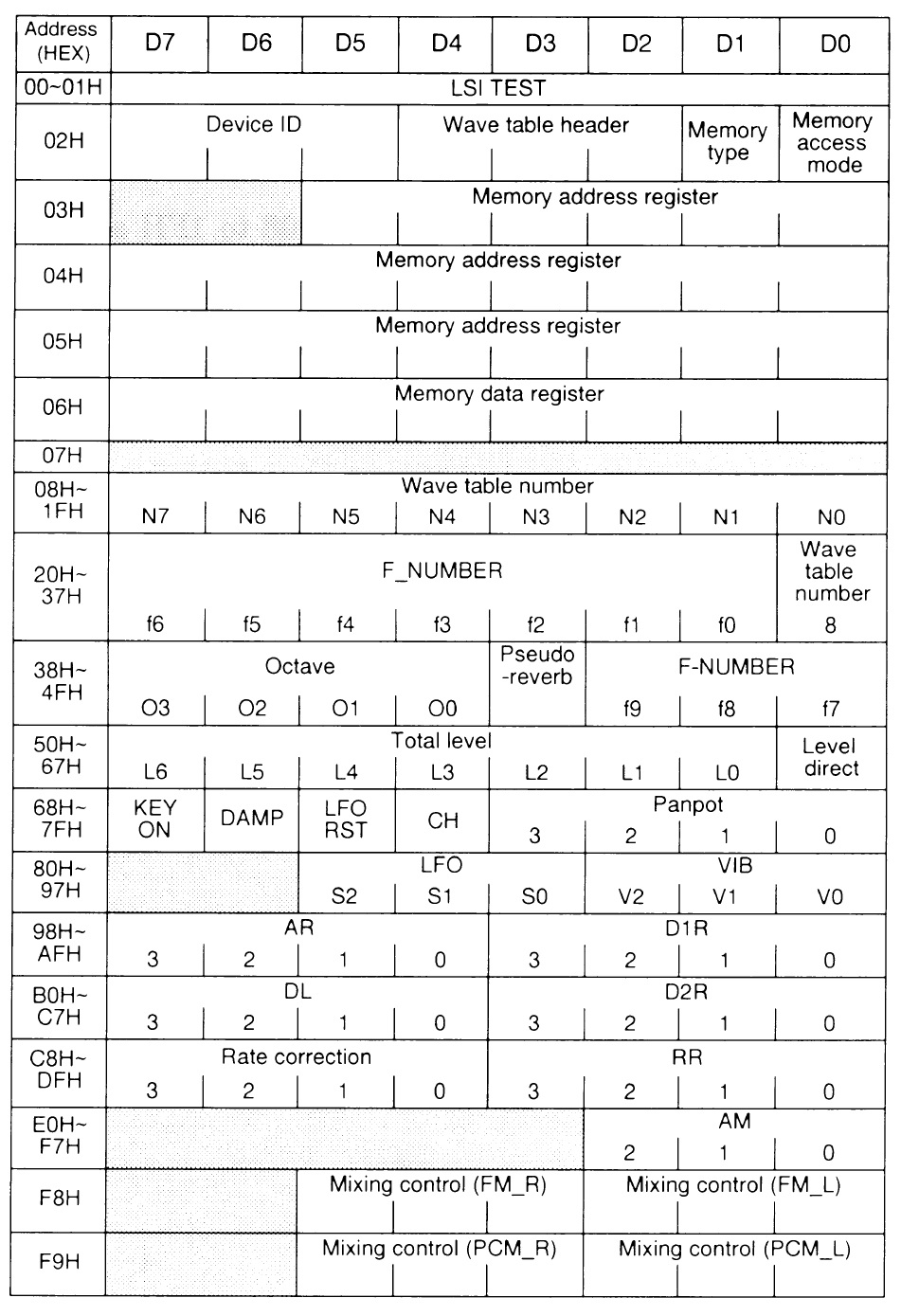
Wave table synthesis is controlled by a few hundred registers. The main control CPU writes common and channel-specific synthesis parameters into the registers. The synthesizer reads the registers during each synthesis macro-cycle and produces a new sound sample for each channel. The channel-specific control registers are organized into register groups. Each group consist of 24 registers, i.e., 24 values of a specific synthesis parameter type, one value per channel. A quick glance at the table below clarifies the register organization and the wave table synthesis parameters. Parameters for envelope generation, pan, LFO control, etc. are easily identifiable. (The YMF278B data sheet has the details).
YMF278 wave table synthesis control registers
I conjecture that today’s SWP70 is organized in a similar way. The CPU-SWP70 communication bus is a memory bus that gives the CPU direct access to the SWP70 synthesis control registers. Think about it. With 128 stereo AWM2 channels, there are several hundred (thousand!) synthesis values which must be configured at the hardware level. Software’s job is easier and fast by making the synthesis registers (channel-specific parameter value) directly accessible.
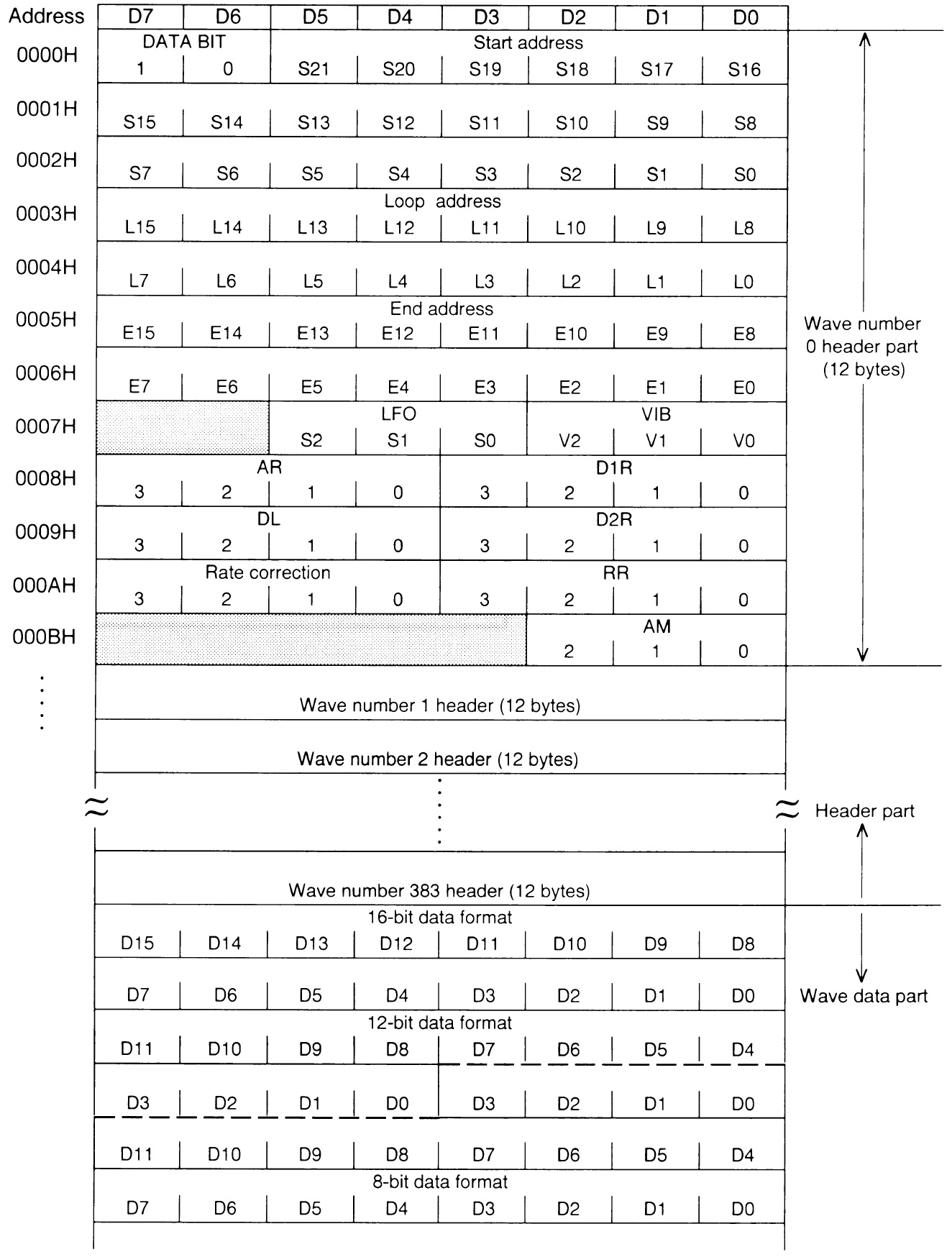
Wave table in external memory
The waveform data and meta-information in external memory cosnsist of two parts: Up to 384 waveform headers and the waveform sample data. Each waveform header is 12 bytes containing:
Wave data start address
Loop address
End address
Voice parameters: LFO, VIB, ADSR, etc.
Today’s wave table is probably similar albeit much bigger. Explore Yamaha’s Universal Voice Format (UVF) and you’ll see what I mean.
FM synthesis
The OPL4 supports 2- and 4-op frequency modulation (FM) synthesis. Quoting the data sheet:
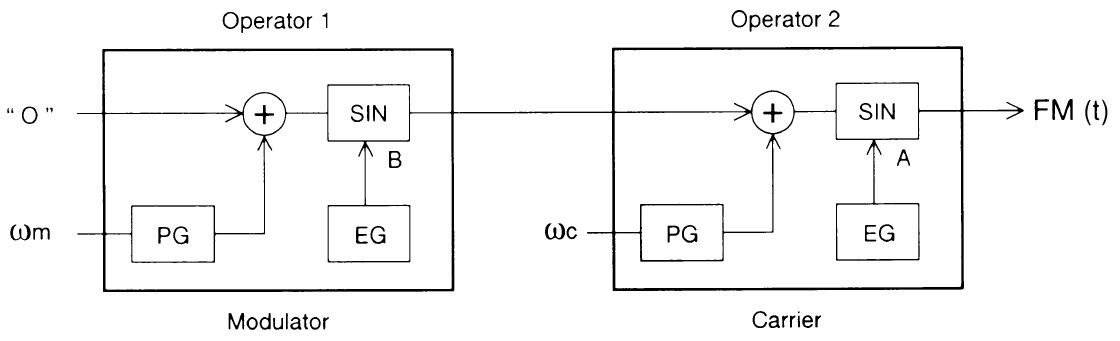
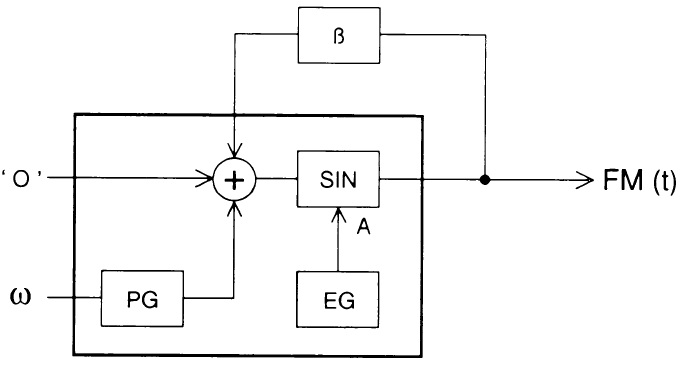
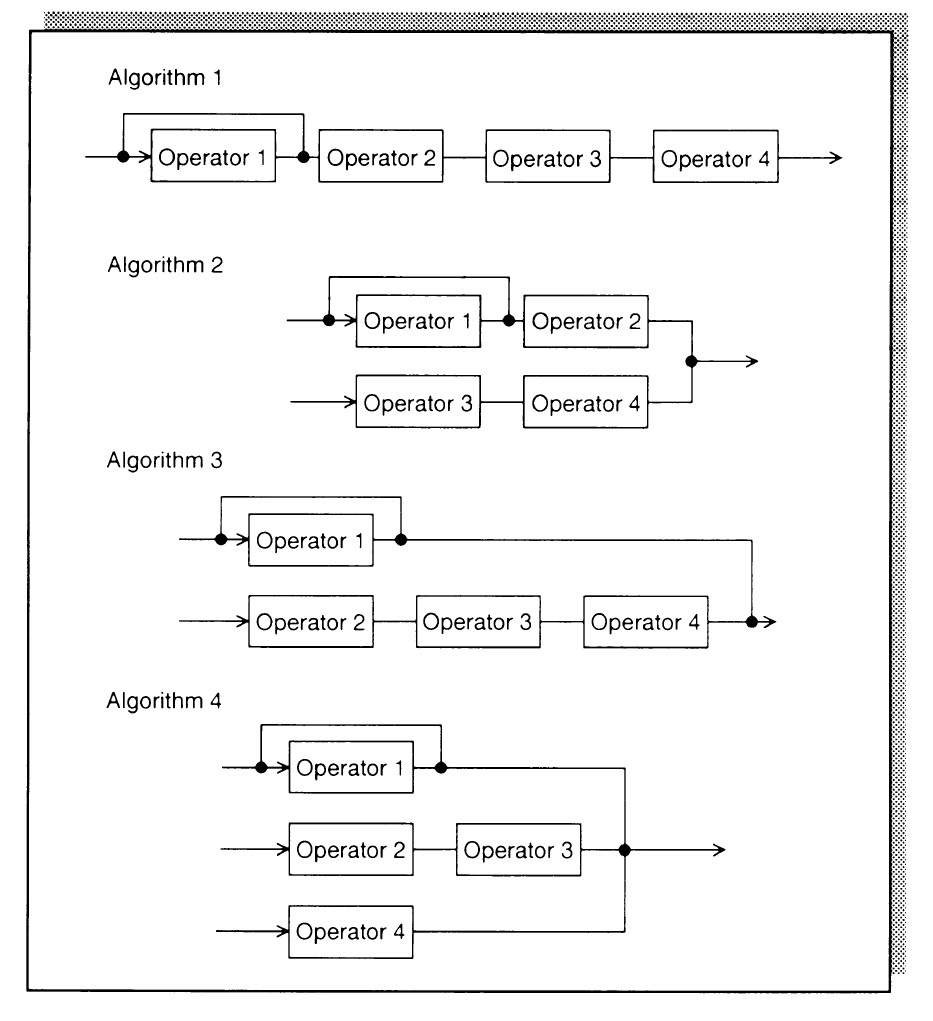
The part that generates one sine wave is called an “operator”. A combination of these operators is called an “algorithm”. The first stage operator (see diegram below) is called the “modulator” and the second stage operator is called the “carrier”. The frequency and envelope can be set for each operator. “Feedback FM” is available to generate a wider range of sounds.
Basic FM system
Feedback FM system
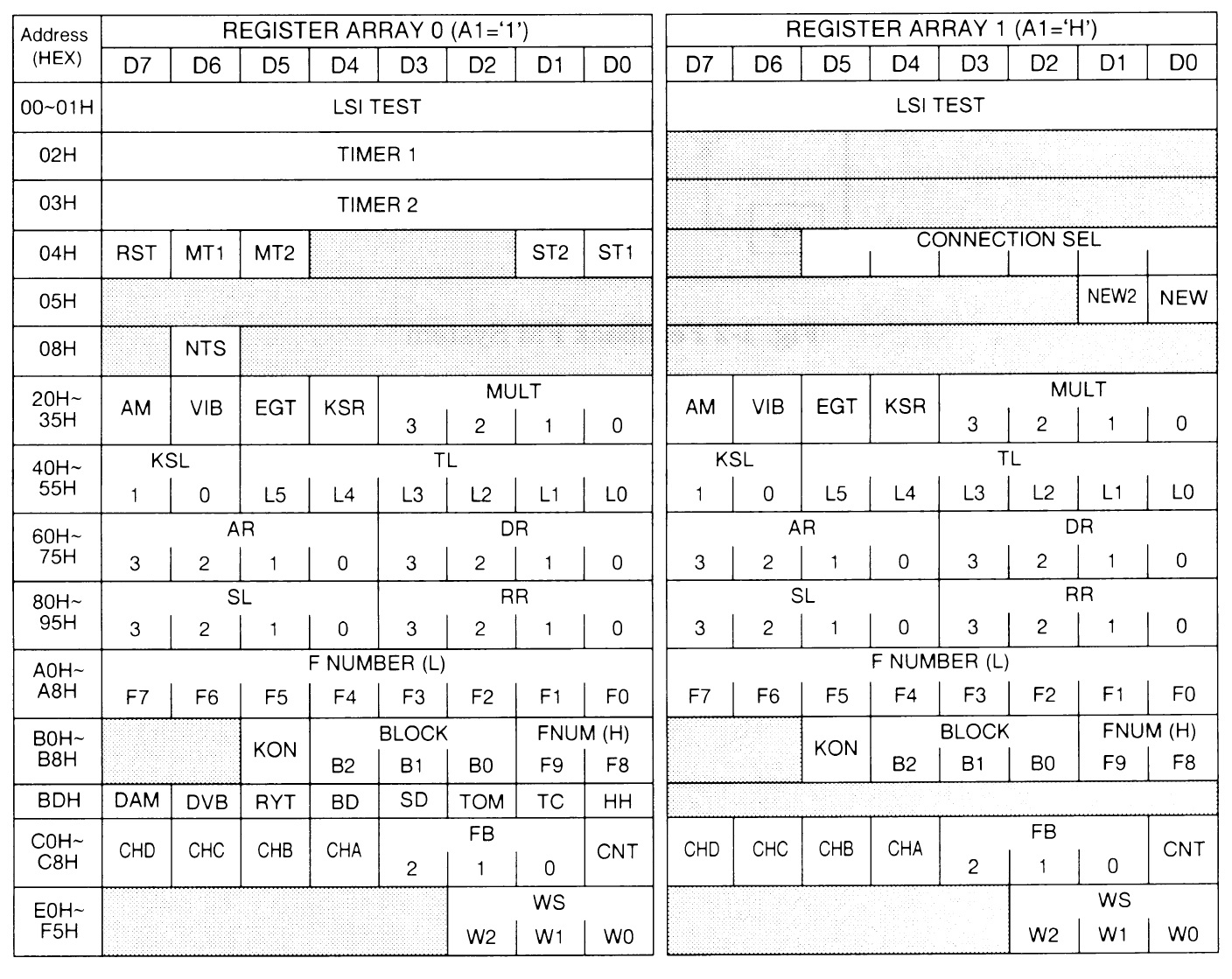
Like the wave table synthesizer, the FM synthesizer has a large table of common and channel-specific synthesis parameters. The register table organization is a little more complicated. Quoting:
The OPL4 has 36 circuits that generate a sine wave. A circuit which generates a sine wave is called a “slot”. A sound unit which is generated by combining two or four operators is called a “channel”.
There are two kinds of sound generation control registers: registers settable in slot units and registers set in channel units.
In 2-op mode, two slots are used to generate on FM sound. With 36 available slots, 18 channels of sound can be generated. In 4-op mode, four slots are used to generate one FM sound. Six channels are generated using 24 slots.
YMF278 FM synthesis control registers
Whew! Given the two dimensional nature of register organization, addressing a specific parameter value for a specific operator is a complicated matter. (See the data sheet for details.) Without going a deep dive into register addressing, here is an image showing common and channel-specific synthesis parameters.
YMF278 4-op algorithms
Summary
I would say that the overall architecture today (SWPxx) is not unlike the architecture of yesteryear. The number of synthesis parameters, of course, has exploded with new features in the wave table synthesis hardware (filtering!) and FM synthesis hardware. Modern FM can route FM output samples to AWM2 wave table filters, adding many wrinkles to datapath and control design.
The main CPU is responsible for channel allocation as notes are played and for channel deallocation as notes are released and completed. Once a channel is allocated, the main CPU must write the appropriate voice parameters into the channel registers. Then, it’s up to the synthesizer hardware to crank out a new sound sample at a 44.1kHz rate. Of course, the per-channel sound samples must be mixed and routed to the DSP effects processors. I would love to get a look at the mixing and DSP processing.
I hope this trip into the past gives you some insight into present-day AWM2 and FM-X hardware and an appreciation for the complexity and sheer number of details at the 10,000 foot level of digital synthesizer design.
Yamaha hold many patents on wave table and FM synthesis techniques. I recommend U.S. Patent 5,250,748 (1993) which describes the digital filter in AWM. For the modern era, I suggest U.S. Patents 8,779,267 (2014), 8,957,295 (2015) and 9,040,800 (2015).
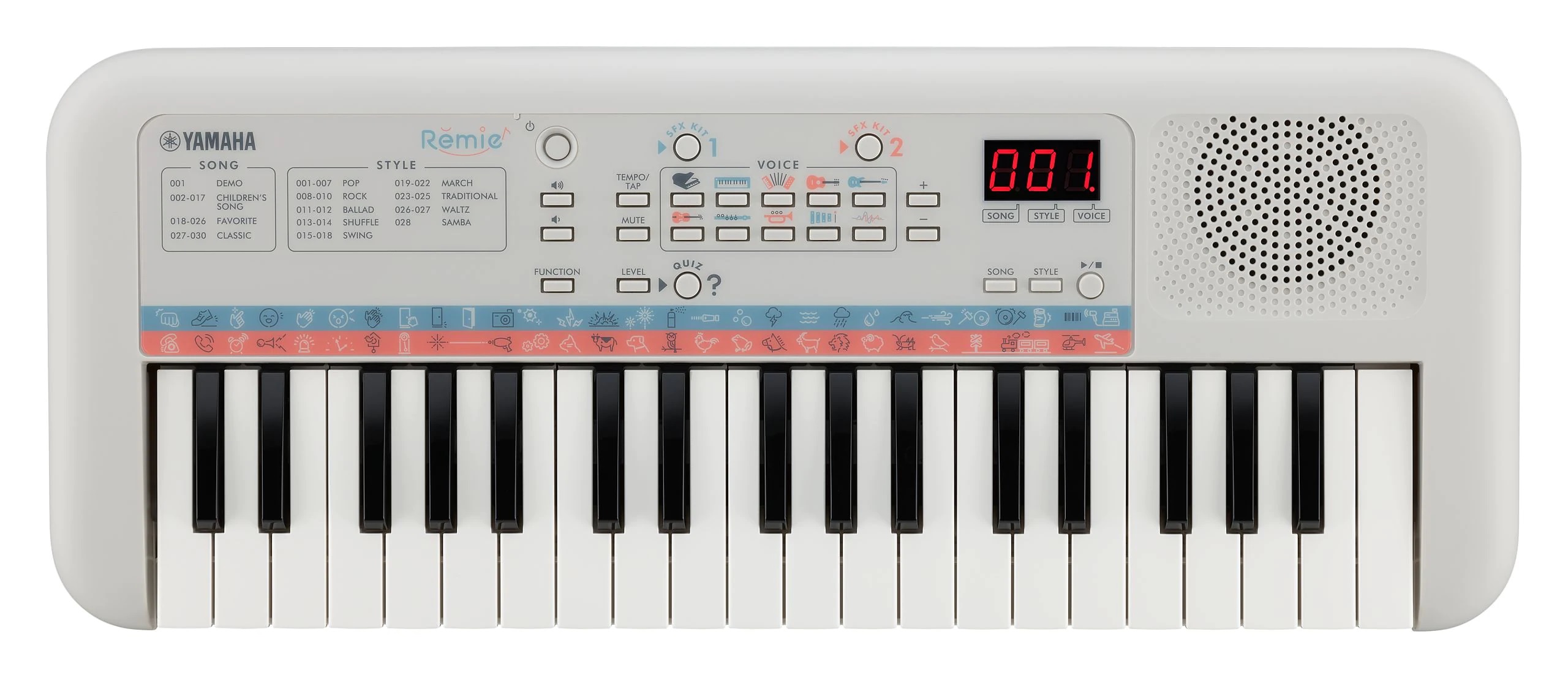
My Yamaha PSS-E30 Remie review promised updates about how Remie works out in the real world with a two year old. Here’s a the first update (and why we moved out west to be with our grandson).
Background: Our grandson attended Kindermusik classes while he was an infant and, man, we can see the effects already. He also hangs with older kids and his big-kid grandfather (me) who all play keys, so playing keys already seems like an every-day activity.
When he comes over to our house, we put on music, or he and I sit down at the Yamaha MODX or Genos, depending on what’s set up and handy. He is in love with the MODX Superknob and the built-in beats, now referring to beat music as “orange music.” Orange is his favorite color and he will literally ask us to play “orange music”. One wonders if he has synesthesia or if he just likes the occasional warm orange glow from the MODX Superknob.
Yamaha PSS-E30 Remie
Well, come Christmas day, he unwrapped Remie and broke into a joyful smile. He quickly started pushing the start/stop button; Do kids understand icons that early? We dropped a few beats and he literally was dancing along. So, I would say the first encounter with Remie was quite successful!
A few minutes later, we caught his mom (a former wind player) trying different features and taking a quiz. Couldn’t have been better. We’ll see how Remie works out in the long run.
Hey, Yamaha! You missed an opportunity, tho’. Kids love the Superknob. Your next keyboard for kids should have a Superknob on it!
Merry Christmas and Happy New Year! (And support art/music education).
I made a little more progress delineating Yamaha’s mini-key product lines. The PSS series is built for low manufacturing cost. Thanks to PSS-E30 (Remie) and PSS-A50 tear-downs, we know that the PSS series is based on the ultra-small, relatively inexpensive SWLL (YWM-830) processor.
So, what to make of the Yamaha SHS-300 and SHS-500 keytars?
The SHS-300 shares the same basic spec as the PSS series: 32 voice polyphony, 8cm speaker, only one effect (reverb), no MIDI, no Bluetooth, etc. Sound quality is comparable to the PSS series. I suspect that the SHS-300 is based on the SWLL, too.
The SHS-500, however, has a much better spec: 48 voice polyphony, MIDI and audio over USB, MIDI over Bluetooth BLE, 9 DSP effects, Master EQ, chorus, reverb, etc. A glance at the SHS-500 service manual shows that the SHS-500 has much in common with the current PSR E-series keyboards, including the SWX03 processor.
If I get the time, I’ll write a quick post about SHS-500 internals.
The SHS-500 is definitely a cut above the SHS-300 in build quality, sound, MIDI capability and tweak-ability. I’m sorely tempted to take a bite of the apple. NAMM, however, is fast approaching (16-19 January 2020) and good sense tells me to wait. Yamaha’s pre-show press release promises 75 new products including a new family-oriented home keyboard.
Product personality is determined by the plastic skin/parts, software in the embedded serial ROM, and the addition/absence of the USB interface integrated circuit (IC). There may be a few other minor differences, but it would be difficult to pin them down without the service manuals. Speaking of which, if you start a mod project, I strongly recommend reading the PSR-F50 Service Manual because the F50’s guts are very similar to the PSS series.
Unless you really want the F50 or E30 voices and functionality, the A50 is the best choice for a mod. The A50 has the USB interface IC and the necessary firmware supporting MIDI over USB. The A50 has a higher street price than the other models, but USB MIDI is worth it.
At the 100,000 foot level, there is plenty of empty space inside for a small microcontroller (e.g., Arduino) or sound mangling analog electronics. You could choose to either keep the speaker if you want portable sound or ditch the speaker and go solely with the headphone output to external amplification.
If keep the speaker, you could easily add some sound mangling circuits like a filter or effects. The littelBits filter might be a good start and is certainly small enough to fit in the empty space. Should be easy to tap into battery power as the battery leads are exposed.
If you ditch the speaker, you have a lot more space to work with. I’d be tempted to add the Korg NTS-1 once it’s available. The NTS-1 can process external audio and has digital effects. Previews have given the digital effects high marks. Unfortunately, the NTS-1 is spec’ed 12.9cm by 7.8cm by 3.9cm, which won’t fit directly into a PSS case. A lot depends upon the size of the NTS-1 electronics board. Even if we can’t fit the NTS-1 into a PSS case, the NTS-1 would be a nice complement to the A50.
Without the speaker, one could use the front panel real estate for additional controls. With all of the arpeggios and such, manual control over filtering and effects would be welcome (in addition to the A50’s fixed motion effects).
At the 50,000 foot level, any one of the PSS models could be stripped down for parts. The case and front panel may or may not float your boat, but you could use the shell and front panel for a keyboard project of your own. It would be easy to apply new graphics to the front panel. The front panel buttons are a switch matrix which can be easily mapped out and then scanned by your code. The front panel has a three digit 7 segment display that needs to be multiplexed and driven.
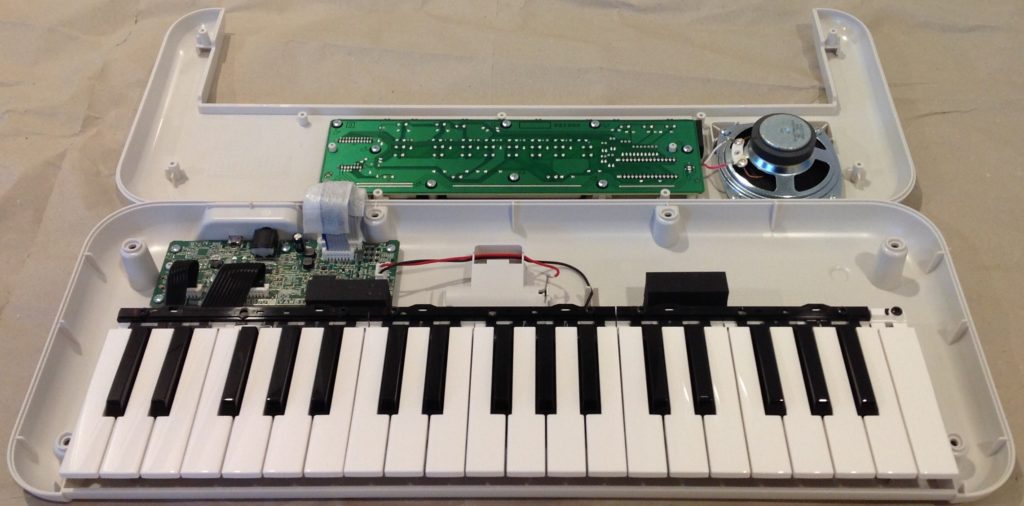
The keybed is quite useful. The keys are affixed to the bottom of the case, so unless you’re reusing the case, too, you probably will need to cut the keybed out of the case, leaving everything as a unit. The keys sit above a printed circuit board (PCB) with the rubberized switch contacts.
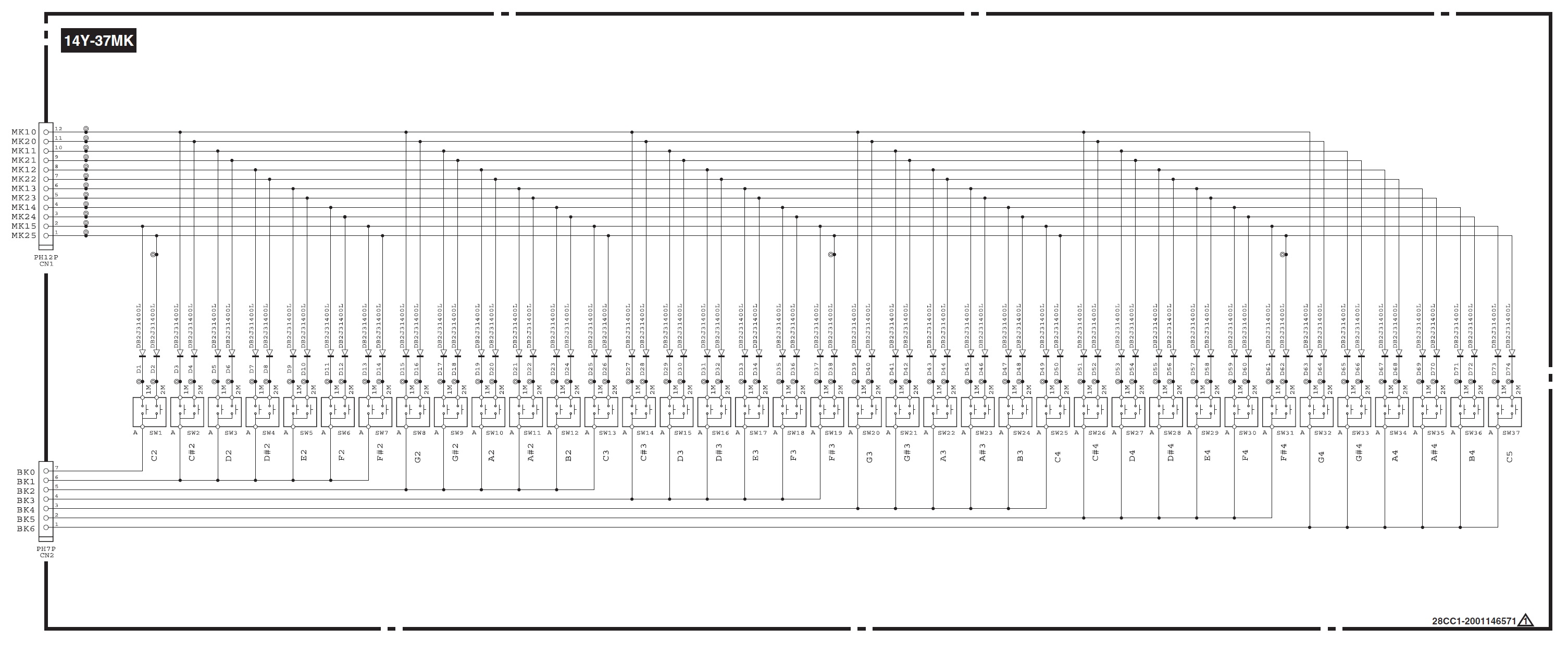
Reface YC switch matrix
I’ll make a leap of faith here and assume that it’s the same keybed as Reface. The schematic above is taken from the Reface YC Service Manual. The key matrix has seven select lines (BK0 to BK6) and twelve sense lines (MK10 to MK21). Your software needs to drive one of the select lines and immediately read the sense lines. There are two sense lines per switch for the “lower” and “higher” key contacts. Software can determine key velocity by measuring the time between contact closures for an individual key.
The most tasty enchilada is the digital logic (DM) board. The A50 board, in particular, could form the basis of a USB MIDI tone module. One could add 5-pn MIDI by bridging a 5-pin DIN and the USB micro-B port. The DM board is quite small: 13.5cm by 4.5cm. And clearly, the DM board can be battery powered. Even if you re-housed the DM board and front panel board, you still would get a very compact module.
Modding at the 10,000 foot level gets difficult. There are the usual difficulties tracing signals and soldering surface mount (SMT) devices and signal paths. Even if you strip out the SWLL (YMW-830) integrated circuit, I’m not sure what you would do with it!
Nor am I confident that the firmware can be easily by re-engineered. Yamaha have never documented wave chip internals, so you don’t have much guidance. There isn’t much code — firmware and waveforms reside together in the 2MByte serial ROM. I would guess that the firmware is SH architecture. Even so, reverse engineering would be a difficult task. I have my doubts about repurposing the code. At best, one might be able to add or change the waveforms?
Personally, I’m inclined to go the sound mangling route.
A few more thoughts before closing.
The A50 is not a General MIDI module. If you want a (mostly) GM/XG compatible Yamaha tone module, I suggest the Pocket Miku NSX-39. Also, while stumbling around the web, you might want to check out the Yamaha YMF-825. It’s a 4-op FM chip which Yamaha released for makers.
With Yamaha PSS-E30 Remie at hand, I’m still comparison shopping the PSS series against the Yamaha SHS-500 Sonogenic. The Sonogenic has better build quality, has 5-pin MIDI as well as MIDI over USB/Bluetooth, and integrates with Chord Tracker.
Then there is the issue of sound quality. Remie and the rest of the PSS series (PSS-F30 and PSS-A50) have only one main DSP effect: reverb. With the exception of the A50’s motion effects, there aren’t the means to tweak sounds.
As to preset voices, I would love to play Remie and Sonogenic side by side. However, in this day and age when brick and mortar stores do not stock inventory or demo units, that’s impossible. Gosh, I ordered Remie from the UK — I live in the big Seattle USA metro area — with the intention of gifting it to our grandson. (A good excuse. 🙂 ) The PSS series keyboards are so inexpensive that even an impulsive purchase is justifiable. I still haven’t seen a Sonogenic alive in the wild and don’t have hand-on experience with it (yet).
First some tech-head stuff. Remie has 32 voice polyphony and my teardown shows that it is based on the tiny Yamaha SWLL (YMW-830) system-on-a-chip (SOC). It stores its program and waveforms on a 2MByte ROM. Right away, I expect Remie’s sound quality to be compromised with respect to the current PSR E-series.
The current PSR E-series is based on the proprietary Yamaha SWX03 processor. The SWX03 is a much larger SOC with external RAM, ROM, digital to analog conversion (DAC), analog to digital conversion (ADC), and LCD display interface. The program/wave memory is 32MBytes (Spansion S29GL256) much larger than Remie. The SWX03 supports 48 voice polyphony and 10 DSP effects in addition to the usual PSR E-series reverb and chorus. Thus, I expect better sound quality from the E-series.
The SHS-500 also has 48 voice polyphony and 10 DSP effects. These characteristics alone make a strong case for the SWX03 as the main engine within the Sonogenic.
The Japanese demo gets rolling roughly 3:30 in. Our jazzer compatriot plays through the presets without a backing track or lots of effects. This is as close to factory stock as one can get. Thank you! Here are direct links to some of the Sonogenic instruments in the video:
These sound pretty good and much better than Remie. The electric piano can bark! The jazz guitar is decent. Many of the brass and woodwind instruments have vibrato sampled in.
The Sonogenic program change table gives us a major clue about the origin of the Sonogenic voices. Most of the Sonogenic voices match up with the PSR series:
 SHS-500            Bank  Bank
 Sonogenic           MSB   LSB  PC#  PSR/Genos voice
 -----------------  ----  ----  ---  -----------------------
 Saw Lead 1          104    20   91  Gemini
 Saw Lead 2            0   104   82  RS Saw Lead1
 Quack Lead            0   112   85  Portatone
 Bright Decay        104    21   85
 Square Lead           0   112   81  Square Lead
 Under Heim          104    51   88  Under Heim
 Analogon            104    52   82  Analogon
 Synth Brass           0   113   64  Ober Brass
 Electric Piano      104    28    5
 DX Electric Piano     0   112    6  DX Modern
 Electric Guitar     104     3   31
 Jazz Guitar         104     0   27  Cool! Slide Jazz Guitar
 Acoustic Guitar       0   117   26  Steel Guitar
 Electric Bass       104     6   34
 Slap Bass             0   112   37  Slap Bass
 Synth Bass            0   112   39  Resonance Bass
 DX Bass               0   118   40  DX100 Bass
 Piano                 0   112    2  Bright Piano
 Piano & Strings     104    39    1
 Piano & Pad         104    40    1
 Air Choir             0   112   55  Air Choir
 Strings               0   116   49  Bow Strings
 Brass                 0   117   63  Pop Brass
 Trumpet               0   115   57  Sweet! Trumpet
 Flute                 0   115   74  Sweet! Classical Flute
 Alto Sax            104     2   66
 Tenor Sax           104     3   67
 Harmonica             0   112   23  Sweet! Harmonica
I verified the matches by comparing the YouTube video against the same voices on Genos. (Removing the Genos effects, of course.) The blank spots in the table are voices which Yamaha re-sampled from PSR or elsewhere. That’s why the electric piano is so darned good. The piano layer voices have a warmer, mellower timbre than the Bright Piano (which really lives up to its name).
So, there you have it. On the basis of sound quality, the Sonogenic SHS-500 wins over the PSS family. Yes, the Sonogenic is more expensive, but you do indeed get more for the money. If Sonogenic had even a single organ voice, it would be a no-brainer and I would have bought one by now. Oh, Yamaha, why do you leave these things out?
Now let’s take a first look at Yamaha PSS-E30 Remie inside.
My Remie is a seasoned world traveller. It was designed in Japan, made in India, distributed by Rellingen, Germany, sold by Amazon UK and played in Washington state, USA. Physics and electrons are indeed universal.
The PSS-E30, PSS-F30 and PSS-A50 are essentially the same physical product. They are part of a family like Reface. The Reface family, BTW, is two pairs of fraternal twins: YC/CP and CS/DX. The PSS family are fraternal triplets and share the same printed circuit board (PCB). In fact, the PCB has three little check boxes. A mark in a check box denotes the specific product personality.
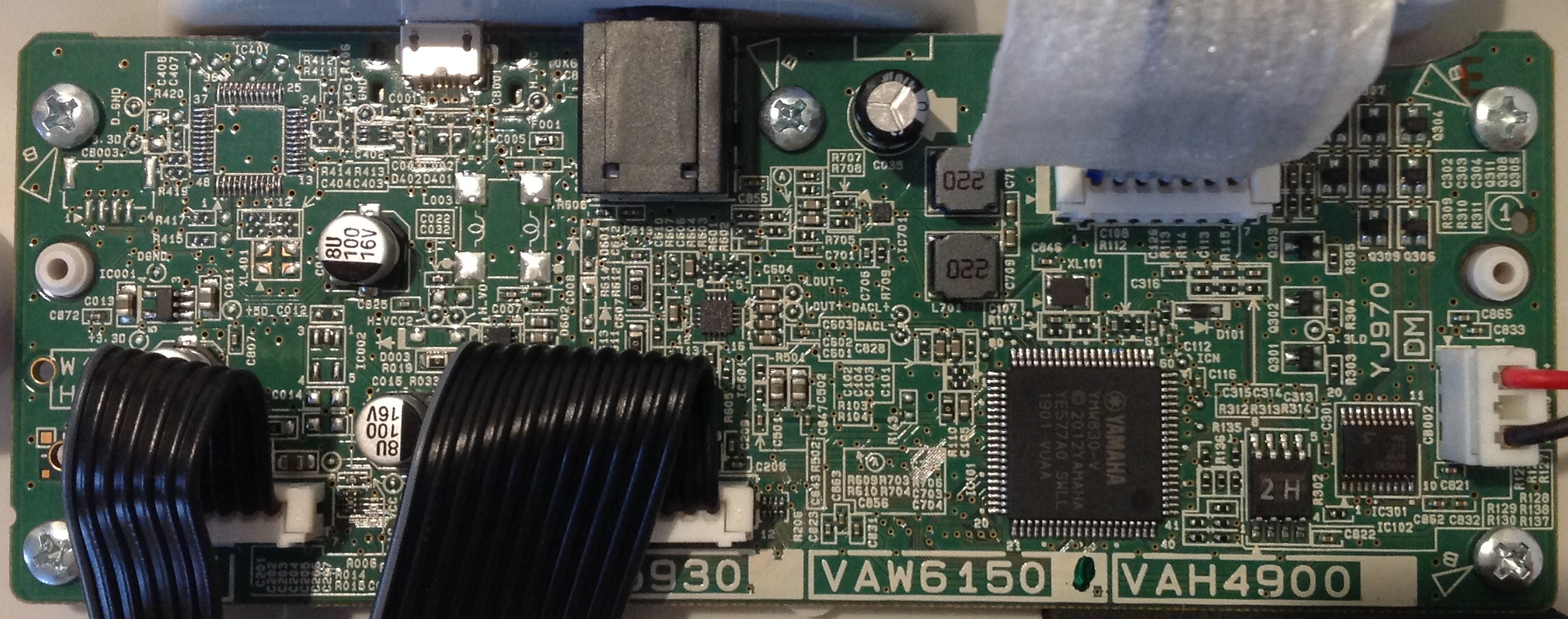
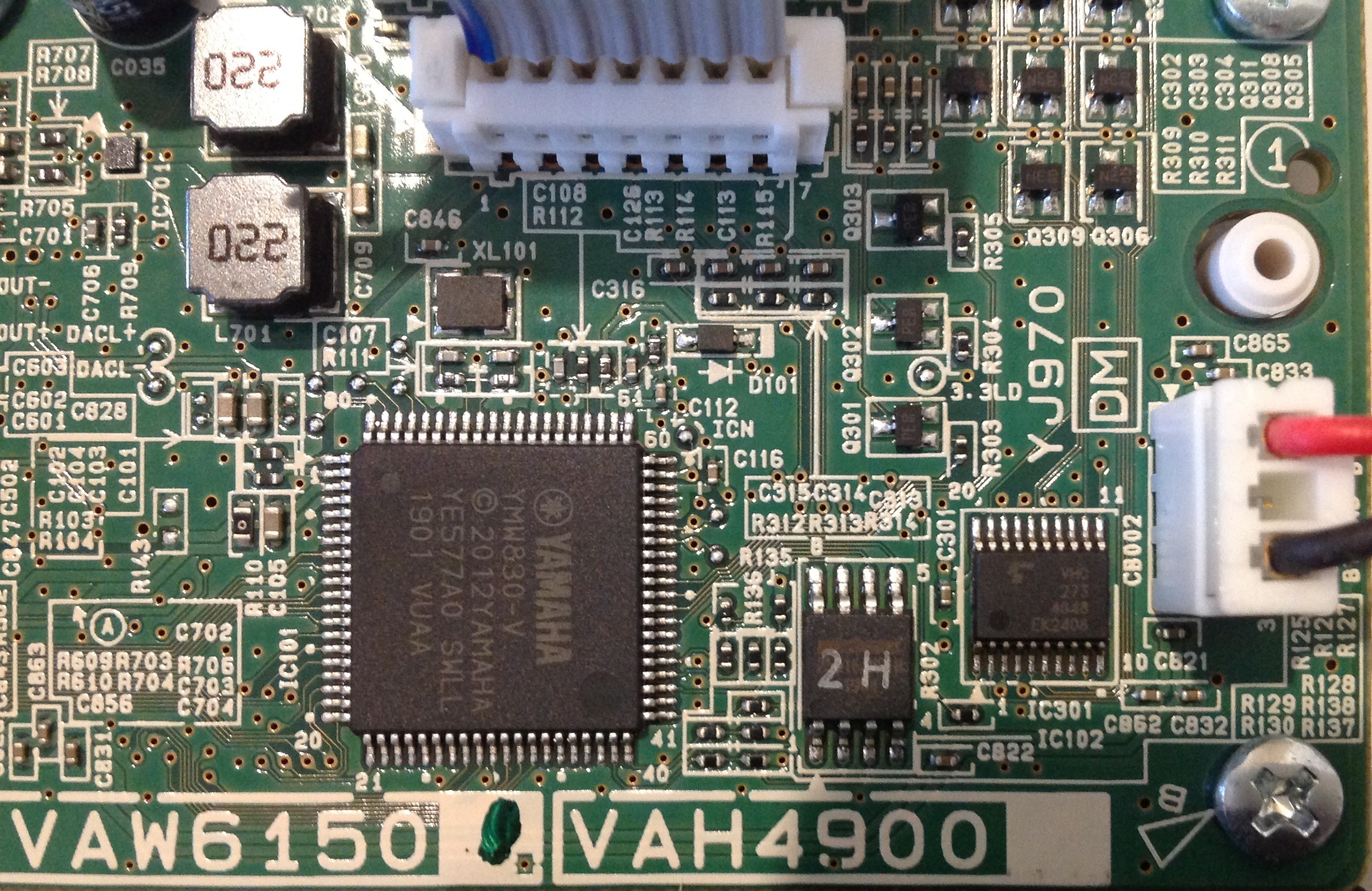
Yamaha PSS-E30 Remie digital logic board (DM)
Product personality is determined by four things: front panel graphics, software, content (voices, styles, etc.) and USB interface.
Line up the three PSS keyboards and you see that they all have the same panel layout. The buttons are all in the same physical place. Everything else that is external is just skin (case color and stick on panel graphics). The panel connections to the digital logic board (DM) are the same in all three products.
Next up, each member of the family has different code and content. The software and content are stored in a Winbond 2MByte serial ROM. The main CPU (SWLL) reads the binary code and waveforms from ROM at boot time. The ROM components are stamped with a product specific code: “2H” for Remie and “2I” for the PSS-A50.
The 2MByte ROM holds both code and waveforms. The small ROM harkens back to the day of the Yamaha QY-70 when XG voices and drum kits fit into 4MBytes. Given the small ROM, one shouldn’t expect super high voice quality in any of the models.
Finally, the PSS-A50 is the only sibling with an active USB interface. Remie has an unpopulated IC site as you can see in the upper left corner of its PCB. This site is populated with a USB chip in the A50. Without the chip, Yamaha can build and sell Remie at a lower cost than the A50. Even if one carefully soldered the correct USB IC into the unpopulated site in Remie, I doubt if Remie’s software has the code to recognize it.
The PSS-F30 is a shrunken PSR-F50. For the rest of this discussion, I’m using the Yamaha PSR-F50 Service Manual as my guide to the electronics. As to the keybed, I’m using the Reface YC Service Manual.
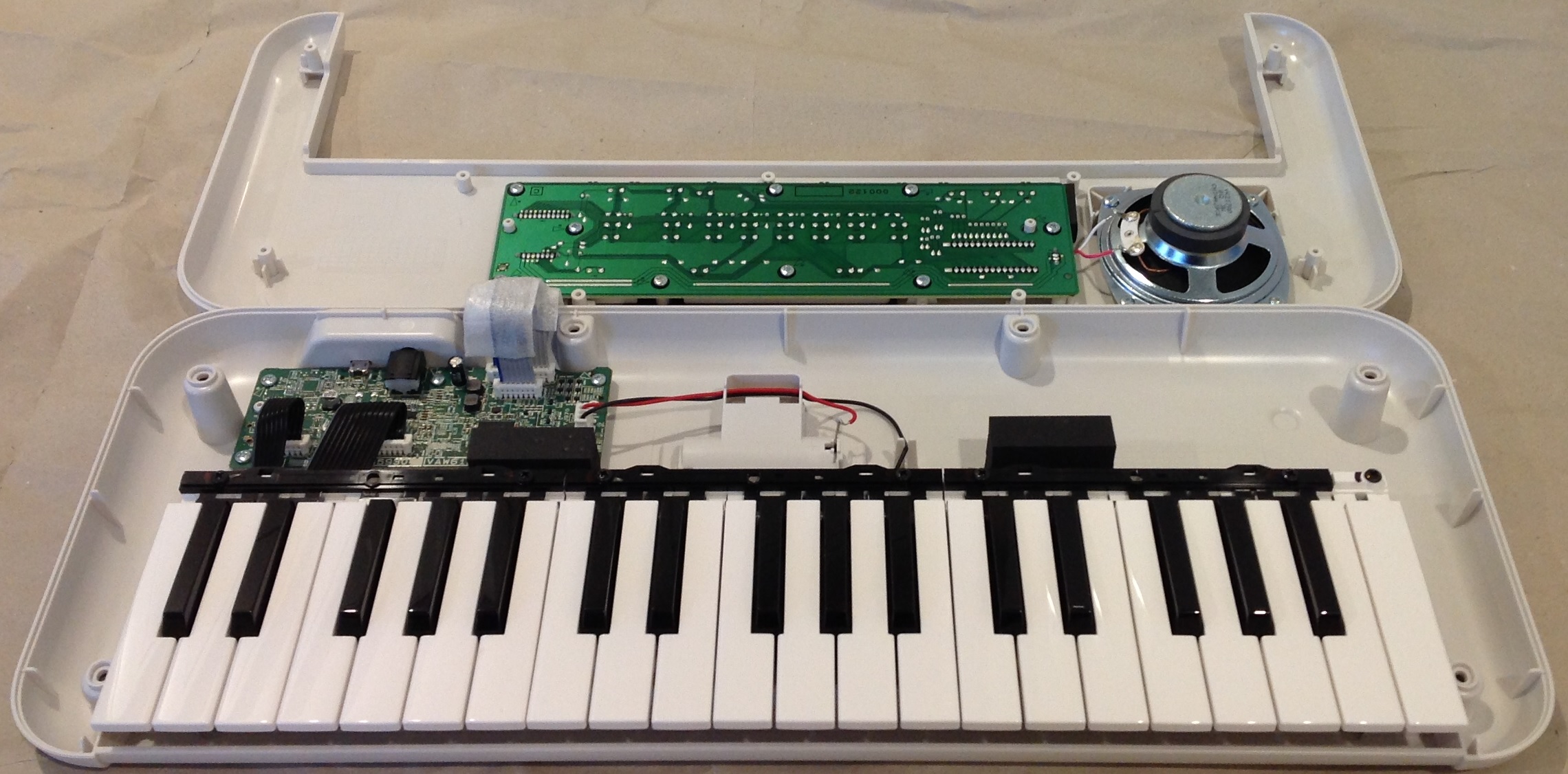
Remie circuit boards and ribbon cables
Inside, each member of the PSS family consists of three circuit boards: the main logic board (DM), the front panel board and the keybed. The front panel board and keybed are each a switch matrix. The CPU scans both the front panel and keybed separately. It scans each board by asserting a switch group select signal and then reading the current state of each switch in the group.
There are twelve switches in a keybed group, two switches per key. The switch contacts are at two different heights and close at two different times when struck. The CPU measures the closure time between the first contact and the second conent in order to sense key velocity.
The panel PCB and the keybed PCB are each joined to the digital logic board by short ribbon cables. The loudspeaker signals hitch a ride through the front panel ribbon cable.
The main CPU and tone generator is a Yamaha proprietary integrated circuit — the YMW830-V or “SWLL”. The SWLL is the ultra-small brother to the SWL01. The chip is housed in an 80 pin surface mount quad pack which is only 1.3cm on a side. That’s tiny. The entire PCB is a tidy 13.5cm by 4.5cm.
The SWLL is a true system on a chip (SOC) containing the CPU, RAM, tone generation circuitry, UART, ADCs and DACs. Amazing. The chip inside is small, too, and Yamaha can print these like postage stamps in large volume. Everything about the SWLL screams “low cost”.
Using the PSR-F50 Service Manual, here is the SWLL pin-out:
     1   DACLPP    Left channel DAC output (positive)
     2   DACLMM    Left channel DAC output (minus)
     3   DAC_VDD   DAC Vdd
     4   DAC_VSS   DAC Vss
     5   DACRMM    Right channel DAC output (minus)
     6   DACRPP    Right channel DAC output (positive)
     7   VSS       Vss
     8   KYN11     Key sense (input)
     9   KYN12     Key sense
    10   KYN13     Key sense
    11   KYN14     Key sense
    12   KYN15     Key sense
    13   KYN16     Key sense
    14   KYB1      Keyboard key group select (output)
    15   KYB2      Keyboard key group select
    16   KYB3      Keyboard key group select
    17   KYB4      Keyboard key group select
    18   KYB5      Keyboard key group select
    19   KYB6      Keyboard key group select
    20   KYB7      Keyboard key group select

    21   KYB8      Keyboard key group select
    22   KYB9      Keyboard key group select
    23   KYB10     Keyboard key group select
    24   KYB11     Keyboard key group select
    25   IOVDD
    26   VSS
    27   LDOTSTO
    28   KYN21     Key sense (input)
    29   KYN22     Key sense
    30   KYN23     Key sense
    31   KYN24     Key sense
    32   KYN25     Key sense
    33   KYN26     Key sense
    34   SWIN0     Panel scan input
    35   SWIN1     Panel scan input
    36   SWIN2     Panel scan input
    37   SWIN3     Panel scan input
    38   VSS
    39   SDQ2      Serial ROM WP# (DQ2)
    40   SDO       Serial ROM DO (DQ1)

    41   SCSN      Serial ROM chip select (CS#)
    42   IOVDD
    43   SDQ3      Serial ROM NC (DQ3)
    44   SCLK      Serial ROM clock (CLK)
    45   SDI       Serial ROM DI (DQ0)
    46   VSS
    47   PORTB0    PSW0
    48   PORTB1    (7seg_e0)
    49   PORTB2    (7seg_e1)
    50   PORTB3    (7seg_e2)
    51   PORTB4    (7seg_lat)
    52   PORTE0    /PSWI
    53   PORTC0    (Sustain input)
    54   TXD       UART transmit data (output)
    55   RXD       UART receive data (input)
    56   PLLBP
    57   TEST
    58   LDOTST
    59   IC_       (Voltage detector)
    60   VSS

    61   ADC_VDD   (+3.3V)
    62   ADC_VSS   (Ground)
    63   AN0       Analog input
    64   AN1       Analog input (battery check)
    65   VSS
    66   PLLVSS
    67   PLLVDD
    68   LDOC
    69   LDOVDD
    70   LDOVSS
    71   VSS
    72   XI        Crystal input
    73   XO        Crystal output
    74   VSS
    75   IOVDD
    76   TDO       Test data out
    77   TCK       Test clock
    78   TMS
    79   TDI       Test data in
    80   TRST_     Test reset
I determined pin function by tracing signals in the PSR-F50 Service Manual. Yamaha may have changed things a bit in Remie and A50. I have not determined how the USB interface is connected to SWLL in the A50 nor have I even identified the component.
Yamaha PSS-E30 Remie LSI components
For the PSR-F50, the SWLL internal clock is 33.8688MHz and the master clock is 67.7376MHz. The clocks are generated from a 16.9344MHz crystal. All clocks are a multiple of 44,100Hz, the sample frequency. I can’t read the marking on Remie’s crystal, but there isn’t any reason to believe that it differs from F50.
The three digit LED display is both retro and cheap. Remie has the same eleven transistors driving the time-multiplexed seven segment display.
Under software control, transistors Q301 to Q303 (7seg_e0 to 7seg_e2) select one of the three digits.
Transistors Q304 to Q311 drive the individual segments.
Segment status is latched into an eight flip-flop SN74LV273 from the SWL KYB1 to KYB8 pins. The latch clock is produced by SWLL pin PORTB4 (7seg_lat). Note that the KYB pins do double duty as inputs from the keybed.
Whew! That leaves us deep in the weeds! Next time, I’ll outline a few ways to mod the new PSS keyboards.
One of the big benefits of moving out west is time with our grandson. The lad went to Kindermusik as a pre-toddler and already has a good sense of rhythm and an appreciation for music. I dropped a few quick beats with the MODX and he started dancing with a big smile on his face! Editorial: Folks, arts are an essential part of a child’s education.
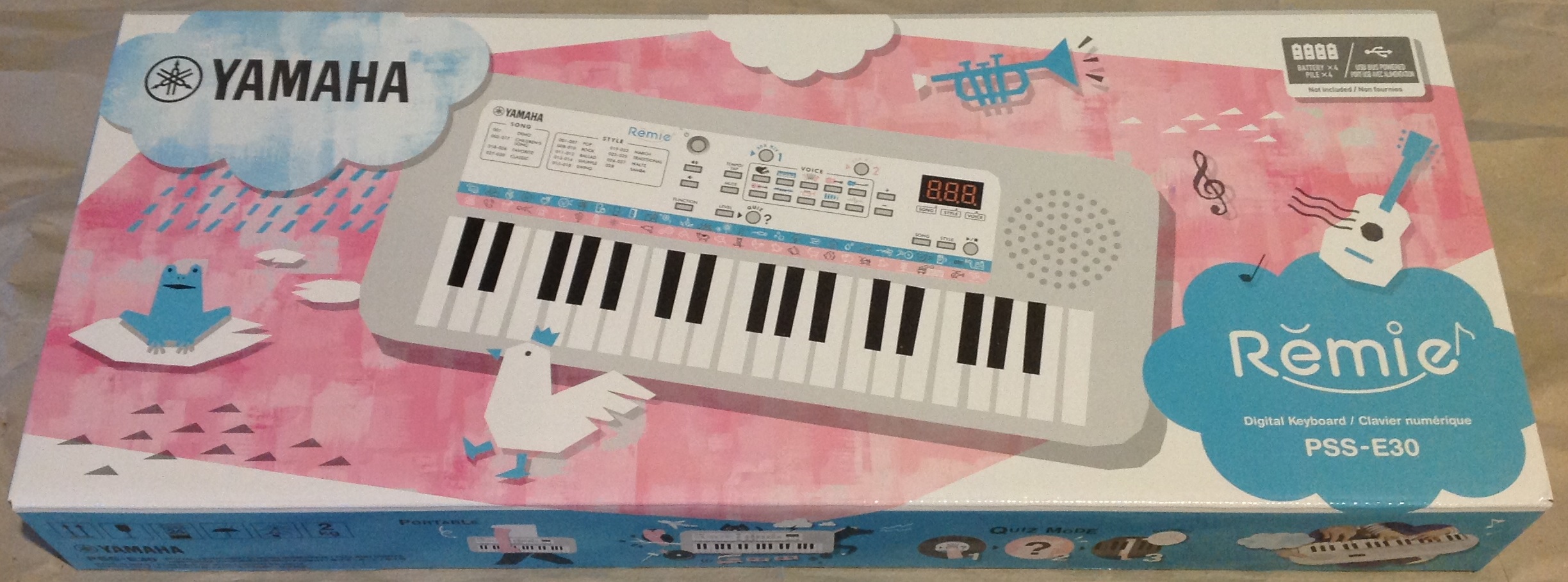
Last Fall, Yamaha announced a trio of mini-sized PSS keyboards: PSS-E30 (Remie), PSS-F30, PSS-A50. The three products have distinct product markets: young kids, older kids, teens and young adults, respectively. Of course, those are mere marketing constructs since one or more of these ‘boards might appeal to jaded musicians and other folks, too.
Yamaha PSS-E30 Remie
There is another market segment which, perhaps, Yamaha did not explicitly intend — modders, AKA “hacks”. This article will focus on Remie (PSS-E30) as an instrument. I’ve already taken a screwdriver to Remie and will eventually post an article about Remie internals and other topics of interest to hacks.
“Keen On Keys” posted a nicely produced PSS-A50 demo on YouTube. The A50 appeals to musicians who want to put together simple tracks from arpeggios (musical phrases). Looks like fun! The A50 is the only member of the family which can record songs and, most importantly, the only member which sends/receives MIDI over USB. Neither Remie nor the PSS-F30 have a USB interface although they use a micro-B connector for power.
The PSS-F30 is the “Honey I Shrunk the PSR-F50” arranger keyboard. The F30 essentially has the same sounds, styles and songs as the F50/F51. The F30 could be the mini-keyboard for arranger enthusiasts on the go. That said, after taking a peak inside the A50 (see the YouTube demo) and the Remie, the program and waveform memory is quite small and the sound is not up to the same quality level of the current E-series arranger keyboards. Something had to be sacrificed to achieve such a small size, low cost and longer battery life (1.5 Watts versus 6 Watts). YMMV.
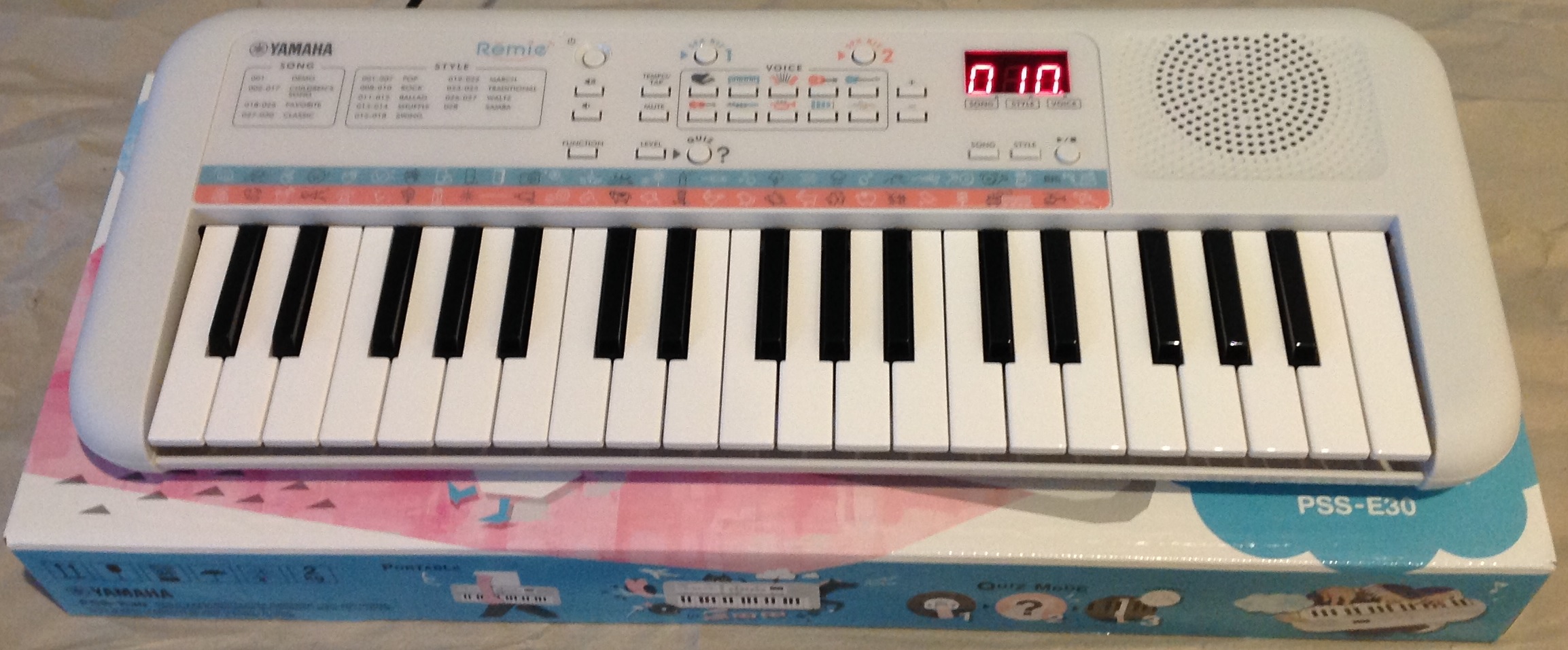
Yamaha PSS-E30 Remie
Circling back to Remie… I had to have one, er, buy one for our grandson. Naturally, I needed to check out Remie to make sure that it works on Christmas morning. 🙂 Oh, that includes a peak inside to make sure everything is in its place.
I wish that I could review Remie from a two year-old’s point of view. That review will wait for Christmas day. In the meantime, here’s my take from a musician’s perspective.
The keybed
Remie has 37 mini keys. To my touch, they are indeed the same as the Yamaha Reface series keyboards. I play the Yamaha Reface YC (drawbar and combo organs) at weekly choir rehearsal. I must say, Remie’s keybed feels better than the YC! Maybe I have worn in the YC’s keys or maybe manufacturing quality is better now. Bottom-line, the mini-keys are pretty darned good.
I think the keybed will hold up when kids go to work on it. Our grandson has watched older kids play piano, and he presses keys instead of whacking on them like most kids. [I trust him enough that we play side-by-side on MODX and Genos.] I haven’t been very gentle with the Reface YC and yet, the keys hold up. Parents shouldn’t worry about key quality. The mini-size should be good for kids, too; most adults find these mini-keys cramped.
I have one main complaint with 37 keys: the note range is sometimes too small for some songs. I wish the keybed was 49 keys with middle C in its rightful place. I like to play the left hand part in the two octaves below middle C. With 37 keys, that leaves only one octave above middle C for the melody and I often run out of keys in the right hand.
Remie is no different. Further, Remie does not have octave shift buttons which would alleviate the short range issue somewhat.
Sound
As I mentioned above, voice quality is comparable to early Yamaha portable keyboards, back in the day when waveform (sound) memory was tight. I’m sure Remie is using recycled sounds; that’s why it’s inexpensive.
The voices do not respond to touch. Thus, when you play the keys soft or hard, you get the same volume and timbre. One can make the overall volume louder and softer using front panel buttons. That’s it for dynamics.
So far, I’ve tested Remie through its built-in speaker, headphones (3.5mm stereo) jack and studio monitors. Of course, an 8cm speaker is not going to produce earth-shaking bass. It is adequate for the family room and reproduces the built-in voices surprisingly well. I think Yamaha learned a lesson with Reface and its disappointing built-in stereo speakers. As a result, I always play the YC through JBL Charge 2 speakers, not the YC’s built-in speakers. Unlike Reface, I could actually see myself using Remie’s speaker. BTW, the sound does not distort when pushed to the MAX.
Plugging into the headphone jack turns off the internal speaker. As expected, sound quality improves dramatically through decent headphones or external speakers. Parents should be careful when kids use headphones. Remie can drive headphones painfully loud. Fortunately, there is a “Volume Limit” function that sets the maximum Master Volume level. Parents should definitely set the “Volume Limit” before letting kids use headphones.
Sound quality through studio monitors is quite good! The sound is clear and is comparable to other entry- and mid-range arranger keyboards.
Overall, I’m tempted to take Remie to rehearsal to see if either the F30 or A50 might make a good ultra-portable rehearsal keyboard. I wouldn’t consider playing one of these keyboards in front of a congregation (audience), however. No such quality qualms about the YC which carried me through a few gigs during the move.
Styles and songs
The styles and songs are what we expect from a low-end Yamaha keyboard. The styles are pleasant enough. However, this isn’t a $5,000 Genos. 🙂 The styles do not have A and B sections or auto-fill. I wouldn’t expect kids to be arranging songs unless they are Mozart reincarnated.
The only concerns that I have in this area are operational. Can a young kid figure out how to play a song? Can a youngster play along with a style? I think adult supervision is needed here. I recommend that adults read the manual since operation is not intuitive, especially if you don’t have experience with Yamaha arranger keyboards.
The sound effects (SFX) shouldn’t be too hard to figure out. There are two dedicated front panel buttons to select either the blue kit or the pink kit. Kids shouldn’t have trouble with that.
Remie has a number of deep features controlled by the “FUNCTION” button. This is definitely beyond young kids. Parents should read the manual for more information. Functions include tuning, transpose, metronome, etc.
Yamaha arrangers usually apply effects like reverberation, chorusing, (guitar) distortion and so forth. Musos often complain about too much reverb. I’m happy to report that Yamaha has set the reverb to a pleasant level — a good thing because there isn’t any way to change the amount of reverb. Reverberation appears to be the only effect on Remie.
Musical scales and smart chords
Remie has a Smart Chord feature which is enabled right out of the box. Smart Chord is designed to keep chords within a chosen musical scale, i.e., the C scale AKA “all of the white keys.” Smart Chord lets a kid play one note chords.
If you’re a musician, however, the result may surprise you. Playing a I-IV-V (C-F-G in the C scale) progression sounds right, but hit that VII (B) and uh-oh. The VII chord plays Bm-flat5, the diminished chord. Play with Remie and you may raise a kid with an ear for “interesting” harmonies. Hope you like dissonance. 🙂
BTW, one of the functions sets the Smart Chord key in case you want to play with Smart Chords in some other key than C.
Summary
Well, Remie is a pretty good — although basic — keyboard instrument. It will be interesting to see what young, two year-old hands will do! It’s well-made and is a worthy impulse purchase.
Yamaha have updated their short video about the Genos V2.0 update. The release date is now specific: 15 November 2019. There was considerable squabbling on the forums as to what “Winter 2019” meant. I’m glad that Yamaha has put the question to rest.
The other big tidbit from the new video as to do with the “Genos V2.0 Superior Pack.” The new content will include 50 new styles and 68 voices including Super Articulation 2 voices. I’m not a big style hound, but new voices are always welcome! I’ve still got plenty of room in expansion memory and can’t wait for the new content. I’m looking forward to the Chord Looper, too.
[Update] The Yamaha Europe site has further details. The Genos Version 2.0 Superior Pack includes SArt2 Premium voices such as “Pan Flutes,” “Female Vocals,” and “Trombone.” The page shows thumbnails for the Yamaha Musicsoft Premium Expansion Packs of the same name. This might be a little disappointing to users who already own these packs. I have “Female Vocals” already. Of course, that’s just icing and we still need to taste the whole cake.
Improvements have been made to expansion pack installation (Yamaha Expansion Manager). Yamaha have also improved Genos Style Creator, which was looking rather long in the tooth. Other improvements include new portamento functionality, sorting playlists alphabetically, and an increase in the number of USER effects which can be stored.
Additional improvements flash by near the end of the video. (Look for the flying boxes!) Unfortunately, the English is a little rocky and its hard to tell what some of them actually mean! One useful improvement is the addition of USER voices to FAVORITES. (?) I hope they allow USER styles in chord step record because I didn’t see this mentioned.
Yamaha are listening. They cite user feedback as the source for many of these enhancements.
BTW, some folks have noted an increase in the USA Minimum Advertised Price (MAP). Please remember that all dealers cannot publicly advertise below MAP as part of their dealership agreement with Yamaha. That doesn’t mean selling at MAP because that would be illegal price fixing in the USA. If you want a good deal, be sure to call around, especially smaller focused dealerships like Audioworks CT. The large on-line retailers don’t have as much incentive to negotiate or to offer a better price below MAP. Smaller dealerships are often more flexible.
Yamaha MODX update V2.0 is here
Yay! The MODX V2.0 update has dropped! I’m downloading now and will be installing shortly.
Yamaha have posted a new MODX Supplementary Manual and a new MODX Data List PDF in the downloads section of the MODX Web pages. You’ve probably already seen the list of new features as implemented in the most recent Montage update:
New effect types have been added: VCM Midi Filter, VCM Mini Booster, Wave Folder.
52 new Performances have been added.
The Pattern Sequencer function has been added.
You can now play songs, patterns and audio files from the Live Set display.
Super Knob Link has been added to the data that is recorded in the Scene function.
Keyboard Control has been added to the data that is recorded in the Scene function.
Increased the range of the LFO Speed parameter.
You can now connect MIDI equipment via the USB TO DEVICE terminal.
The Global Micro Tuning settings have been added.
The Audition Loop setting has been added.
Improvements have been made to the user interface.
The sequencer storage capacity (total User Memory) has been increased from about 130,000 to about 520,000 (for Songs) and about 520,000 (for Patterns).
The new Performances are listed on page 17 of the new Data List PDF (version c0). The new Performances are numbered from 2144 to 2195. Laser Trumpet?
Not going to the gym today… 🙂
Installing the MODX V2.0 update
The first thing to note: This is a major update.
I don’t just mean that as a compliment to Yamaha. The software engineers had to touch many, if not all, of the major internal data structures. You must perform a complete back-up before attempting installation as you will need to initialize all data and then reload your back-up file.
Please read the installation directions before starting. The directions clear state that all of User Memory (Library Data, User Data, etc.) will be initialized. Be sure to do a complete back-up following the directions on pages 60-61 of the Owner’s Manual and pages 201-202 of the Reference Manual. You want to write a back-up file, also known as an “ALL file” or “X8A” file by its extension. A back-up file saves the whole shee-bang including your libraries.
Follow the steps in the installation guide. The installation process takes about 4 to 5 minutes. If everything is successful, you will see messages like:
Searching for the updater ... OK

MODX updater 2.00.1

Preparing ... OK (current version 1.10.0)
Updating ... OK
Verifying ... OK
Finish.
Please turn off.
Turn MODX off, remove the USB drive with the updater, and turn MODX on again. Navigate to the System Settings by pressing [UTILITY] > [Settings] > [System]. I pressed the “Initialize All Settings” screen button first and then pressed the “Initialize All Data” button. (Deep breath.) Yamaha’s installation directions should be a little more specific here as to which buttons to press.
The initialization steps will, of course, wipe everything clean. Next, insert the USB drive with your back-up file. Navigate to the load contents page, i.e., [UTILITY] > [Contents] > [Load] and select the “Backup File” content type. Find your back-up file on the USB drive and re-load your content. If all goes well (modulo power failure, cosmic debris, pulsars, etc.), you should be good to go again.
I liked the Genos block diagrams which I posted the other day. The diagrams summarize the Genos main CPU and tone generation subsystems in a compact form.
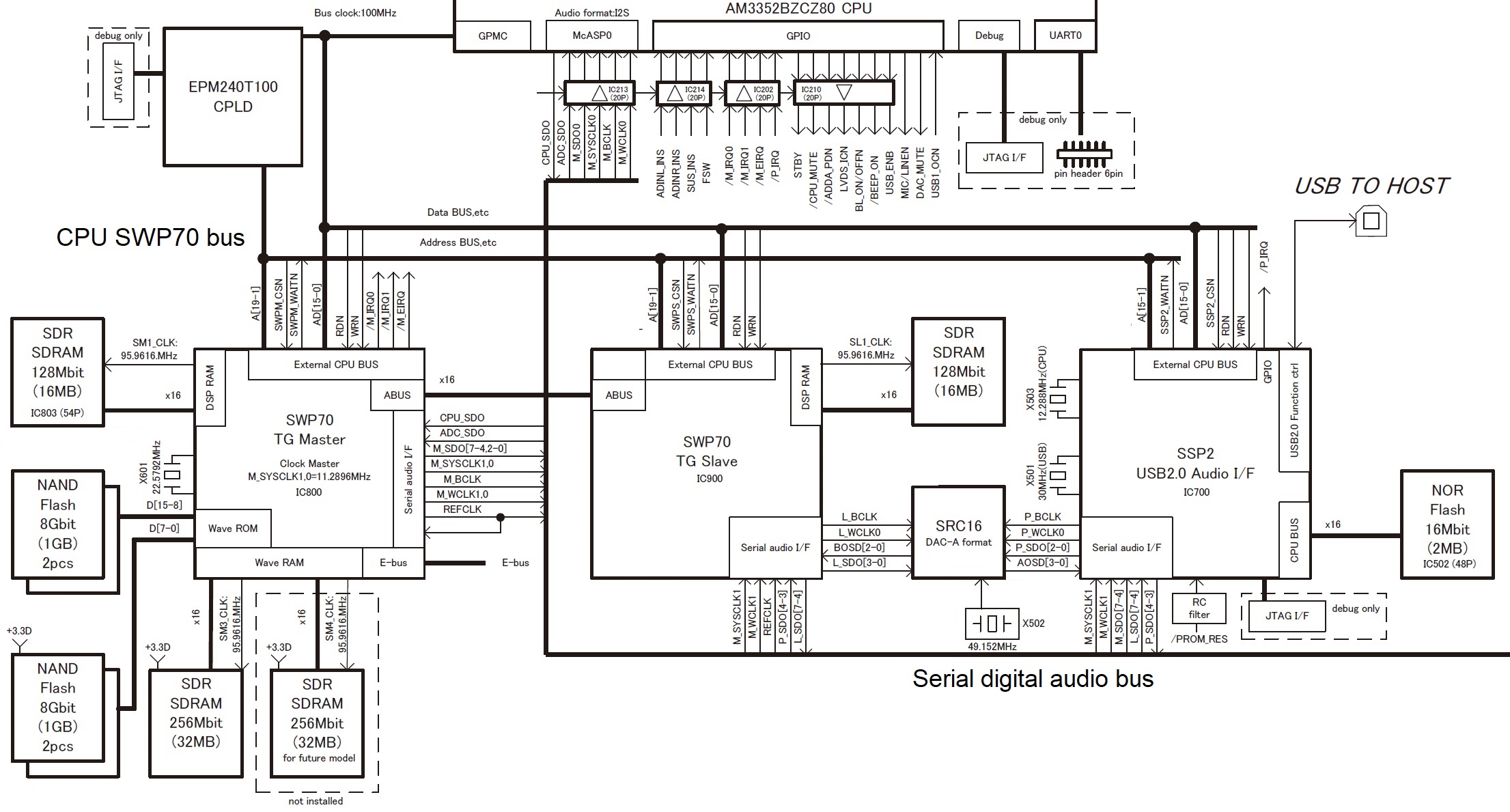
So, let’s move on to Montage. The diagrams below are taken from the Yamaha Montage Service Manual. I scrubbed non-essential detail (e.g., power rails) in order to focus on the overall digital system organization.
The internal design of mid- and high-end synths and arrangers separates neatly into a main CPU subsystem (running Linux) and a tone generation/digital audio subsystem. Genos, Montage and MODX fit this design pattern.
[Click images to enlarge.]
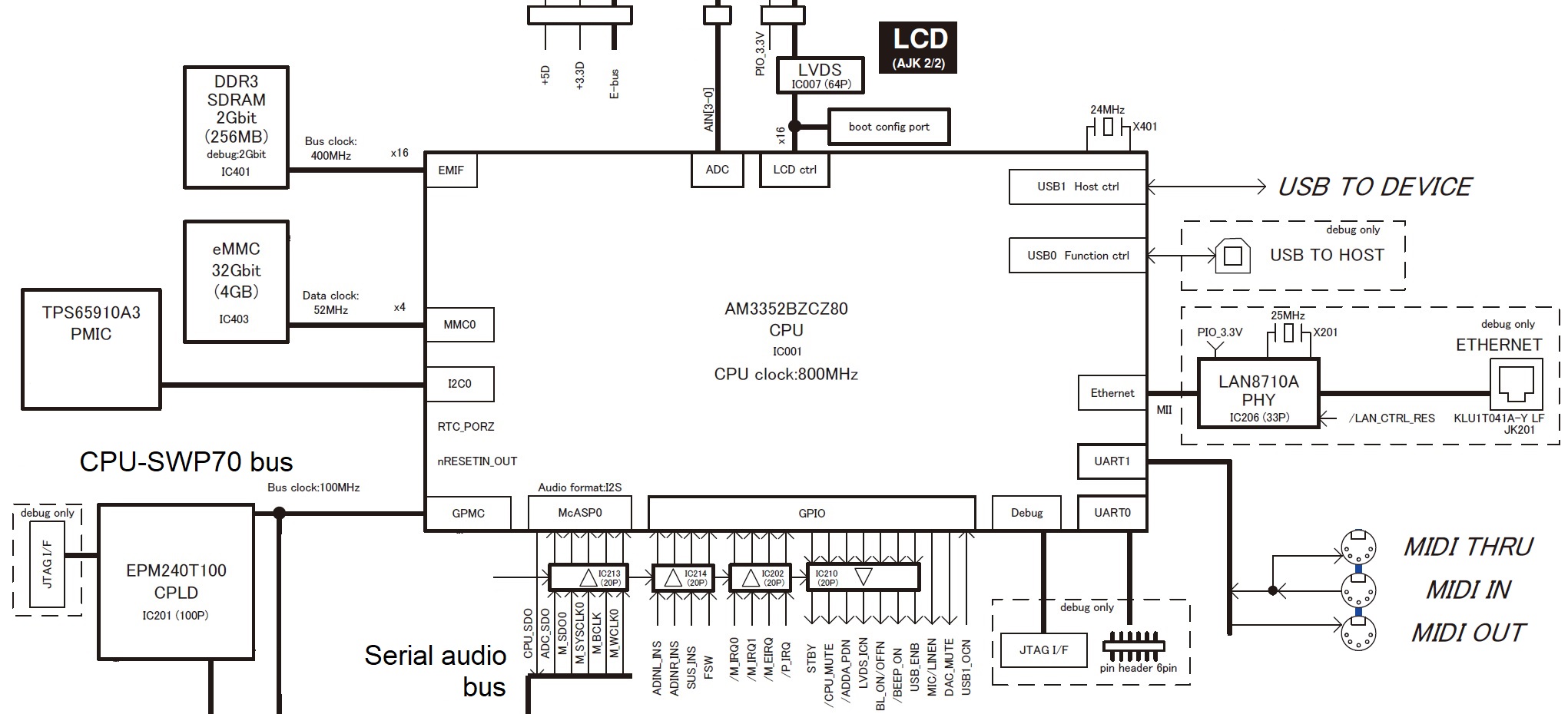
The Montage main CPU is a Texas Instruments AM3352. Montage has a slightly lower clock rate: 800MHz vs. 1.0GHz (Genos). I don’t think the difference in clock speed is significant because the main CPU generally doesn’t perform compute intensive tasks. (The tone generator circuits and the audio DSP do the heavy lifting.) The main CPU handles sequencing, user interface, the file system, etc.
The AM3352 is an ARM Sitara Cortex-A8 32-bit “system on a chip.” The AM3352 is designed for embedded applications and as such, it has many integrated input/output (I/O) interfaces. The main interfaces are:
Primary working memory (EMIF)
Touch panel and display (LCD)
Bulk memory (MMC0)
USB to device interface (USB1)
MIDI I/O (UART1)
Serial digital audio bus (McASP0)
CPU-SWP70 bus (GPMC)
Power management (I2C0)
General purpose I/O (GPIO)
Having so many interfaces in one integrated circuit (IC) package lowers cost signficantly.
Memory resources are modest. Primary memory is only 256MBytes. Bulk storage is provided by a 4GByte eMMC embedded memory device. Linux and user data (performances, songs, arpeggios, etc.) reside in the eMMC device. Please note that the bulk memory bus (MMC0) has a relatively slow clock speed (52MHz) and width (4 bits). Simply put, this bus cannot support real-time sample streaming for synthesis. [Please stop ranting about this on the Web.] Instead, waveform samples are stored in NAND flash connected to the Master SWP70 tone generator.
Speaking of tone generation, the main CPU is connected to two SWP70 tone generation ICs by the CPU-SWP70 bus. The bus is mediated by a programmable logic device (CPLD). The bus clock is 100MHz. The bus has 19 address bits and the data path is 16 bits wide. The CPU sends control data to the SWP70s through this bus. Also, the main CPU loads samples into NAND flash using this bus. I doubt if this bus could sustain high volume sample streaming in real time.
The CPU-SWP70 bus is organized as an addressable memory bus. (The ARM acronym “GPMC” means “General Purpose Memory Controller.”) Instead of ordinary memory, I believe that the CPU-SWP70 bus provides direct access to thousands of synthesis control registers for AWM2 and FM-X. Check out the huge list of synthesis parameters in the MIDI section of the Montage/MODX Data List PDF. Each parameter controls some aspect of AWM2 or FM-X synthesis. These parameters need to be loaded quickly into the the SWP70 tone generation blocks. Addressable control registers provide the appropriate mechanism.
There are two other major busses in Montage: the EBUS and the serial digital audio bus. (More about the digital audio bus in a second.) The EBUS is driven by an ARM architecture microcontroller (MB9AF141NBPQC) which scans knobs, sliders and switches. The EBUS sends user input to other components, most notably the SWP70s. Thanks to the EBUS, user inputs are quickly acquired and sent to the tone generation process, thereby minimizing latency. This fast path is an important aspect of Yamaha’s design.
On to tone generation and digital audio!
High-end Yamaha synths and arrangers have two SWP70 (“Standard Wave Processor”) tone generation chips. One SWP70 is the Master and the other SWP70 is the Slave. “Master” and “Slave” refer to the communication relationship between the two components. The Master generates the reference clocks for both the Master and Slave, and it generates the clock for the serial audio bus.
In Montage, the Master SWP70 performs AWM2 synthesis and the Slave performs FM-X synthesis. The Master has waveform memory; the Slave does not. Waveform memory isn’t required for FM-X synthesis, apparently.
Both the Master and Slave SWP70s have 16MBytes of DSP RAM apiece. The DSP RAM provides big, fast random access storage for effects processing. Time-based effect algorithms like reverb and delay need a large amount of memory space. The DSP RAM does the job.
The Master SWP70 has two additional kinds of memory: Wave ROM (4GBytes physical capacity) and Wave RAM (32MBytes). [The Genos designers use slightly different terminology for these units, but the functionality is the same.)
Wave ROM is Open NAND Flash Interface (ONFI) compliant. This is the same commodity NAND flash built into PC solid state drives. Instead of using a solid state drive and a SATA bus, Yamaha have built the controller and data cache into the SWP70. This design eliminates the cost, power consumption and delay of a PC solid state drive controller. The Wave RAM is the data cache, holding the currently used samples needed for AWM2 synthesis.
Why a data cache? NAND flash has two major drawbacks. First, writing to NAND flash is slow. Second, random read access to NAND flash is much slower than sequential block access. In fact, random access is too slow for direct streaming into synthesis. The SWP70 pre-fetches blocks of samples into fast Wave RAM which, in turn, provides fast random access to samples. This two-level storage organization supports the high read bandwidth required for 128 lanes of stereo AWM2 synthesis.
The SWP70 has two independent Wave RAM channels. Only one of these channels is populated in Montage. The second Wave RAM unit is not installed and is reserved for a future model. We haven’t seen the full power of the SWP70 generation — yet.
Montage has a power digital audio subsystem which is interconnected by the serial digital audio bus. The CPU, SWP70s and SSP2 chips transfer digital audio on the serial audio bus. These units send audio to the digital-to-analog converters (DACs) and receive audio from the analog-to-digital converters over the bus. The main audio streams are:
The main CPU receives audio from the AD INPUT ADC and the Master SWP70.
The Master SWP70 receives audio from the main CPU and the AD INPUT ADC.
The Slave SWP70 receives audio from the SSP2.
The SSP2 receives audio from the Master SWP70 and the Slave SWP70.
The Master SWP70 sends digital audio to the two DACs (assignable output and main output, respectively). The DACs and the ADCs are on a separate circuit board away from the digital electronics (Pure Analog Circuit).
Montage has an SSP2 processor dedicated to USB2.0 audio I/O. It’s like having a mini Steinberg UR interface inside. The SSP2 is the source of Montage’s audio prowess. The SSP2 is a fairly beefy computational engine having an SH-2 CPU core (135.4752MHz internal clock). It is the computational engine in the high-end Steinberg UR series, the Reface DX and the Reface CS. Its role in Montage is like a UR — high speed, multi-channel USB audio. This is why the SSP2 supplies the Montage USB TO HOST interface. Digital USB audio has a direct path to the USB HOST.
The SSP2 gets commands and transfers data with the main CPU over the CPU-SWP70 bus.
I hope you have found this quick tour to be informative and helpful. Yamaha had a few other tricks up its sleeve as we shall see when I discuss MODX specifically. Take care and stay tuned for the MODX update which is about to drop.