Yamaha CK61™ and CK88™

Update: Product pages and manuals are now available at Yamaha sites everywhere.

Pre-announcement information is breaking out all over. I recommend the GAK Music CK series video with Luke Juby. It gives a great overview and demonstrates the preset sounds and effects. The CK has sliders, knobs and buttons dedicated to program/effect selection and tweaking (attack, release, cut-off and resonance). The drawbar sliders are short-throw like the Reface YC. The physical controls should reduce menu-diving.

A few interesting tidbits from the video. The CK has the ability to trigger backing tracks from the keyboard. Foot pedal control is assignable. There are four zones for external control and 5-pin MIDI IN and OUT. Split and layer are supported with two split points.

Here are Yamaha CK88™ specifications:

  • 88 keys, weighted GHS keyboard, initial touch
  • Tone Generator: AWM2 and AWM for Organ Flutes
  • 128 voices of polyphony
  • Integrated Effects, Master EQ
  • 363 Voices, 160 Live Set Sounds (80 preset)
  • Pitch Bend and Modulation Wheel
  • Nine Organ Footage Sliders, three Part Volume Sliders, eleven control Knobs
  • Built-in amplifiers (2 ✗ 6 W) and speakers (2 ✗ (12cm ✗ 6cm)); Can be switched off
  • Battery powered operation (eight AA alkaline or Ni-MH batteries) or AC adaptor
  • Monochrome LCD display (128 x 64 dots)
  • Stereo Line Output: 6.3 mm mono phone jack x2
  • Stereo Input: 6.3 mm mono phone jack x2
  • Stereo Phones Output: 6.3 mm stereo phone jack
  • Two connectors for Footswitches or Foot controllers
  • MIDI [IN]/[OUT] 5-pin DIN
  • USB [TO DEVICE] to connect USB memory sticks
  • USB [TO HOST] to connect to PCs, USB-Audio-Interface function (two stereo channels from PC to CK, two stereo channels from CK to PC)
  • Bluetooth connectivity to play back audio from a Bluetooth device
  • Dimensions (W x D x H): 1,333 mm × 354 mm × 148 mm
  • Weight: 13.1 kg (28.9 pounds)
  • Included accessories: Owner’s Manual, AC adaptor (PA-150B)
  • Optional accessories: Footswitches and Foot controllers (FC3A, FC4A, FC5, FC7), Soft Case SC-DE88, Music Rest YMR-03

The CK61 weighs 5.6kg (12.3 pounds) and has a new synth action keybed (the FSB action borrowed from the PSR SX line).

Sounds like an entry-level keyboard for price-sensitive customers. I anticipated a battery power option, but the in-built amplification (2 ✗ 6W) and speakers are unexpected. Given the entry-level spec, I suspect that SWX09 is the internal host/tone generator engine.
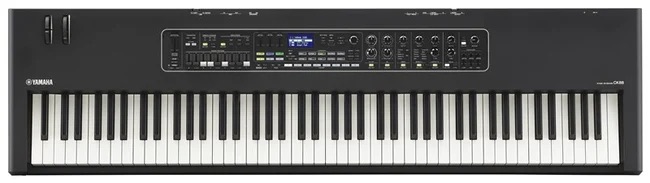
Yamaha CK88 portable stage synthesizer

The CK is a “poor man’s” combination of Reface YC and Reface CP. Or, stated another way, CK is someone’s dream combination of Reface YC and Reface CP with full-size controls. A lot of people pined for a combined organ/EP Reface with a full-sized keybed. They got it. 🙂

363 voices aren’t many. I expect to see promotion reading “363 voices from the acclaimed Montage, YC stage organ and CP stage piano.” This smacks of the way a few new voices were lifted from Motif and built into the ill-fated MM series. I expect recycled effects from MODX, etc. and CK will not include the new, improved YC rotary speaker algorithm.

We’ll need to hear more details, of course. I don’t think the CK directly replaces the MX series. A lot hinges on its DAW/VI integration which is an MX strong point. The MX88 weighs 13.9kg, so the CK88 (13.1kg) does not have a weight advantage over MX88. CK61 weighs 5.6 kg, not much less than MODX6. Based on weight alone, I don’t have much reason to spurn my MODX6 for CK61.
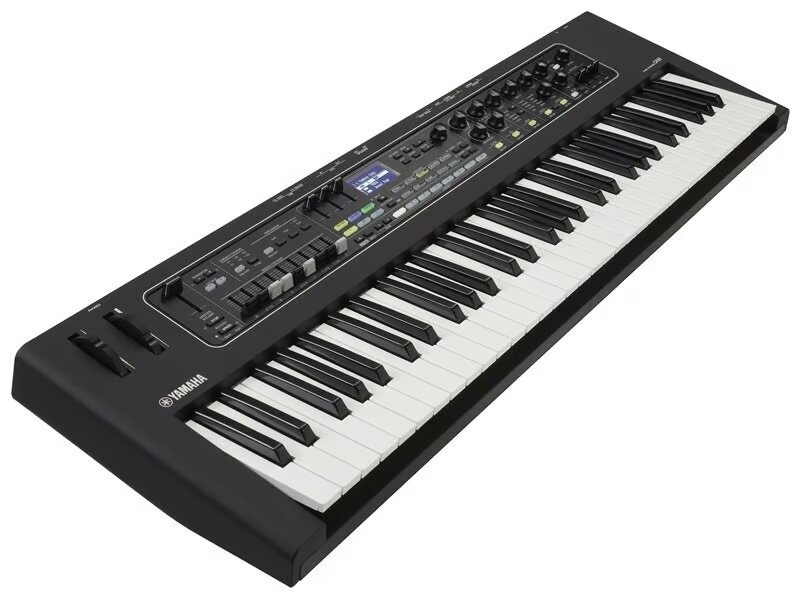
Yamaha CK61 portable stage keyboard

If you own an MODX, I don’t think you’re going to be green with G.A.S. The extra sliders are nice, but MODX (MODX+) is so much more. The CK series should appeal to the weekend warrior with a family on a tight budget. CK61 MSRP is $1,249 USD and MAP is $999; CK88 MSRP is $1,899 and MAP is $1,499. Yamaha got the CK61 MAP under the psychological $1,000 barrier.

The pictures are fuzzy. We’ll know more and have better pictures after the official product announcement tomorrow when Yamaha releases high res assets.

Copyright © 2023 Paul J. Drongowski
CK: It’s almost here

Thanks to Saul’s recent post at Yamaha Musicians Forum, it looks like tomorrow is the day for CK.

By Tuesday evening, we’ll all be laughing at the ridiculous predictions and wishful thinking that we’ve all posted.

So, here’s some more wishful thinking. 🙂

Knowing the price points, about $1,250 USD for the 61 and $1,920 for the 88, we instantly know that these aren’t the droids some people have been looking for. At these prices, the CKs impinge on the entry-level niche held by the long-in-the-tooth MX series. Yamaha may have decided to spiff up and bulk up the MX to CK in order to establish higher margins at the entry-level without blowing up the magic $1,000 barrier. [I have some reason to believe that the rumored prices are MSRP.]

Yamaha CK61 and CK88 portable synthesizers

At such low price points, forget an FSX keybed, aftertouch, a large touch display, etc. I suspect that Yamaha engineers chose one of its proprietary SWX processors instead of the higher spec SWP70 which is the mainstay of mid- and high-end Yamaha keyboards. The SWX series integrates the host processor, display interface, USB interface and AWM2 tone generator into a single integrated circuit package. Reface YC, Reface CP and first-gen MX are based on an earlier version of SWX (SWX08). The current rev is SWX09.

The word “portable” in the terse CK description might imply an internal battery power option. Choosing SWX would at least give the engineers a fighting chance at low power. I suspect that the SWP70 tone generator is a bit of a power hog. Yamaha do not currently offer a battery-powered synth while some competitors do (e.g., Roland JUNO DS61). I would love battery power for rehearsals — anything to make the schlep and set-up easier.

Part of the MX pitch is “controller integration.” Yamaha currently do not offer a MIDI controller with all the front panel knobs, sliders, widgets and gizmos that warm the heart. Even though Yamaha tout the MX for control, it’s really feature poor in comparison to most full size MIDI controllers. Although the MX is reasonably well-integrated with Cubase, more people are running virtual instruments on IOS/Android tablets/phones instead of laptops. Yamaha must (should) respond to these trends.

I often wonder why Yamaha haven’t put forth a Halion-based version of Arturia’s wonderful V Collection or Analog Lab? I was immediately impressed by the integration of Analog Lab with Arturia Keylab Essential. Yamaha have been missing an opportunity here.

Up to this point, Yamaha seem reluctant to offer an all-in-one stage keyboard combining, piano, organ and synth. As a player, you’re forced into a multi-keyboard “top and bottom” rig decision. Implications are many. If organ or piano are your main need, then perhaps you choose a YCxx or CPxx for the bottom. Neither ‘board provides comprehensive synth sounds, so you need a synth for the top. Maybe a CK61™?

Schlep and cost are major factors. Two keyboards is a lot more trouble and cost than one. The keyboard stand is bigger and heavier. Yada-yada. For me, I play in an incredibly small space and, as an older adult, my body is whacked out from hauling gear! Cost is another big factor as I don’t want to tie up funds in idle keyboards — no matter how pretty they are. 🙂

So, maybe I will view the CK61™ as a Korg Triton Taktile on steroids. The Triton Taktile 49 was a light-weight controller with lots of knobs and sliders, and had a “courtesy” Triton engine. The Triton Taktile had its disdvantages — no way to store user edits, no internal battery power. The CK likely avoids these pitfalls in which case a CK plus an iPad (Camelot, Korg Module, iSymphonic, SWAM) might do the trick as a light-weight stage gig rig.

As to that “all-in-one,” might that be the Montage successor? Yamaha was slow to follow Motif XF (August 2010) with Montage (January 2016), so the wait for the Montage successor is not that surprising. Plus, you don’t really think you’re getting AN-X™ for free, do you? 🙂

Copyright © 2023 Paul J. Drongowski